Last July, a publication celebration was held for Biographies of Independence Army Soldiers from Jeonnam. Authored by Professor Park Hae-hyun of Chodang University, the book chronicles 41 independence fighters from Jeonnam who received government merits, a project initiated by their descendants. This work reaffirmed that the activities of Jeonnam-born freedom fighters are the very history of the Korean Liberation Army (KLA).
On September 17, 1940, the Korean Liberation Army—the regular armed forces of the Provisional Government of the Republic of Korea—was established in Chongqing, China. The KLA carried on the anti-Japanese resistance spirit of the Korean Empire's military, which had been forcibly disbanded by Japan in 1907, and united the capabilities of armed independence movements led by righteous armies and earlier resistance groups. Beyond waging joint operations with the Chinese military, the KLA fought alongside British forces on the India-Myanmar front and prepared for a domestic landing operation in cooperation with the United States. As part of the Allied forces, they fought in the War against Japan for national liberation. A significant number of KLA soldiers were young Koreans who had escaped the Japanese military to join the liberation ranks. Lee Sa-seop, a native of Daechon, Gwangsan, recalled in his later years that he and his comrades engaged in a fierce battle with pursuing Japanese troops during their escape.
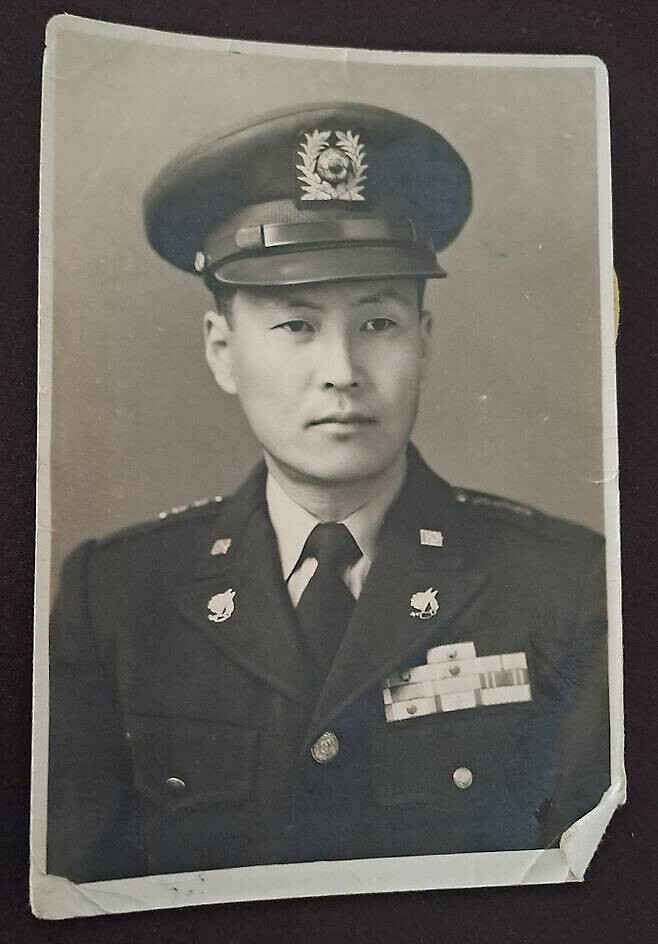
Yet, we often fail to properly recognize these brilliant activities of the KLA, frequently downplaying their historical significance. In particular, the deployment of the KLA to the India-Myanmar front—where they conducted intelligence and psychological warfare alongside the British military and even engaged in combat against Japanese troops—remains largely unknown. Choi Bong-jin (1917–2003), a native of Boseong, was a representative KLA veteran of that front. He journeyed to find the independence army in China, joined the Korean Youth Frontline Corps (한국청년전지공작대), became a KLA officer, and stood against the Japanese military alongside British forces. After liberation, he was a legend of the liberation army who went on to participate in the founding of the Republic of Korea Armed Forces.
Journey to the Independence Movement
Choi Bong-jin was born on December 17, 1917, in Chil-dong-ri, Beolgyo-eup, Boseong-gun, Jeollanam-do. During his KLA activities, he used the alias Choi Sang-cheol. When the Second Sino-Japanese War broke out in 1937 and Japan expanded its invasion of China, he resolved to join the armed independence struggle. In 1939, at the age of 23, he left his hometown and headed for Manchuria. Crossing the border was made possible with travel certificates secured through an acquaintance working at a Japanese-run company in Tianjin, China.
Avoiding Japanese surveillance, he spent months secretly searching for underground independence networks. Eventually, he met Kim Yong-joo, who operated a photo studio in Henan Province. Kim was an underground operative connected with the Provisional Government, running the studio while gathering intelligence and handling communications. Choi spent time doing chores at the photo studio to verify his identity—a necessary precaution given the constant threat of Japanese spies.
Choi later recalled the day Kim Yong-joo showed him a coin engraved with the Taegeuk pattern and asked if he was prepared to risk his life. Joining the independence movement required not only verified identity but also the willingness to sacrifice one's life for the country's liberation. Having already left his hometown in search of the independence army, Choi had no reason to hesitate.
The India-Myanmar Front and the Allied Effort
Introduced by Kim Yong-joo, Choi engaged in activities around Sodong-gu, Zhangye County, where the forward base of the Korean Youth Frontline Corps—organized by Na Wol-hwan from Naju—was located. At the time, the corps infiltrated behind Japanese lines to gather intelligence, build underground networks, recruit comrades (chomo operations), and conduct anti-Japanese propaganda.
Choi lived in an earthen dugout, undergoing guerrilla training while suffering from a severe lack of food, often struggling to secure even basic meals. Yet, he recalled later that the mere fact of being part of the independence army helped him endure all hardships, fulfilling his long-held aspiration.
In September 1940, Choi entered the Korean Youth Training Class (the Han-cheong Class) at the 4th Special Detachment of the Chinese Military's Central Cadre Training School. Here, Korean youth received military leadership training alongside Chinese cadets, laying the foundational military background for Choi's later KLA activities.
On January 1, 1941, the Korean Youth Frontline Corps was incorporated into the Korean Liberation Army as the 5th Zone, commanded by Na Wol-hwan. Later, through organizational restructuring, the 5th Zone was integrated into the 2nd Zone. Choi shared the continuous flow of armed independence movements from the frontline corps to the KLA.
Life in the liberation army was a series of hardships. Choi once recalled marching for over 20 days with a pack filled with millet and garlic pickles. When passing through Japanese-occupied zones, they wore cloth shoes to muffle their footsteps. Near Luoyang, he witnessed Chinese officers killed by Japanese airstrikes, constantly surrounded by unpredictable wartime dangers.
Upon completing his training, Choi was assigned to the Propaganda Department of the KLA General Headquarters. He handled document liaison with the Chinese government, the creation and printing of anti-Japanese leaflets, and the production of propaganda materials. The KLA valued psychological and intelligence warfare to weaken Japan's military capabilities just as much as armed combat. The experience Choi gained here served as a crucial foundation for his upcoming joint operations with the British military.
International Solidarity and Post-Liberation Dedication
One of the most notable aspects of Choi’s resistance career was his service on the India-Myanmar front. This marked a significant historical milestone, demonstrating that the KLA extended beyond the Chinese mainland to actively participate in the global anti-Japanese war alongside Allied forces.
In 1943, as British forces prepared their counteroffensive against Japan, they requested the Provisional Government to dispatch KLA troops. The British recognized that Koreans—well-versed in Japanese internal affairs and language—could play vital roles in intelligence gathering, prisoner interrogation, and enemy-facing propaganda.
In response, the KLA formed the India-Myanmar Front Special Operation Unit (인면전구공작대), led by Han Ji-sung. This unit included Choi Bong-jin from Boseong and Na Dong-gyu from Naju, with many members originating from Na Wol-hwan's Korean Youth Frontline Corps. Jeonnam-born independence fighters leveraged their years of anti-resistance experience from mainland China to participate in joint operations with the Allies.
After receiving training in English, broadcasting, and propaganda techniques in Calcutta, India, the unit was attached to British military units. Choi served in a British intelligence unit, translating Japanese documents, interrogating prisoners, running anti-enemy broadcasts, and producing leaflets.
Their work went far beyond simple interpretation or propaganda. They tracked Japanese troop movements, analyzed intelligence from prisoners to support British tactical execution, and carried out psychological warfare through broadcasts and leaflets. Alongside traditional firearms combat, weakening enemy morale and securing vital intelligence proved instrumental to the war's outcome.
During the pivotal Battle of Imphal in 1944, which determined the direction of the India-Myanmar front, Japanese forces attempted an invasion of India but suffered heavy blows from British and Allied counterattacks. KLA members, including Choi Bong-jin, participated in intelligence gathering and psychological operations throughout this campaign.
Despite contracting malaria on the Indian front, Choi persevered in his duties. Rising through the ranks from second lieutenant to captain during his KLA service, he even underwent airborne parachute training in preparation for a landing operation in Singapore following the recapture of Myanmar. However, Japan's surrender on August 15, 1945, meant the planned operation was never executed.
Returning to Chongqing in September 1945, Choi participated in repatriation efforts for Korean compatriots living in China. Upon returning to his homeland, he chose the path of a soldier once more, entering the 3rd class of the National Defense Security Academy to participate in founding the ROK Armed Forces.
As a KLA veteran, Choi served as a supply officer, holding positions such as head of the Gwangju Logistics Bureau and the Incheon Logistics Bureau before retiring as a colonel in 1959. In civilian life, he contributed to community development and the preservation of the independence spirit as the head of the Boseong Farmland Improvement Association and the Jeonnam branch of the Gwangbokhoe (Korean Liberation Association).
In recognition of his contributions, the government awarded him the National Foundation Medal (Diplom) in 1977 and the Order of Independence Merit (Patriotism Medal) in 1990.
Too often, we understand national liberation as something simply handed down by Allied victory. Yet, fighters like Choi Bong-jin and the KLA actively fought shoulder-to-shoulder with the Allies against the Japanese military—their struggle representing a genuine effort to reclaim the nation's independence by their own hands. In particular, Choi’s service on the India-Myanmar front vividly demonstrates that the KLA was an independent military force that participated in the international War against Japan.
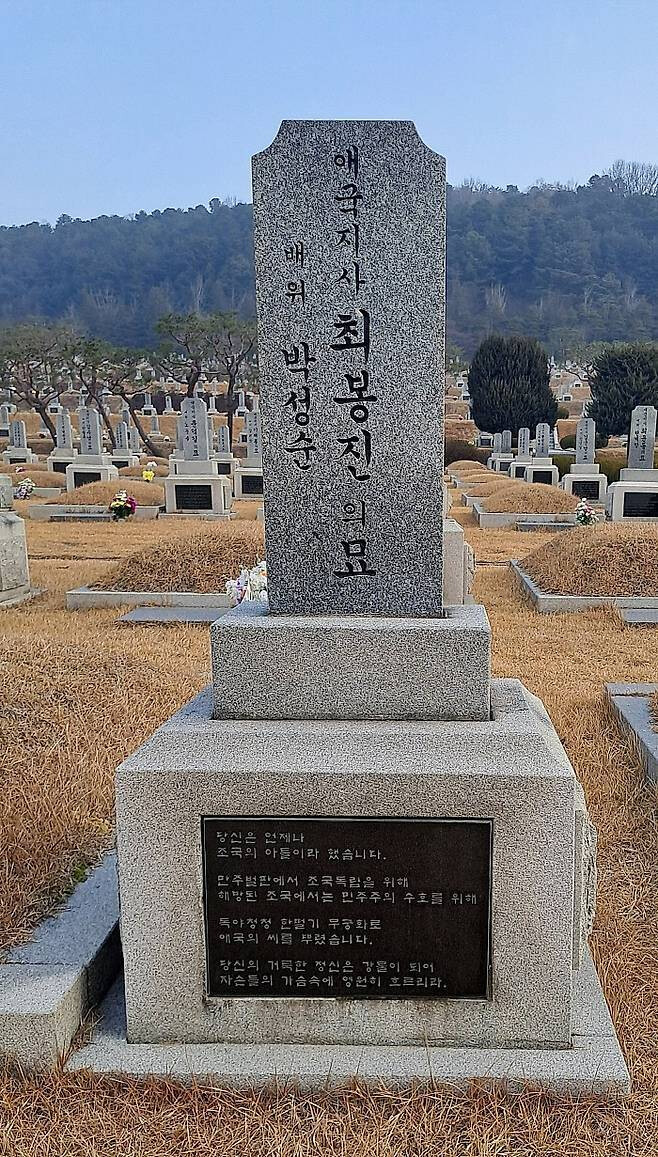
Inscribed on Choi Bong-jin's gravestone is the epitaph: “He fought for national independence on the plains of Manchuria, and dedicated himself to protecting democracy in a liberated homeland.” Born in Boseong, traversing the Chinese mainland, and reaching the India-Myanmar front, his life remains a vital chapter of both KLA history and the history of the Republic of Korea Armed Forces that we must newly remember.
[Copyright (c) Global Economic Times. All Rights Reserved.]