President Lee Jae-myung has moved to recalibrate South Korea–U.S. relations by simultaneously replacing the top officials in diplomacy, national security, and intelligence.
Carried out amid recent controversies over restricted intelligence sharing on North Korea between Seoul and Washington, as well as internal policy rifts within the administration’s foreign and security team, this reshuffle is interpreted as more than a simple cabinet shake-up; it is seen as a measure to restore trust in diplomacy with the U.S. and re-establish the direction of foreign and security policy.
In particular, given that the overhaul completely replaced a foreign and security lineup often characterized by the rivalry between the "self-reliance faction" (Jaju-pa) and the "alliance faction" (Dongmaeng-pa), this appointment is expected to serve as a critical turning point for the Lee administration’s diplomatic strategy.
Simultaneous Replacement of Foreign, Unification, and Intelligence Chiefs… The Meaning of Personnel Renewal
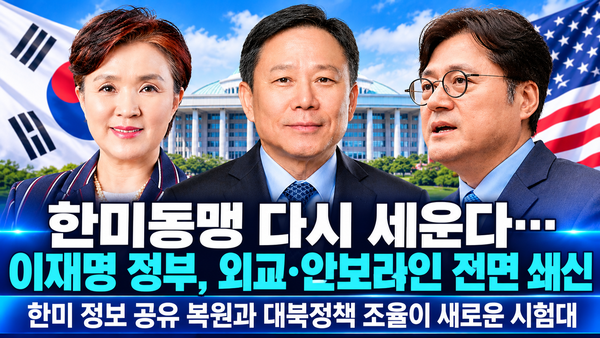
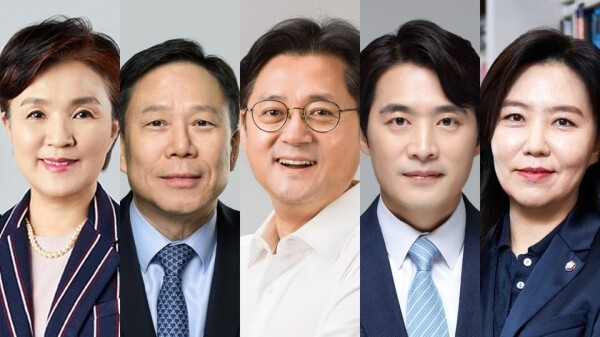
According to an announcement by Presidential Chief of Staff Lim Kwang-hyun on the 23rd, President Lee nominated former Minister of Justice Kang Kum-sil as Director of the National Intelligence Service (NIS), Second Deputy Director of the National Security Office Lim Woong-soon as Minister of Foreign Affairs, and former Senior Presidential Secretary for Political Affairs Hong Ihk-pyo as Minister of Unification.
(Note: Photo caption) According to an announcement by Presidential Chief of Staff Lim Kwang-hyun on the 23rd, President Lee nominated former Minister of Justice Kang Kum-sil (left) as Director of the National Intelligence Service, Second Deputy Director of the National Security Office Lim Woong-soon (center) as Minister of Foreign Affairs, and former Senior Presidential Secretary for Political Affairs Hong Ihk-pyo (right) as Minister of Unification.
The figure drawing the most attention in this lineup is Foreign Minister nominee Lim Woong-soon.
Lim is a career diplomat who passed the High Diplomatic Service Examination and has served as Minister at the South Korean Embassy in the U.S. and Ambassador to Canada. Building on his extensive diplomatic experience in the United States, he is regarded as the right person to strengthen the ROK-U.S. alliance and expand bilateral cooperation beyond security into trade, industry, and advanced technology.
Unification Minister nominee Hong Ihk-pyo is both a policy expert—having worked at the Korea Institute for International Economic Policy (KIEP) and as a policy advisor to the Ministry of Unification—and a seasoned politician who served as a National Assembly member, Democratic Party floor leader, and Senior Presidential Secretary for Political Affairs.
His key challenge will be coordinating policy alignment with the United States while simultaneously pursuing tension reduction and trust-building between the two Koreas.
NIS Director nominee Kang Kum-sil carries the symbolic significance of being the first female nominee to lead the agency. The government expects her to strengthen democratic oversight and political neutrality at the NIS, as well as bolster international cooperation against emerging threats such as cybersecurity.
However, her expertise in intelligence agency operations and counterintelligence is expected to face intensive scrutiny during the upcoming confirmation hearing.
The ROK-U.S. Intelligence-Sharing Controversy… The Starting Point of This Reshuffle
Behind this cabinet reshuffle lies the issue of intelligence cooperation between South Korea and the United States.
Last March, a controversy over the disclosure of classified information erupted when then-Unification Minister Chung Dong-young mentioned Kusong, North Pyongan Province, at the National Assembly as the location of a North Korean uranium enrichment facility.
Subsequently, then-NIS Director Lee Jong-seok acknowledged that certain intelligence sharing between South Korea and the U.S. had been restricted. This fueled growing concerns that friction had developed in intelligence cooperation with Washington.
Under these circumstances, simultaneously replacing the heads of diplomacy, unification, and intelligence is interpreted as a move to convey to the United States Seoul's commitment to stably managing the ROK-U.S. alliance.
In particular, the selection of Lim Woong-soon, who possesses deep diplomatic experience with the U.S., appears focused on strengthening communication with Washington and restoring diplomatic trust.
Patching Up the Rift Between the 'Self-Reliance' and 'Alliance' Factions… Teamwork in the Foreign and Security Lineup Is Key
Politically analyzed, this reshuffle carries a strong intent to resolve internal ideological rifts within the foreign and security lineup and reinforce a president-centered policy coordination system.
Until now, critics had pointed out a policy gap within the administration between the self-reliance faction, which emphasizes autonomy in North Korea policy, and the alliance faction, which prioritizes the ROK-U.S. alliance.
Rather than completely discarding either side's policy, this reshuffle can be seen as an attempt to integrate different diplomatic approaches into a single cohesive strategy.
In fact, the Presidential Office emphasized that even with this reshuffle, the existing policy基調 (keynote) of upholding both the ROK-U.S. alliance and peace on the Korean Peninsula remains unchanged.
What matters here is the direction and execution of foreign and security policy.
Pursuing improvements in inter-Korean relations while strengthening the ROK-U.S. alliance is possible. However, on sensitive issues such as the North Korean nuclear program, sanctions against North Korea, and managing military tensions, prior consultation and policy coordination with the United States are essential.
Ultimately, how consistently the new foreign and security team speaks with one voice will be a crucial benchmark for the recovery of ROK-U.S. relations.
Next Tasks for the ROK-U.S. Alliance… Beyond Intelligence and Security to Trade and Advanced Technology
The new foreign and security team faces a considerable number of tasks ahead.
First is stably restoring the intelligence-sharing framework between South Korea and the United States. Intelligence related to North Korea's nuclear and missile programs is a core element not only for South Korea’s security but also for managing the situation on the Korean Peninsula.
Second is coordinating sensitive security issues, such as ROK-U.S. security consultations and the transfer of wartime operational control (OPCON). The team faces the task of narrowing differences between the two countries while simultaneously securing South Korea's security sovereignty and the effectiveness of the alliance.
Third is expanding the realm of diplomacy into economy and industry.
Semiconductors, artificial intelligence, advanced technologies, energy, and the defense industry have now become core agenda items in ROK-U.S. relations. This is why pragmatic diplomacy that translates security cooperation into economic results is required.
It means the ROK-U.S. alliance must not be confined solely to military cooperation, but developed into a strategic partnership encompassing economic security and future industries.
Vetting of Nominee Kang Kum-sil and the Execution Capability of the New Diplomatic Team Also Face a Test
Whether this reshuffle can settle smoothly is also a matter of keen interest.
In the case of NIS Director nominee Kang Kum-sil, while there are expectations for strengthened democratic control and political neutrality, concerns are also being raised over her lack of practical experience in intelligence and counterintelligence.
The National Intelligence Service is a core security agency responsible not only for monitoring North Korean nuclear and missile threats, but also for addressing cyberattacks, industrial technology leaks, and international intelligence cooperation.
Therefore, how she demonstrates organizational command and expertise is expected to be the focal point of upcoming vetting.
With the opposition party also questioning the expertise of the intelligence agency nominee and the appropriateness of the appointment, heated debate is anticipated during the National Assembly confirmation hearing.
Recalibrating ROK-U.S. Relations Must Lead Beyond Personnel Renewal to Tangible Results
This complete overhaul of the foreign and security lineup is a critical political choice by the Lee Jae-myung administration to newly align its diplomatic strategy at the midpoint of its term.
The weight of these appointments is by no means light, given that the team must simultaneously solve the tasks of restoring trust with the U.S., coordinating North Korea policy, and normalizing intelligence cooperation.
In particular, a sense of balance is required to convey a commitment to strengthening the alliance to the United States while safeguarding South Korea's diplomatic autonomy and national interests.
The ROK-U.S. alliance is not strengthened by slogans alone. Trust must be built through intelligence sharing, security cooperation, and economic achievements.
Whether this reshuffle ends up as a mere personnel change or becomes a diplomatic turning point that elevates ROK-U.S. relations to the next level depends on the policy execution capability of the new foreign and security team.
[Copyright (c) Global Economic Times. All Rights Reserved.]