• 2026.11.10 (Tue)
  • All articles
  • LOGIN
  • JOIN
Global Economic Times
[등록] 2026-09-01 15:48:31
  • Synthesis
  • World
  • Business
  • Industry
  • ICT
  • Distribution Economy
  • Well+Being
    • Pet Life
    • Halal Horizon
  • Travel
  • Eco-News
  • Education
  • Korean Wave News
  • Opinion
  • Arts&Culture
  • Sports
  • People & Life
    • International Student Report
    • With Ambassador
  • Column
    • Cho Kijo Column
    • Cherry Garden Story
    • Ko Yong-chul Column
    • Kim Bong-seon's Photo Column
    • Kim Seul-Ong Column
    • Lee Yeon-sil Column
  • Photo News
  • New Book Guide
MENU
 
Home > Distribution Economy

The Generational Wealth Divide: Why Young South Koreans Are Resentful Over the Basic Pension System

Kim Sungmoon Reporter / Updated : 2026-11-10 18:17:28
  • -
  • +
  • Print

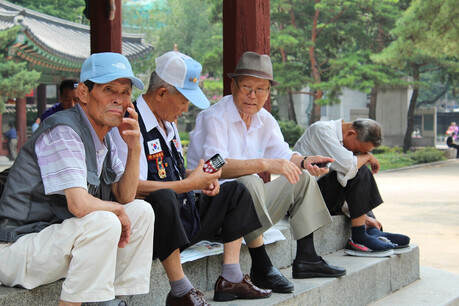
SEOUL — In an era defined by economic uncertainty and mounting living costs, a growing policy debate is intensifying across South Korea. At the heart of the friction is a stark contrast: young professionals struggling to afford rent while paying heavy taxes to support retired seniors, many of whom own multi-billion-won real estate.

The Million-Dollar Homeowner Collecting Public Pensions

Consider a hypothetical couple in their mid-60s residing in Seoul. They own an apartment with a market value approaching 1.6 billion KRW (publicly assessed value around 1.1 billion KRW). One spouse works part-time near their neighborhood, earning a modest monthly salary. Under South Korea’s current welfare framework, designed to alleviate senior poverty, this couple still qualifies for the Basic Pension.

Government data released by lawmakers shows that out of approximately 7.06 million Basic Pension recipients last year, about 57 percent—roughly 4 million people—own real estate. While homeownership alone does not equate to liquid cash, critics point out that the system has drifted far from its original mandate of targeting vulnerable, impoverished seniors. Because the eligibility threshold automatically adjusts to cover the top 70 percent of the elderly population, even seniors who own high-value properties in affluent districts—such as Seoul’s Gangnam area—continue to receive monthly payouts funded entirely by taxpayers.

Shifting Burdens onto a Straining Youth Generation

This dynamic has fueled rising frustration among younger generations. For thirty-somethings who have spent years navigating a sluggish job market and high entry barriers to the housing market, watching a portion of their monthly salaries go toward funding pensions for asset-rich retirees feels fundamentally unbalanced.

Economic data highlights a widening chasm between generations. Over the past decade, the average net worth of households headed by individuals aged 60 and older nearly doubled, climbing from about 360 million KRW to over 600 million KRW. In contrast, the average asset growth for households in their 30s has crawled at a much slower pace, widening the wealth gap between the two age groups from roughly 115 million KRW to over 240 million KRW.

Furthermore, South Korea’s demographic crisis—marked by a rapidly shrinking working-age population and an accelerating low-birth rate—means that a dwindling number of young workers will have to support an expanding pool of retirees. Although policymakers previously explored tightening asset cutoffs to reallocate funds toward genuinely impoverished seniors, the proposed reforms stalled amid concerns over political backlash and senior voter sentiment.

A Call for Structural Reform

Economists and policy experts warn that maintaining the rigid "top 70 percent" benchmark is no longer viable in a low-growth, super-aged society. Without structural adjustments to decouple pension eligibility from broad demographic quotas and tie it more strictly to actual financial need, the fiscal pressure on future generations will only intensify. Analysts stress that comprehensive pension reform is urgently needed to restore intergenerational equity before demographic realities force a crisis.

[Copyright (c) Global Economic Times. All Rights Reserved.]

  • #Cherry Garden
  • #HalalFood
  • #Halal
  • #Petlife
  • #Halalhorizone
  • #Hormuz Impasse
  • #globaleconomictimes
  • #micorea
  • #mykor
Kim Sungmoon Reporter

Popular articles

  • Alteogen Expands Growth Horizon with In-House Production and Sales Beyond Its 83% Platform-Driven Revenue

  • 30-Year Senior-Junior Duos to In-House Couples: Building AI Services All Night Without Knowing How to Code

  • Daejeon Secures 6 Spots in "2026 Defense Innovation Enterprise 100", Cementing Status as a High-Tech Defense Hub

I like it
Share
  • Facebook
  • X
  • Kakaotalk
  • LINE
  • BAND
  • NAVER
  • https://globaleconomictimes.kr/article/1065604571993766 Copy URL copied.
Comments >

Comments 0

Weekly Hot Issue

  • Intergenerational Strain Deepens in South Korea: The Rising Cost of Senior Welfare for Asset-Poor Youth
  • COP31 Opening Day Stumbles Amid Friction Over Climate Finance and Adaptation Goals
  • Genesis Enters Ultra-Luxury EV Segment with Flagship GV90 and Neolun SUVs 
  • Daewoo Consortium Begins Detailed Design for Gadeokdo New Airport Amid Environmental Backlash
  • Shift of Focus Urged for South Korea's Zero Energy Building Policy
  • Cheongdo County Secures 61 Billion Won for Climate Resilience and Eco-Friendly River Restoration

Most Viewed

1
Why Can't We Use 'Muse' in Korea?… Zuckerberg Says, "Due to a Lack of Data Centers"
2
US Army Conducts Rare Temporary Burial Drills to Prepare for Worst-Case Large-Scale War Scenarios
3
World Citizens are Flying Directly to Busan... The Era of 4 Million Foreigners is Just Around the Corner
4
Eating 100g of Baechu Kimchi Daily Linked to Lower High-Cholesterol Risks
5
November Shopping Festival Sparks Retail War in South Korea: Where to Find the Best Deals
체리가든 스토리
nutri huevos
로타리
동포저널

Hot Issue

Jensen Huang Faces Shareholder Class Action and Leadership Scrutiny Amid Espionage Allegations Involving Former Associate

Disgraced South Korean Scientist Hwang Woo-suk Becomes UAE Citizen

Is South Korea Heading Toward France's Path? Aging Population and Fiscal Pressures Looming Ahead

Fashion Runway Show 2026

Let’s recycle the old blankets in Jeju Island’s closet instead of incinerating them.

Global Economic Times
korocamia@naver.com
CEO : LEE YEON-SIL
Publisher : KO YONG-CHUL
Registration number : Seoul, A55681
Registration Date : 2024-10-24
Youth Protection Manager: KO YONG-CHUL
Singapore Headquarters
5A Woodlands Road #11-34 The Tennery. S'677728
Korean Branch
Phone : +82(0)10 4724 5264
#304, 6 Nonhyeon-ro 111-gil, Gangnam-gu, Seoul
Copyright © Global Economic Times All Rights Reserved
  • News K
  • 반달곰 프로젝트
  • 광고문의
Search
Category
  • All articles
  • Synthesis
  • World
  • Business
  • Industry
  • ICT
  • Distribution Economy
  • Well+Being 
    • 전체
    • Pet Life
    • Halal Horizon
  • Travel
  • Eco-News
  • Education
  • Korean Wave News
  • Opinion
  • Arts&Culture
  • Sports
  • People & Life 
    • 전체
    • International Student Report
    • With Ambassador
  • Column 
    • 전체
    • Cho Kijo Column
    • Cherry Garden Story
    • Ko Yong-chul Column
    • Kim Bong-seon's Photo Column
    • Kim Seul-Ong Column
    • Lee Yeon-sil Column
  • Photo News
  • New Book Guide
  • Overseas Koreans
  • Multicultural News