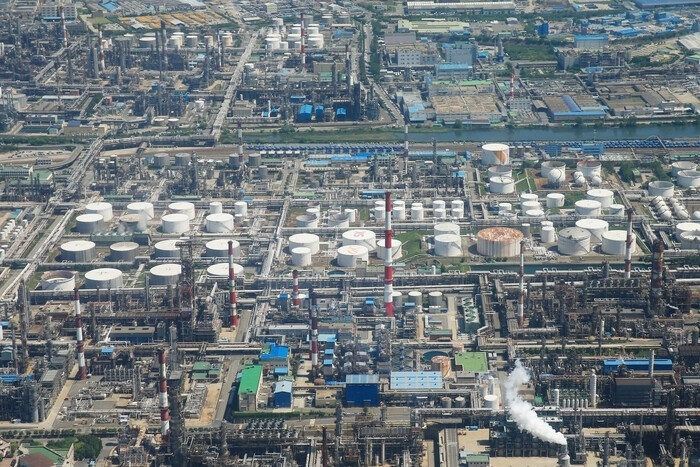
The number of idle businesses within industrial complexes in Ulsan has shifted back to an upward trend this year. This is attributed to falling operating profit margins driven by high interest rates and inflation, alongside an increasing number of small and medium-sized enterprises (SMEs) facing liquidity crises.
According to the nationwide industrial complex status statistics released on the 22nd by the Korea Industrial Complex Corporation (KICOX), the number of contracted tenants across 33 industrial complexes in the Ulsan region stood at 2,553 in the second quarter of this year, representing a 3.0% increase compared to the same period last year (2,479). However, the number of businesses actively operating their factories dropped to 1,860, a 1.6% decrease from the previous year (1,891). Consequently, idle businesses—those that have suspended operations due to closures, temporary shutdowns, or delayed construction—surged by 17.9% year-on-year to 693.
Idle businesses in Ulsan's industrial complexes have returned to growth after just one year. Based on second-quarter figures, the number of idle businesses rose from 272 in 2023 to 648 in 2024, before showing signs of stabilization with a decline to 588 last year. This year, however, the figure has expanded sharply once again. Furthermore, the total number of operating businesses in local industrial complexes, which had increased annually (1,727 in Q2 2023, 1,733 in 2024, and 1,891 last year), turned downward this year. This marks the first time in the past five years that the number of operating businesses in Ulsan complexes has declined.
The downward trend in operating businesses this year was concentrated primarily in national industrial complexes, where key industries are clustered. During the second quarter, the number of tenant businesses in Ulsan's two national industrial complexes (Ulsan-Mipo and Onsan) increased by 2.3% year-on-year from 1,512 to 1,547. Yet, the number of active operating businesses fell by 8.0%, dropping from 1,012 to 931. The number of idle businesses in these national complexes soared by 23.2% over the year, jumping from 500 to 616.
This trend is widely attributed to the deepening management hardships faced by micro and small subcontractors, compounded by prolonged high inflation and high interest rates.
Indeed, the Bank of Korea's finalized statistics on "2025 Corporate Management Analysis" clearly highlight the polarization between large corporations and SMEs within the manufacturing sector. Last year, the sales-to-operating-profit ratio for large manufacturing enterprises rose significantly to 7.3%, up from 5.6% the previous year. In contrast, the operating profit margin for manufacturing SMEs declined from 3.9% in 2024 to 3.6% in 2025.
In particular, small manufacturing enterprises—which have a high proportion of micro-subcontractors—saw their sales growth rate cut in half, dropping from 4.0% in 2024 to 1.6% in 2025. Their sales-to-operating-profit ratio also fell for two consecutive years, dropping from 3.7% in 2023 and 3.4% in 2024 to 2.8% in 2025. Furthermore, the interest coverage ratio for small businesses, which indicates whether operating profits are sufficient to cover interest expenses, plummeted from 171.1% in 2023 to 135.7% in 2025.
The atmosphere on the ground in regional industrial complexes is rapidly chilling. Amid worsening profitability, local SMEs desperate to secure operational funds have flooded local government policy-fund application channels. As a result, competition has intensified sharply despite an increase in the total scale of support funds.
An official from the SME Support Center at the Ulsan Economic Promotion Agency remarked, "Although the total scale of this year's SME promotion fund increased by 30 billion KRW from last year to reach 250 billion KRW, an influx of applying companies caused the competition rate to spike significantly from 1.33-to-1 last year to 1.96-to-1 this year." The official added, "We are also receiving numerous inquiries from SMEs whose financial conditions remain precarious."
[Copyright (c) Global Economic Times. All Rights Reserved.]