Chungcheongnam-do has been selected as a top-performing local government in the Ministry of Education’s "Regional Growth Talent Development System" evaluation for the second consecutive year, securing 59.6 billion won ($59.6 billion won / approx. 59.6 billion KRW) in incentives and proving itself as a leading model for regional university policies. Through the operation of Chungnam-style contract departments and local government-university cooperation projects, the province achieved its employment and technology transfer targets ahead of schedule, contributing to the retention of local talent and the establishment of an innovative ecosystem. Moving forward, the province plans to utilize the secured financial resources to expand support for contract departments and heavily invest in new strategic tasks tailored to each university's specialization, accelerating mutual development between the region and its universities.
Chungnam Province has secured 59.6 billion won in incentives after being chosen as a top-tier local government in the Ministry of Education's "Regional Growth Talent Development System" project evaluation for the second straight year. The province plans to hold the Regional Innovation University Support Committee in November to determine the specific direction of the new tasks and proceed with additional budget distribution.
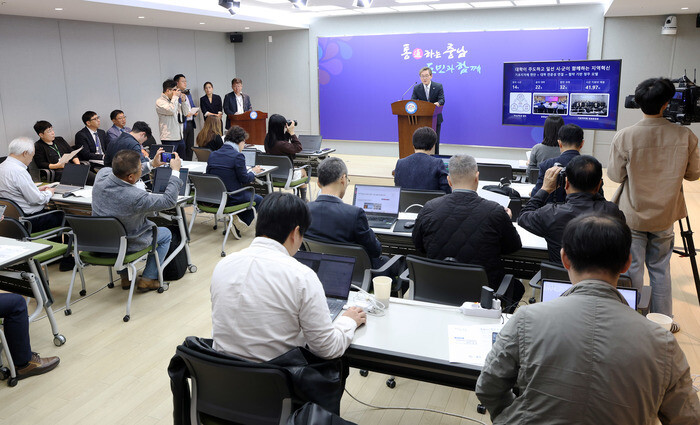
Lee Jong-ik, Director-General of the Youth and Women's Bureau of Chungnam Province, held a press briefing at the provincial government press center on the 21st to announce the "Plan for Securing and Utilizing Incentives for the Regional Growth Talent Development System (Anchor)."
This year, three local governments were selected as top-tier (S-grade) entities: Chungnam, Busan, and Gwangju. Among them, Chungnam and Gwangju are the only two to receive an S-grade for two consecutive years. Regarding this achievement, Director-General Lee stated, "It is an official national recognition that Chungnam's university policies are becoming a role model for South Korea."
First, the province established a "Chungnam-style contract department" model designed to prevent local talent from leaving the region and realize regional settlement by securing employment at the exact moment of admission.
While the primary goal of the project's first year was building infrastructure such as establishing departments, the province proactively created 16 universities and 42 departments to accelerate the generation of project outcomes early on. As a result, in the second year, it achieved 292 out of 500 contracted partner companies and 563 out of 750 employed individuals, accomplishing its core performance targets ahead of schedule.
In addition, 22 universities and municipal governments within the province collaborated to operate a total of 32 cooperative tasks, including the creation of the Anseodong University Street in Cheonan and the Cheongyang Youth Win-Win Agri-Food Processing Valley. This marks the only case among 16 cities and provinces nationwide where basic local governments actively participated.
Through the Chungnam-style anchor project, the province has also built an innovative ecosystem for new growth industries that draws R&D and startup achievements—previously dispersed outside the region—back into the local area. The initiative provides full-cycle support ranging from technology transfer to commercialization and tech-based startups. Already in its first year, it surpassed its targets by recording 1.713 billion won in technology transfers and 100 tech startups.
Regarding the additionally secured 59.6 billion won in incentives, the province plans to expand support for existing initiatives while focusing strategic investments on new competitive open recruitment projects tailored to the specialization of each university.
Director-General Lee noted, "While we will support all universities in a balanced manner, we plan to provide additional support for contract departments, which are our signature flagship projects. Out of 22 universities receiving additional allocations overall, additional support for contract departments will be distributed to 15 institutions in proportion to their first-year performance, with a total of approximately 14.3 billion won invested."
He added, "Specific project titles, scales, and the number of selected universities for the new tasks are yet to be finalized, and will be officially confirmed through deliberations by the Regional Innovation University Support Committee in November."
[Copyright (c) Global Economic Times. All Rights Reserved.]