![[등록] 2026-09-01 15:48:31](/support/_updata/banner2/tl181982910_6749.png)


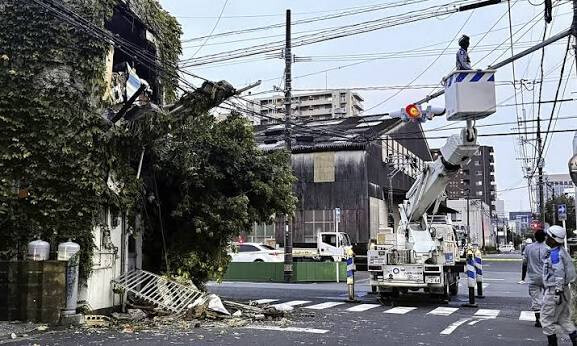
SEOUL / BUSAN — A powerful 7.1-magnitude earthquake that struck Kumamoto Prefecture on Japan’s southern island of Kyushu late Tuesday afternoon triggered widespread tremors across southern parts of South Korea. High-rise buildings swayed in major southern metropolitan areas and coastal provinces, prompting hundreds of frantic emergency calls from concerned citizens.
According to the Korea Meteorological Administration (KMA) and the Japan Meteorological Agency (JMA), the main shock occurred at 4:27 p.m. local time on July 28, 2026. The epicenter was pinpointed approximately 23 kilometers south of Kumamoto City, with a shallow focal depth of 10 kilometers beneath the seabed.
While the epicenter was situated across the East China Sea, the shockwaves traveled across the Korean Strait, delivering noticeable seismic shaking across the southern and central regions of the Korean Peninsula.
Tremors Felt Across South Korea: Hundreds of Calls Flood Emergency Lines
The KMA reported that maximum seismic intensity in South Korea reached Level III (on the Modified Mercalli Intensity Scale) in Busan, Gyeongsangnam-do, Gwangju, Jeollanam-do, and Jeju Island. An intensity III tremor is noticeably felt indoors—especially by occupants on the upper floors of high-rise apartment complexes and office towers—and can cause stationary vehicles to rock gently.
In addition, a seismic intensity of Level II was registered across broader swathes of the country, including Ulsan, Daegu, Gyeongsangbuk-do, Jeonbuk, 충북 (North Chungcheong), 충남 (South Chungcheong), Gangwon-do, and parts of Gyeonggi-do.
According to municipal data from Busan Metropolitan City, its internal seismic monitoring system detected a Peak Ground Acceleration (PGA) reading of 2.0 at 4:28 p.m., just one minute after the initial shock in Kumamoto.
The sudden vibration triggered immediate alarm among urban residents:
Busan: The Busan Fire and Disaster Headquarters reported that emergency dispatch lines received 157 earthquake-related inquiry calls in the first 12 minutes alone (by 4:40 p.m.).
Jeju: Residents in high-rise apartments reported feeling dizzy as furniture and beds shifted from side to side. Local fire authorities confirmed dozens of inquiry calls, though no structural damage or casualties were immediately reported in Korean territory.
Jeonnam & Gwangju: Citizens reported hanging lights swaying and office monitors vibrating during late-afternoon working hours.
The KMA issued safety advisories urging residents in southern coastal regions to stay alert to potential aftershocks, noting: "Seismic waves were felt in several southern districts. Citizens are requested to pay close attention to safety guidelines."
Emergency Alerts and Tsunami Warnings Issued in Japan
Across the sea in Japan, the magnitude 7.1 earthquake caused severe ground shaking, reaching the maximum level of 7 on the Japanese Shindo intensity scale in parts of Kumamoto Prefecture.
Immediately following the main shock, the JMA issued emergency earthquake warnings for seven southern prefectures: Kumamoto, Nagasaki, Kagoshima, Fukuoka, Saga, Oita, and Miyazaki. A tsunami advisory was placed for Ariake Bay and surrounding coastal zones on Kyushu’s western shores, with coastal waves estimated to reach up to 1 meter (3.3 feet) above normal sea levels. Authorities urged coastal residents to evacuate immediately to higher ground.
Major disruption to regional infrastructure was reported shortly after the quake:
Power Outages: Utility operator Kyushu Electric Power confirmed that approximately 40,000 to 45,000 households lost electrical power across Kumamoto and neighboring municipalities.
Transportation Blockades: Bullet train operations (Shinkansen) and local railway lines throughout Kyushu were suspended for safety inspections.
Industrial Hub Impact: Semiconductor manufacturing facilities located in Kumamoto’s technology corridor—including plants operated by Sony Group and Taiwan Semiconductor Manufacturing Co. (TSMC)—began emergency status checks to determine if precision equipment suffered alignment damage.
Nuclear Safety: Japan's Nuclear Regulation Authority (NRA) confirmed that nearby nuclear facilities, including the Sendai Nuclear Power Plant in Kagoshima, reported no operational abnormalities and continued normal power generation.
Context and Tectonic Background
Japan sits atop four major tectonic plates along the Pacific "Ring of Fire" and accounts for roughly 20% of the world's magnitude 6.0 or greater earthquakes. The Kyushu region has a history of severe seismic events. Notably, in April 2016, twin earthquakes of magnitude 6.5 and 7.3 struck Kumamoto, resulting in over 270 casualties and destruction of tens of thousands of structures.
Seismologists in South Korea noted that while major inland fault zones in Kyushu rarely trigger destructive tsunamis along Korea's eastern or southern coasts, the transmission of low-frequency seismic waves across ocean basins often causes noticeable swaying in tall buildings throughout Busan, Ulsan, and Jeju.
Disaster management agencies in South Korea remain on elevated monitoring alert to track potential aftershocks or secondary coastal sea level fluctuations over the next 24 to 48 hours.
Translate & Supplement Source Notes: KMA seismic bulletin, JMA official alerts, and emergency municipal dispatch statistics.
[Copyright (c) Global Economic Times. All Rights Reserved.]