(C) Gemini Image
What Changes Under the U.S. Semiconductor Curbs on China?
Tensions are mounting within South Korea’s semiconductor industry as the U.S. Congress pushes forward with legislation to tighten export controls, aiming to curb China’s advanced semiconductor and artificial intelligence (AI) sectors.
At the core of this move is an effort to expand the scope of regulation beyond restricting exports of finished chips to controlling manufacturing equipment, distribution channels, and the end-use of semiconductors.
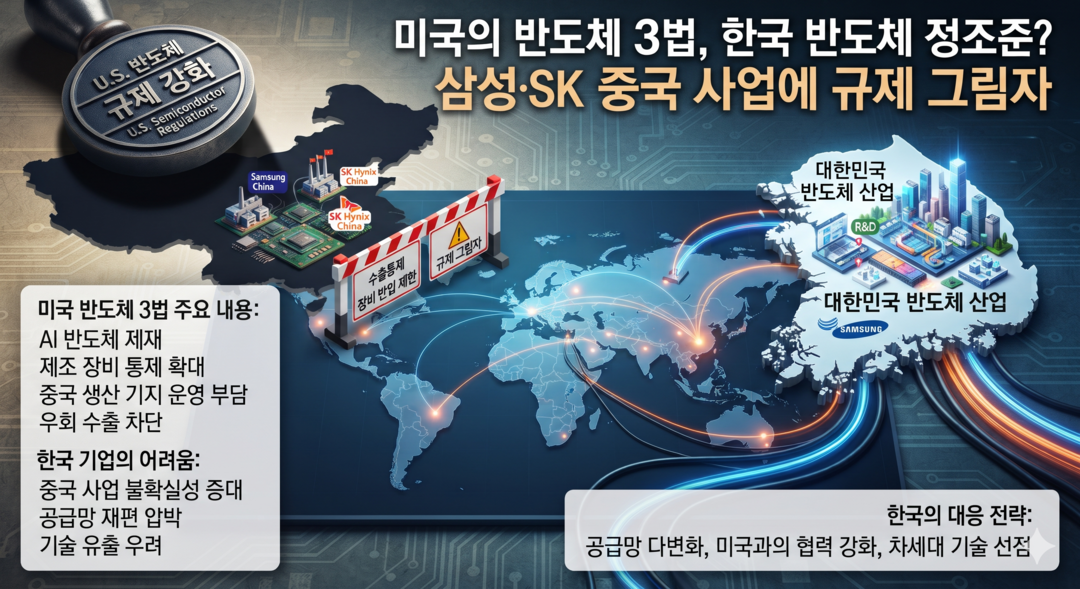
The three bills currently advancing in Congress are the AI OVERWATCH Act, the Chip Security Act, and the MATCH Act.
The AI OVERWATCH Act centers on granting Congress oversight over exports of advanced AI semiconductors to countries of concern, including China, allowing lawmakers to block executive branch export approvals.
The Chip Security Act includes provisions to strengthen location verification and tracking systems for semiconductors to prevent U.S.-made advanced chips from flowing into China via third countries.
The legislation expected to have the most direct impact on South Korea is the MATCH Act. Its core provision requires allies—including Japan, the Netherlands, and South Korea—to tighten their export controls on semiconductor manufacturing equipment to China to levels comparable to those of the United States.
Lawmakers are discussing measures that would apply U.S. export controls even to foreign-made equipment containing U.S. technology or components if an ally fails to align its regulatory standards within a specified timeframe.
The primary concern lies with the Chinese manufacturing facilities operated by Samsung Electronics and SK Hynix. Samsung manufactures NAND flash memory in Xi’an, China, while SK Hynix operates DRAM and NAND flash production bases in Wuxi and Dalian, respectively.
For these plants, securing equipment is vital not only for maintaining existing production lines but also for process migration and technological upgrades.
If U.S. regulations expand, companies could face increased burdens not just in bringing in new equipment, but also in maintaining, repairing, and upgrading existing facilities. In particular, if the scope of regulation extends beyond U.S.-made machinery to allied-produced equipment incorporating U.S. technology or parts, the supply chain management burden on South Korean firms will grow substantially.
However, the actual scope of the regulations and whether exemptions will be granted for existing production facilities remain subject to the final text of the legislation and subsequent enforcement rules.
Allies Push Back as U.S. Regulatory Pressure Becomes a Diplomatic Issue
Not all U.S. allies share the same stance on Washington’s push to tighten restrictions.
According to Reuters reports on November 25 and 26, the Dutch government is actively working to block the passage of the MATCH Act, expressing concerns that the bill could impose a significant burden on its domestic semiconductor equipment industry.
In particular, the potential impact on ASML’s Chinese market and equipment exports has emerged as a key point of contention. This demonstrates that the proposed regulations go beyond mere technological rivalry between the U.S. and China, directly intersecting with the industrial policies and trade sovereignty of U.S. allies.
South Korea likewise faces the dual challenge of cooperating with U.S. security demands while safeguarding the operational stability of its domestic chipmakers.
Both Crisis and Opportunity for South Korean Semiconductors
The tightening regulations do not necessarily spell purely negative outcomes for South Korean companies.
If Chinese chipmakers struggle to secure advanced manufacturing equipment and technology, Samsung Electronics and SK Hynix could gain a relative advantage in terms of technological competitiveness and market share.
Especially amid surging demand for High Bandwidth Memory (HBM) driven by the growth of the AI industry, a restructuring of the global semiconductor supply chain could open up new business opportunities for South Korean firms.
Nevertheless, if equipment upgrades at their Chinese facilities are restricted and machinery supply chains become more complex, both companies will face headwinds in maintaining existing production capacities and investment efficiency.
Furthermore, as U.S. export controls intensify, South Korean chipmakers will be forced to fine-tune their technology, production, and sales strategies across both the U.S. and Chinese markets.
Ultimately, what matters most is not only the direction of the regulations, but also their actual scope, grace periods, and exemption clauses for existing facilities.
Trade Diplomacy and Industrial Strategy Hold the Key
Rather than simply taking a binary stance for or against U.S. regulations, the South Korean government must focus on negotiations that reflect the practical realities facing its companies.
First, Seoul must secure stable pathways for bringing in equipment and conducting maintenance and repairs at Samsung Electronics and SK Hynix’s existing production facilities in China.
Second, during consultations with Washington, the government needs to thoroughly articulate the South Korean semiconductor industry's contributions to the global supply chain and its technological competitiveness.
Third, Seoul must formulate a strategy to diversify global production bases—including expanding footprints in the U.S. and South Korea—while gradually reducing reliance on Chinese manufacturing hubs.
Above all, establishing a joint public-private response system is critical to ensure that stricter U.S. regulations do not translate into unilateral financial burdens for domestic enterprises.
The U.S. Congress is currently discussing the inclusion of these provisions in the final version of the National Defense Authorization Act (NDAA) for Fiscal Year 2027. However, the final inclusion of the three bills and their specific implementation terms have yet to be finalized.
U.S. semiconductor export controls are no longer an issue aimed solely at China. They have expanded into an industrial security issue capable of affecting the production facilities and technology supply chains of allies, including South Korea.
Attention is now focused on whether South Korea’s semiconductor industry can leverage these shifts as an opportunity to strengthen its competitiveness, or whether it will be saddled with new burdens stemming from its Chinese operations and the restructuring of the global supply chain.
[Copyright (c) Global Economic Times. All Rights Reserved.]