• 2026.11.29 (Sun)
  • All articles
  • LOGIN
  • JOIN
Global Economic Times
한인동포뉴스(상단)
  • Synthesis
  • World
  • Business
  • Industry
  • ICT
  • Distribution Economy
  • Well+Being
    • Pet Life
    • Halal Horizon
  • Travel
  • Eco-News
  • Education
  • Korean Wave News
  • Opinion
  • Arts&Culture
  • Sports
  • People & Life
    • International Student Report
    • With Ambassador
  • Column
    • Cho Kijo Column
    • Cherry Garden Story
    • Ko Yong-chul Column
    • Kim Bong-seon's Photo Column
    • Kim Seul-Ong Column
    • Lee Yeon-sil Column
    • Professor Lee Soo-young’s Life Essays
  • Photo News
  • New Book Guide
MENU
 
Home > Business

Hyundai Glovis Bets Big on Mega-Car Carriers, Reaping Rewards Amid Global Vessel Crunch

KO YONG-CHUL Reporter / Updated : 2026-11-29 14:30:15
  • -
  • +
  • Print

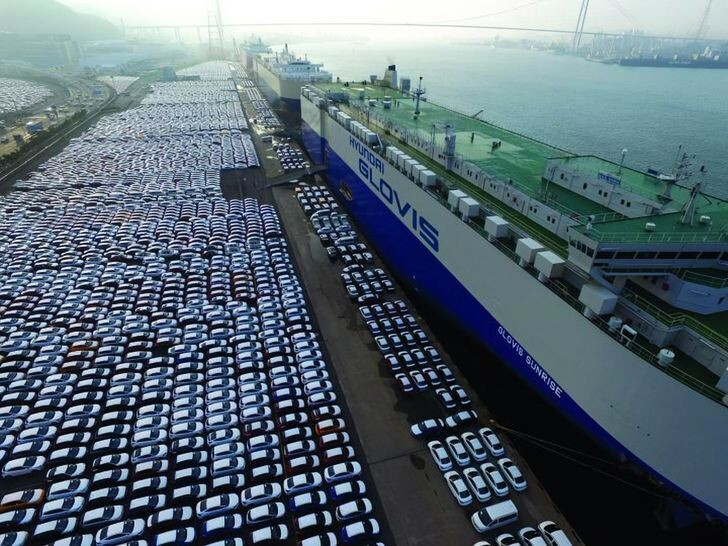
GUANGZHOU, China — As a relentless boom in Chinese automotive exports pushes global shipping rates to record highs, South Korean logistics giant Hyundai Glovis is cashing in on a bold fleet expansion strategy initiated three years ago.

On November 26, the company officially christened the Glovis Navis at the Guangzhou Shipyard International (GSI) in southern China. Measuring 230 meters long and 40 meters wide, the vessel stands as the world’s largest Pure Car and Truck Carrier (PCTC), capable of transporting up to 10,800 compact vehicles in a single voyage.

A 14-Deck Engineering Marvel

Designed like a massive floating parking garage, the 16-story vessel dedicates 14 decks—spanning a combined area equal to 14 soccer fields—strictly to cargo. To maximize versatility beyond standard passenger cars, five of those decks feature adjustable ceiling heights that can expand up to 8 meters. This allows the ship to accommodate heavy construction machinery, buses, and even full-sized railway cars loaded on trailers.

In line with tightening maritime environmental regulations, the Glovis Navis runs on a liquefied natural gas (LNG) dual-fuel engine—cutting carbon emissions by roughly 26% compared to traditional low-sulfur fuel—and includes shore power connectivity. The vessel is slated to begin operations on South American trade routes.

Economies of Scale Meet a Tight Market

The Navis is the latest delivery from a 2023 initiative in which Hyundai Glovis moved to acquire 30 new vessels, including 20 of the 10,800-unit mega-carriers, to insulate itself from volatile charter markets. Seven of these giant ships have joined the fleet this year alone, with one more expected before year-end. Four of the vessels are backed by policy financing through a 2024 partnership with the Korea Ocean Business Corporation, ensuring dedicated export capacity for South Korean automakers during shipping bottlenecks.

According to Hyundai Glovis CEO Lee Kyu-bok, upsizing vessels delivers critical unit-cost advantages. While the new mega-carriers hold 80% more cargo than traditional 6,000-car ships, construction and fuel expenses do not scale at the same rate, significantly lowering the per-vehicle shipping cost.

This cost efficiency comes at a pivotal moment for the maritime industry. Driven by China's rapid rise as an auto export powerhouse—with total shipments projected to climb from 7.99 million units last year to 11.25 million this year—demand for PCTCs has severely outpaced supply. Maritime data provider Clarksons notes that daily charter rates for car carriers doubled from an average of $49,375 last year to $100,000 in October. With major shipyards booked solid through early 2030—a bottleneck that prompted Hyundai Glovis to turn to Chinese shipbuilders while Korean yards focused on LNG tankers—competitors face steep barriers to expanding capacity.

Expanding Global Market Share

Capitalizing on its early fleet investments, Hyundai Glovis saw its third-quarter car carrier revenue jump 38.5% year-over-year to 1.37 trillion won.

Looking ahead, the logistics firm aims to grow its share of seaborne auto exports departing China from 12.2% (recorded in the first nine months of this year) to 13.6% next year. By 2030, Hyundai Glovis plans to expand its total operating fleet to 128 vessels (based on 6,500-car equivalents) and raise its ratio of owned and long-term chartered ships from 54% to 64%. Ultimately, the company targets hauling 5 million vehicles annually—up from 3.4 million today—to capture roughly one-fifth of the global seaborne auto transport market.

[Copyright (c) Global Economic Times. All Rights Reserved.]

  • #Cherry Garden
  • #HalalFood
  • #Halal
  • #Petlife
  • #Cats
  • #Dogs
  • #Halalhorizone
  • #Hormuz Impasse
  • #Joseon
  • #globaleconomicti
KO YONG-CHUL Reporter
Reporter Page

Popular articles

  • Culinary Mashups and Nostalgia with a Twist: South Korea’s F&B Giants Vie for Consumer Attention

  • Japanese Hotel Prices Surge Nearly 9% Amid Booming Korean Tourism

  • NVIDIA Expands Local AI Horizons with RTX Spark Laptops for Offline Creators

I like it
Share
  • Facebook
  • X
  • Kakaotalk
  • LINE
  • BAND
  • NAVER
  • https://globaleconomictimes.kr/article/1065590940354823 Copy URL copied.
Comments >

Comments 0

Weekly Hot Issue

  • Exploring Strategies to Expand Exhibition Opportunities and Revitalize Distribution for Chungbuk Art
  • South Korea’s Chip Windfall Piles Up in Financial Assets Rather Than Household Wallets, Central Bank Says
  • South Korea Enters the $700 Billion Nuclear Decommissioning Race with Kori-1 Dismantling
  • South Korea’s Major Telecoms Complete Nationwide Shift to True 5G Standalone Networks
  • Amazon Launches 36 Satellites Just Nine Days After Mishap, Intensifying Race Against Starlink
  • South Korean Gaming Giants Eye China Return Following Landmark FTA Breakthrough

Most Viewed

1
Memory Chip Rout Deepens as Wall Street Questions AI Spending and DRAM Pricing
2
Exercise Beats Diet in Extending Lifespan, Major Review Finds
3
South Korean Burger Chain Lotteria Expands Singapore Footprint with Halal Certification and New Teriyaki Lineup
4
AI Semiconductor Stocks Plummet: Philadelphia Index Drops 5.28% and Micron Plunges 7.59% Amid Executive Shakeup and Export Restrictions
5
"Stay Out, Get Paid, or Have Police Stay With You": Shenzhen Imposes Strict Security Ahead of APEC Summit
체리가든 스토리
nutri huevos
로타리
동포저널

Hot Issue

Magnitude 5.0 Quake Rattles Los Angeles, Disrupting LAX Flights and Damaging Infrastructure

IDF Faces Backlash Over Allegations of Using Gaza Civilians to Clear Booby-Trapped Sites

South Korea’s Chip-Fueled 4% Growth Masks Deepening Domestic Divide

Fashion Runway Show 2026

Let’s recycle the old blankets in Jeju Island’s closet instead of incinerating them.

Global Economic Times
korocamia@naver.com
CEO : LEE YEON-SIL
Publisher & Editor : KO YONG-CHUL
Registration number : Seoul, A55681
Registration Date : 2024-10-24
Youth Protection Manager: KO YONG-CHUL
Singapore Headquarters
5A Woodlands Road #11-34 The Tennery. S'677728
Korean Branch
Phone : +82(0)10 4724 5264
#304, 6 Nonhyeon-ro 111-gil, Gangnam-gu, Seoul
Copyright © Global Economic Times All Rights Reserved
  • News K
  • 반달곰 프로젝트
  • 광고문의
Search
Category
  • All articles
  • Synthesis
  • World
  • Business
  • Industry
  • ICT
  • Distribution Economy
  • Well+Being 
    • 전체
    • Pet Life
    • Halal Horizon
  • Travel
  • Eco-News
  • Education
  • Korean Wave News
  • Opinion
  • Arts&Culture
  • Sports
  • People & Life 
    • 전체
    • International Student Report
    • With Ambassador
  • Column 
    • 전체
    • Cho Kijo Column
    • Cherry Garden Story
    • Ko Yong-chul Column
    • Kim Bong-seon's Photo Column
    • Kim Seul-Ong Column
    • Lee Yeon-sil Column
    • Professor Lee Soo-young’s Life Essays
  • Photo News
  • New Book Guide
  • Overseas Koreans
  • Multicultural News