![[등록] 2026-09-01 15:48:31](/support/_updata/banner2/tl181982910_6749.png)


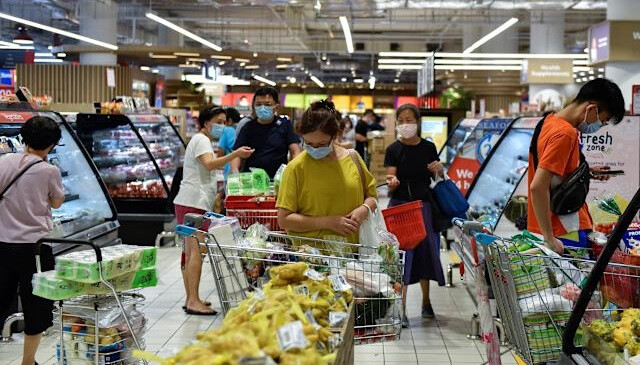
Singapore – Singapore's key consumer price gauges in April slightly exceeded forecasts but remained at low levels, with authorities assessing that inflation risks are skewed to the downside given the uncertain global economic environment.
Data released last Friday (local time) showed that annual core inflation, which excludes costs of private road transport and accommodation, came in at 0.7% in April. This figure was higher than the median forecast of 0.5% in a Reuters poll of economists and also up from 0.5% in March.
Overall headline inflation in April stood at 0.9% year-on-year, the same level as March, and slightly above economists' predictions of 0.8%.
Core Inflation Rises Slightly, Yet Remains Below 1%
The marginal rise in April's core inflation marked the first increase since it hit 2.8% in September of the previous year. However, it continued to remain below 1% for the fourth consecutive month, reflecting the complex situation facing Singapore's economy. Core inflation typically serves as an indicator of underlying inflation trends, excluding volatile factors. While the slight uptick might signal that consumer prices are not entirely decelerating, the persistent low level below 1% simultaneously suggests that overall demand pressures are not robust.
Selena Ling, an economist at OCBC Bank, analyzed at the time, "Even with the ongoing US-China trade negotiations, the disinflationary path will remain bumpy, given the uncertainty over US tariffs, particularly the unclear final outcome of the 90-day (US-China) trade truce." Her remarks underscore the significant impact of the international trade environment on Singapore's inflation and economic outlook. The US-China trade dispute can disrupt global supply chains, dampen corporate investment sentiment, and ultimately affect consumer prices.
Geopolitical Factors Outweighing Economic Fundamentals
Bank of Singapore noted at the time that "geopolitical factors are driving markets more than fundamentals," pointing out that political risks, including trade disputes, were having a greater impact on market sentiment than economic indicators. This illustrates that global economic uncertainty was being shaped by complex factors beyond mere economic data. As an open economy, Singapore is highly sensitive to changes in the global trade environment.
MAS's Accommodative Monetary Policy and Growth Concerns
The Monetary Authority of Singapore (MAS), which acts as Singapore's central bank, eased its monetary policy for the second time that year at its April review meeting. This move reflected concerns about Singapore's growth outlook amid economic uncertainties stemming from US tariffs. MAS also lowered its forecasts for both core and headline inflation to a range of 0.5% to 1.5%.
MAS primarily conducts monetary policy through the exchange rate. By adjusting the policy path of the nominal effective exchange rate (NEER) within a currency basket, it manages the value of its currency, which is crucial for Singapore's export-oriented economy. The easing of monetary policy can be interpreted as an intention to induce a depreciation of the Singapore dollar, thereby enhancing export competitiveness and stimulating economic growth.
In a joint statement on inflation data, MAS and the Ministry of Trade and Industry stated, "Given the increased uncertainties in the external environment, inflation risks are skewed to the downside." This indicated that Singaporean authorities were more concerned about deflationary pressures due to an economic slowdown rather than rising prices.
GDP Growth Downgrades and Recession Risks
Singapore had previously lowered its gross domestic product (GDP) growth forecast for 2025 from the earlier 1%–3% to 0%–2%. This adjustment primarily cited the direct and indirect impacts of US tariffs, with officials warning of recession risks for the city-state.
As a major global trade hub and financial center, Singapore is highly susceptible to global economic trends. The US-China trade dispute, in particular, presented a direct hit to Singapore's economy as it involved its two major trading partners, the world's largest economies. The imposition of tariffs could reshape global supply chains and alter companies' production and investment plans, negatively impacting Singapore's exports and re-exports. Furthermore, a slowdown in global economic growth could also affect Singapore's service sector, especially its financial and tourism industries.
Structural Vulnerabilities and Singapore's Response Efforts
Singapore, possessing a small domestic market, is an open economy heavily reliant on exports and foreign investment. This structural characteristic makes it more vulnerable to global economic uncertainties. At the time, the trade conflict between the US and China caused severe disruptions to global supply chains, directly affecting Singapore's manufacturing and trade sectors. Key industries, such as electronics and refining, faced performance pressures due to shifts in global demand and supply chain realignments.
The Singaporean government and MAS implemented various policy efforts to address these challenges. The easing of monetary policy was a key tool for economic stimulus, and the government sought to mitigate economic shocks through financial support for businesses and job retention programs. Furthermore, Singapore pursued strategies to diversify its economic structure in the long term, seeking to transition to higher-value-added industries and strengthen economic cooperation with Southeast Asia and other regions to reduce external dependency.
Future Outlook and Challenges
At the time, Singapore's economy was navigating a cautious path amid external uncertainties. While the slight increase in core inflation could have been interpreted as a sign of demand recovery, MAS continued to perceive significant downside risks, maintaining vigilance against an economic slowdown. The prolonged US-China trade dispute and the deceleration of global economic growth represented the biggest challenges facing Singapore.
The Singaporean government and central bank focused on securing policy leeway and strengthening their economic resilience to respond flexibly to such external shocks. This demonstrates Singapore's strategic approach to preparing for future uncertainties and pursuing sustainable growth. Singapore's ongoing efforts to enhance national competitiveness in the long term, even while remaining sensitive to changes in the global economic environment, will continue to be noteworthy.
[Copyright (c) Global Economic Times. All Rights Reserved.]