• 2026.10.25 (Sun)
  • All articles
  • LOGIN
  • JOIN
Global Economic Times
[등록] 2026-09-01 15:48:31
  • Synthesis
  • World
  • Business
  • Industry
  • ICT
  • Distribution Economy
  • Well+Being
    • Pet Life
    • Halal Horizon
  • Travel
  • Eco-News
  • Education
  • Korean Wave News
  • Opinion
  • Arts&Culture
  • Sports
  • People & Life
    • International Student Report
    • With Ambassador
  • Column
    • Cho Kijo Column
    • Cherry Garden Story
    • Ko Yong-chul Column
    • Kim Seul-Ong Column
    • Lee Yeon-sil Column
  • Photo News
  • New Book Guide
MENU
 
Home > World

Efforts to Bolster Japan’s Production of Next-Generation Solar Cells Are Powering Up

Desk / Updated : 2026-10-25 11:35:30
  • -
  • +
  • Print


Japanese companies are turbocharging their efforts to mass-produce perovskite solar cells—a home-grown technology widely tipped to become the leading generation of photovoltaics. With robust backing from the government, domestic firms are racing to commercialize these light, thin, and flexible cells, though they face stiff competition and market dominance from Chinese manufacturers.

Strategic Shift Toward Economic Security

Perovskite solar cells have been designated as a key product under the 17 strategic fields supported by Prime Minister Sanae Takaichi’s administration. While traditional solar cells rely heavily on silicon—an element predominantly produced by China—perovskite utilizes iodine as a primary raw material. Because Japan ranks as the world's second-largest producer of iodine behind Chile, perovskite offers a promising carbon-free power source with significantly lower economic security risks.

Industry Leaders Scale Up Production

Several Japanese pioneers are actively building out their manufacturing infrastructure:

EneCoat Technologies: In late September, the Kyoto University spinoff held a completion ceremony for its new headquarters and manufacturing plant in Uji, Kyoto Prefecture. Chief Executive Officer Naoya Kato expressed ambitions to make the technology a widespread "power source found anywhere." Set to begin production next year and operate at full scale by 2028, the facility targets an annual capacity exceeding 10 megawatts, focusing on building exteriors, vehicles, and clocks. EneCoat currently develops film-type cells boasting an energy conversion efficiency rate of 17.7%—reportedly the highest for this cell type in Japan.
Panasonic Holdings Corp.: Tapping into government subsidies, Panasonic is soon launching a mass-production technology development facility in Nagahama, Shiga Prefecture. The company specializes in glass-type perovskite solar cells designed to blend seamlessly with building architecture and cityscapes. While aiming for commercial mass production around fiscal 2030, Yukihiro Kaneko, general manager of the Perovskite Photovoltaics Business Promotion Office, noted that internal discussions are underway to accelerate this timeline.
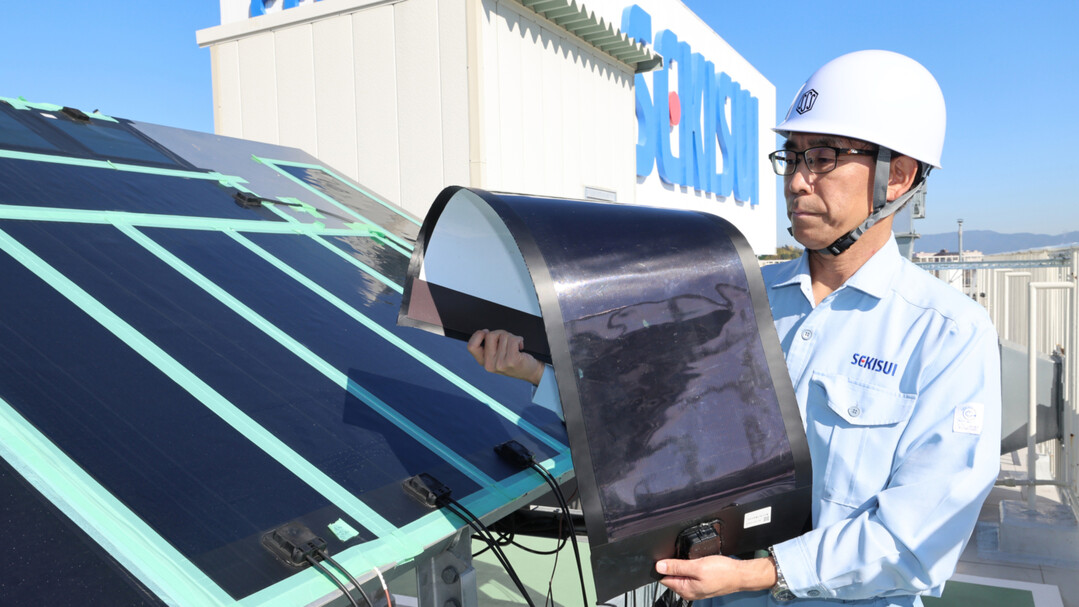
Sekisui Chemical Co.: Having launched its film-type perovskite brand "Solafil" in March, Sekisui Chemical plans to commence operations at a major plant in Sakai, Osaka Prefecture, by fiscal 2027. The facility will boast a production capacity of 100 megawatts—equivalent to the annual electricity consumption of approximately 31,000 households.

The Global Competition and the Road Ahead

According to market research firm Fuji Keizai Co., the global perovskite market is projected to surge to approximately ¥3.6 trillion by 2040, representing an 80-fold increase from 2025. Currently, Chinese enterprises such as Kunshan GCL Optoelectronic Materials Co. and UtmoLight Co. hold the lion’s share of the market.

"China’s government and local governments provide generous subsidies and preferential treatment, creating an environment more conducive to making massive capital investments," pointed out Chiharu Ando of Fuji Keizai.

Ultimately, whether Japanese companies can carve out and expand their market share will depend heavily on their ability to differentiate their products through superior versatility and durability.

[Copyright (c) Global Economic Times. All Rights Reserved.]

  • #Cherry Garden
  • #HalalFood
  • #Halal
  • #Petlife
  • #Halalhorizone
  • #Hormuz Impasse
  • #globaleconomictimes
  • #micorea
  • #mykor
Desk
Desk

Popular articles

  • Department Stores Enter '1 Trillion Won Era' Driven by Foreign Shoppers: Expanding Beyond Myeong-dong to Jamsil and Regional Areas

  • BNK Busan Bank Suffers Data Leak Affecting 11 Outsourced Developers Due to AI-Driven Cyber Attack

  • Foreigners Net Sell 1.7 Trillion Won; KOSPI Surrenders 7,000 Mark While KOSDAQ Surges Nearly 3%

I like it
Share
  • Facebook
  • X
  • Kakaotalk
  • LINE
  • BAND
  • NAVER
  • https://globaleconomictimes.kr/article/1065580453537672 Copy URL copied.
Comments >

Comments 0

Weekly Hot Issue

  • Human language prefers safety over happiness?
  • Qnity Strengthens 'Customer Collaboration' Strategy for Semiconductor Material Innovation… “Shortening South Korea’s Semiconductor Development Cycles”
  • Detective in Disguise, Close Romance… TVING's "My Guilty Person"
  • Korean Research Team Corrects 15-Year-Old International Standard Error in Power Semiconductors
  • Drinking 6 to 8 cups of tea a day helps heart health... Need to consider types and additives
  • The Secret to Returning Food Waste to the Earth

Most Viewed

1
Nearly 900 Schools Temporarily Closed as 'Flu' Epidemic Sweeps Japan
2
US Pushes to Deploy Special Task Force to the Korean Peninsula—Is It Also Targeting China?
3
Samsung Electronics Enters the 100 Trillion Won Quarterly Operating Profit Era
4
McDonald's Korea Expands and Relocates Headquarters to Booyoung Taepyeong Building in Taepyeong-ro
5
AI Companies Rush to Go Public, But Face Sudden Brakes Amid Cooling Investor Sentiment
체리가든 스토리
nutri huevos
로타리
동포저널

Hot Issue

Wall Street Falls as Middle East Escalation Fears and Surging Oil Prices Send Dow Down 1.2%

Global Credit Spreads Widened to 17-Month High Amid AI Investment Concerns

Investor Deposits Plummet by 51 Trillion Won in Four Months, Dropping to Lowest Level This Year

Fashion Runway Show 2026

Let’s recycle the old blankets in Jeju Island’s closet instead of incinerating them.

Global Economic Times
korocamia@naver.com
CEO : LEE YEON-SIL
Publisher : KO YONG-CHUL
Registration number : Seoul, A55681
Registration Date : 2024-10-24
Youth Protection Manager: KO YONG-CHUL
Singapore Headquarters
5A Woodlands Road #11-34 The Tennery. S'677728
Korean Branch
Phone : +82(0)10 4724 5264
#304, 6 Nonhyeon-ro 111-gil, Gangnam-gu, Seoul
Copyright © Global Economic Times All Rights Reserved
  • 향기네무료급식
  • APEC2025
  • 반달곰 프로젝트
Search
Category
  • All articles
  • Synthesis
  • World
  • Business
  • Industry
  • ICT
  • Distribution Economy
  • Well+Being 
    • 전체
    • Pet Life
    • Halal Horizon
  • Travel
  • Eco-News
  • Education
  • Korean Wave News
  • Opinion
  • Arts&Culture
  • Sports
  • People & Life 
    • 전체
    • International Student Report
    • With Ambassador
  • Column 
    • 전체
    • Cho Kijo Column
    • Cherry Garden Story
    • Ko Yong-chul Column
    • Kim Seul-Ong Column
    • Lee Yeon-sil Column
  • Photo News
  • New Book Guide
  • Overseas Koreans
  • Multicultural News