![[등록] 2026-09-01 15:48:31](/support/_updata/banner2/tl181982910_6749.png)


(C) The South Korean Embassy in Peru
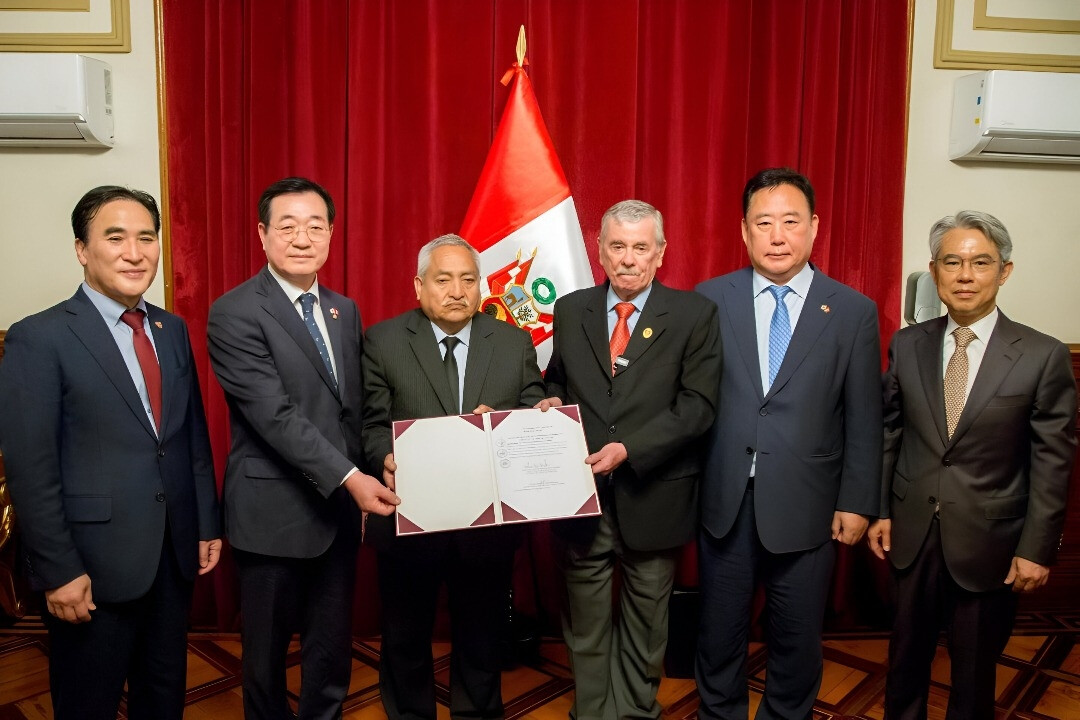
The Peruvian Congress has unanimously passed a bill designating April 1st of every year as the 'Day of Peru-Korea Friendship.' The motion was approved by all 105 attending members, according to the South Korean Embassy in Peru on Tuesday (local time).
The bill's passage formalizes a commitment to strengthen diplomatic relations and officially acknowledges South Korea's significant contributions to Peru’s development in economic, academic, scientific, technological, social, and cultural sectors. The date, April 1st, was strategically chosen to coincide with the establishment of diplomatic ties between the two nations in 1963.
A Unanimous Endorsement for a "Solid Alliance"
The overwhelming, unanimous vote in Congress underscores the strong, decades-long relationship between Lima and Seoul. At the bill signing ceremony held the day before the announcement, a South Korean National Assembly delegation, including Min Hong-cheol, President of the Korea-Peru Parliamentarians’ Friendship Association, was in attendance to witness the historic moment.
Fernando Rospigliosi, President of the Peruvian Congress, emphasized the significance of the legislation, stating that it "reaffirms the solid alliance built on decades of respect, cooperation, and friendship."
The initiative for the 'Day of Korean Friendship' originated in November 2023 during a regular meeting of the two countries' parliamentary friendship associations. The proposal was made by Choi Jong-wook, the then South Korean Ambassador to Peru, and subsequently championed by Victor Flores, President of the Peru-Korea Parliamentarians’ Friendship Association, who led the drafting and discussion of the bill.
Expanding Cooperation Beyond Trade: Technology and Sustainability
During the presentation of the bill, Aidy Juárez Calle, Chair of the Peruvian Congressional Foreign Relations Committee, highlighted South Korea's pivotal role in Peru’s international partnerships.
"Korea is Peru's most important trading partner in the Asian region," Juárez Calle remarked. She further advocated for the necessity of designating the Friendship Day to broaden the scope of exchange, particularly recognizing South Korea as a key partner in critical areas such as digital government, smart cities, startups, environmental initiatives, sustainable development, healthcare system improvement, and science and technology. This focus indicates Peru's strategic intent to leverage South Korea’s advanced expertise to fuel its own modernization and development goals.
The designation is expected to unlock new avenues for collaboration, providing a crucial foothold for South Korean enterprises seeking to expand their presence in the Peruvian market.
Cultural Diplomacy and Future Outlook
The South Korean Embassy in Peru plans to utilize the newly designated 'Day of Korean Friendship' to host large-scale events that will broadly introduce various facets of Korean culture, including the increasingly popular K-Pop phenomenon.
Beyond cultural diplomacy, the Embassy affirmed its commitment to continued cooperation with the Peruvian Congress to expand major bilateral cooperation projects. The goal is clear: to establish a stable bridgehead for South Korean companies to enter and succeed in the local market, transforming the existing "friendship" into concrete economic and technological partnerships.
This legislative action solidifies the status of South Korea as a vital strategic partner in Latin America. By creating an official day to celebrate the relationship, Peru has sent a strong signal of its desire to integrate South Korean technology and cultural influence more deeply into its national development strategy.
In a related development, the Korea-Paraguay Parliamentarians’ Friendship Association met with Raúl Latorre, President of the Paraguayan Chamber of Deputies, in Asunción on November 19th. The South Korean delegation requested special attention for the Korean community in light of the 60th anniversary of Korean immigration to Paraguay this year, underscoring the broader diplomatic efforts to support the Korean diaspora and strengthen ties across the region.
[Copyright (c) Global Economic Times. All Rights Reserved.]