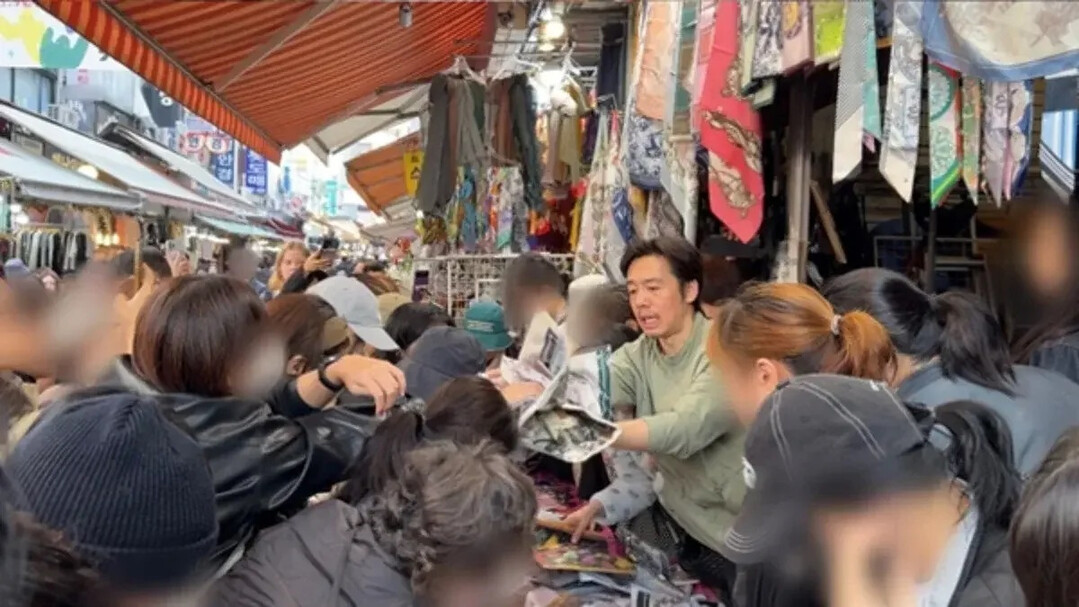
The legendary Namdaemun Market in Seoul is buzzing with energy once again. Recently, my social media feeds and everyday conversations have been filled with mentions of friends visiting the market. A particular vendor affectionately nicknamed ‘Scarfriyo’ has achieved minor celebrity status, drawing crowds of curious shoppers. Even a friend who typically shops exclusively at luxury department stores traveled all the way from Sejong City just to experience the hype. Thanks to her trip, my home is now stocked with practical souvenirs: a traditional Korean bath towel, exfoliating mitts, a scalp massager, and a floral-patterned kimjang (kimchi-making) vest.
My personal memories of Namdaemun date back decades to late-night wholesale shopping excursions during high school. After staying up all night at a friend's place, we would head to the market in the dead of night. Despite the hour, every stall blazed with bright lights, and tour buses loaded with wholesale merchants from all over the country lined the streets. We would bounce from shop to shop, spending our meager allowances on clothes and capping off the night with a steaming bowl of hot noodles. Hearing about the market’s recent revival instantly brings those nostalgic scenes rushing back.
Over the years, shopping habits shifted dramatically online. With just a few clicks, consumers can compare prices and have goods delivered straight to their doorstep, making traditional markets feel inconvenient for younger generations. For a long time, traditional markets were a sore point for tourism policymakers as well. Vibrant with food and sights, the eternal question remained: How do we get people to make a special trip here? Revitalizing these markets is about far more than just supporting local merchants' livelihoods; it is about preserving unique regional cultural assets.
It is heartening to see foreign travelers and domestic youth flocking to the market together. According to the Seoul Metropolitan Government, 13.14 million foreign tourists visited Seoul between January and September of this year, representing a 21.5% increase compared to the same period last year. During the same timeframe, Shinhan Card recorded that foreign credit card spending in tourism-related sectors around Namdaemun Market’s Free Market area surged 65.6%, jumping from 9.51 billion won to 15.75 billion won. Given the prevalence of cash transactions in traditional markets, the actual growth is likely even higher.
Stepping away from computer screens to shop offline brings a distinct joy to selecting items. Browsing through various goods, finding a fair price, and picking up an extra item to gift someone turns shopping into an adventure. Even when visiting with no intention to buy, shoppers often leave with hands full of plastic bags. In modern shopping malls, shoppers check price tags and head straight to checkout in silence; in a market, shopping sparks conversation. As you ask which item is better, the vendor chimes in, and fellow shoppers jump into the discussion. The viral videos of people repeatedly watching tourists buy simple scarves are popular precisely because of those warm, lively interactions.
When traveling abroad, I feel the irresistible urge to visit local markets first. Tasting street food and browsing unfamiliar groceries and everyday goods offers a glimpse into how local people live and eat. Foreign visitors exploring Namdaemun feel the same way. They bite into sweet, 잡채 (japchae)-filled hotteok, and pause in fascination before bath supplies and floral-print kimjang vests. To locals, those items evoke memories of public bathhouses or traditional kimchi-making days; to international travelers, they serve as tangible souvenirs capturing everyday Korean life.
Namdaemun is far from the only market enjoying a renaissance. Famous destinations like Gwangjang Market in Seoul, Jagalchi Market in Busan, and Dongmun Traditional Market in Jeju continue to draw crowds. Because each market boasts distinct regional specialties and street foods, a pilgrimage across South Korea’s traditional markets makes for a wonderful tourism product.
Earlier this year, the Ministry of Culture, Sports and Tourism and the Korea Tourism Organization selected 11 traditional markets—including Jeonbu Nambu Market, Danyang Gu-gyeong Market, and Incheon Sinpo International Market—as part of the second phase of "K-Tourism Markets." The initiative provides international promotion, market experience programs, and travel packages linking the markets with nearby tourist attractions. Meanwhile, the Ministry of SMEs and Startups designated 10 historic traditional markets with over 70 years of heritage—such as Busan Jagalchi Market, Gangwon Jeongseon Arirang Market, and Suwon Nammun Market—as "Centennial Markets," helping them share their stories and develop signature products and interactive programs. However, caution is warranted; without careful preservation, modernization risks erasing the unique, rustic charm that makes these traditional markets so special.
In Korean, there is a common idiom: “It’s like a marketplace (시장통 같다).” It is traditionally used to describe chaotic, noisy, and overwhelmingly crowded scenes. Judging by the bustling energy of Namdaemun Market today, that phrase has never felt more alive—and it is a vibrant chaos we hope echoes through traditional markets nationwide every single day.
[Copyright (c) Global Economic Times. All Rights Reserved.]