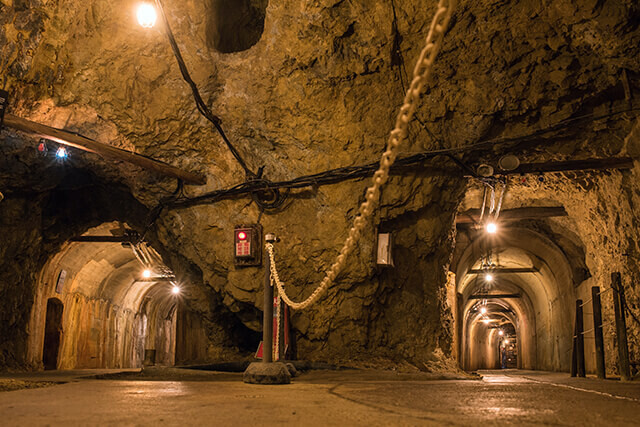
Climbing the narrow, chilly stairs of an unheated building, I reached a small room tucked away in a corner on the second floor.
This modest space houses the exhibition on Korean laborers—a display established as part of Japan’s commitments when the Sado Mine was inscribed as a UNESCO World Heritage site in 2024. Titled "Life of Mine Laborers Including Those from the Korean Peninsula," this isolated room serves as practically the only separate space dedicated to exploring the history of Korean workers at the site.
More than 80 years after being forcefully mobilized into dark, hazardous tunnels for grueling labor, the treatment and representation of these Korean workers appear largely unchanged by the passage of time. The word "forced" is conspicuously absent from every explanatory panel inside the exhibition room.
One panel notes that Korean peninsula workers were disproportionately assigned to dangerous underground tasks compared to those from mainland Japan. These included sakam (drilling holes in rock for explosives), jiju (using timber to shore up unstable areas prone to cave-ins), and transportation (manually hauling mined ore). However, the presentation seemed to dilute the essence of discrimination and forced mobilization by hiding behind objective statistics.
Another panel states only that while the National Mobilization Law was promulgated in April 1938 and the National Conscription Ordinance followed in July 1939, distinct systems were introduced to the Korean Peninsula: "recruitment" in September 1939, "official recommendation" in February 1942, and "conscription" in September 1944. Conscription itself was described as "obligating workers to perform duties based on legal statutes," creating the impression that the process was carried out lawfully and properly.
On the opposite wall hung copies of old Special Higher Police documents detailing the mass escapes and labor disputes of Korean workers. Yet, they featured only dense, unannotated original texts without any explanatory context.
The seclusion of the Korean labor exhibits—tucked away in an empty corner room with no visitors in sight—stood in stark contrast to the flamboyant World Heritage promotions surrounding the Sado Island. High-speed ferries heading to the island were inundated with promotional pamphlets highlighting "World Heritage Sado Mine" and "gold panning experiences."
From the entrance of "Kirarium Sado," the modern main visitor facility, the focus was entirely on celebrating Japan's industrial modernization. The exhibits proudly boasted that the mine achieved its peak annual output of 1.5 tons of gold in the 1940s—when forced mobilization of Koreans was at its height—dubbing it a "golden age." Yet, not a single line acknowledged the human sacrifices behind this success.
Despite the sweeping publicity campaign, the late-autumn off-season left parts of Sado Island quiet and deserted. Neither the Aikawa Local Museum nor Kirarium Sado saw any visitors that afternoon. When asked if tourism had increased following the World Heritage designation, a local restaurant worker offered a flat response: "It only picked up slightly during the summer peak season. The off-season is naturally quiet."
In July, the UNESCO World Heritage Committee adopted a resolution urging improvements to exhibits to reflect the "entire history" of the Sado Mine, but that message appeared not to have reached Sado Island. On online platforms like Google Maps, biased reviews for the Aikawa Local Museum even claimed that "South Korea will demand moving the exhibits to the more-visited Kirarium Sado, which is interference in domestic affairs."
As the gap in historical perspectives between Seoul and Tokyo remains wide for the third consecutive year regarding the reflection of the "entire history," annual memorial ceremonies have repeatedly triggered diplomatic friction. Disagreements over the level of attending officials and the wording of memorial addresses resulted in South Korea and Japan holding separate memorial ceremonies for the third straight year.
At the Japanese government-hosted memorial held last September, Tokyo omitted any mention of the coercive nature of Korean labor for the third consecutive year. With Japan’s continued reluctance to acknowledge "forced" labor in its exhibition facilities, the deep divide between the two nations regarding historical accountability shows little sign of narrowing anytime soon, making a unified joint memorial ceremony seem unlikely in the near future.
[Copyright (c) Global Economic Times. All Rights Reserved.]