• 2026.03.09 (Mon)
  • All articles
  • LOGIN
  • JOIN
Global Economic Times
fashionrunwayshow2026
  • Synthesis
  • World
  • Business
  • Industry
  • ICT
  • Distribution Economy
  • Well+Being
  • Travel
  • Eco-News
  • Education
  • Korean Wave News
  • Opinion
  • Arts&Culture
  • Sports
  • People & Life
    • International Student Report
    • With Ambassador
  • Column
    • Cho Kijo Column
    • Cherry Garden Story
    • Ko Yong-chul Column
    • Kim Seul-Ong Column
    • Lee Yeon-sil Column
  • Photo News
  • New Book Guide
MENU
 
Home > People & Life

Retired Navy Frogman Dives for Golf Balls

Eugenio Rodolfo Sanabria Reporter / Updated : 2024-12-15 07:42:48
  • -
  • +
  • Print

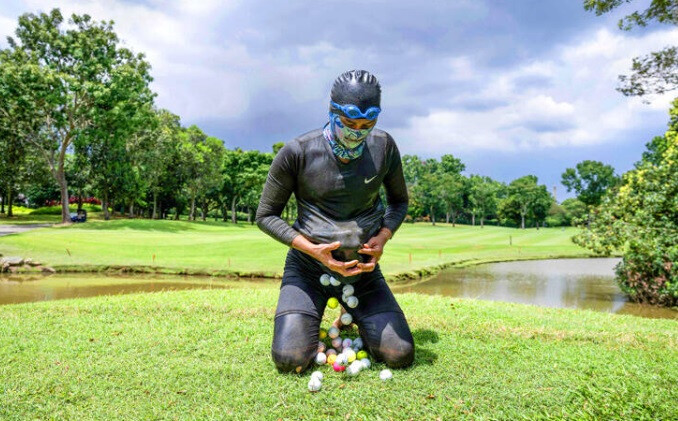
Shah Alam, Malaysia - Sumadi Ibrahim, a former Royal Malaysian Navy frogman, has traded the open sea for the serene, yet challenging, golf course ponds. After 22 years of defending his country’s waters, he now dives into these aquatic hazards to retrieve lost golf balls.

Sumadi's unique career path began when he retired from the navy in 2014. Instead of pursuing a traditional 9-to-5 job, he was drawn to the unconventional world of golf ball diving. Intrigued by the potential earnings and the opportunity to continue his underwater pursuits, he embarked on this unusual career.

Every night, under the cover of darkness, Sumadi dons a floral balaclava and plunges into the murky depths of the golf course ponds. Armed with nothing but his skill and the moonlight, he searches for lost golf balls. His years of experience as a navy frogman have honed his underwater abilities, allowing him to navigate the murky waters with ease.

To maximize his efficiency, Sumadi has hired a part-time assistant to keep watch and provide support. This collaborative approach ensures his safety and allows him to focus on the task at hand.

Once retrieved, the golf balls are carefully cleaned and sorted. Sumadi then sells them to golfers at a fraction of the cost of new balls. This not only provides a sustainable income for him but also offers an environmentally friendly option for golfers.

While Sumadi's work may seem unconventional, it has a positive impact on the environment. By recovering thousands of plastic and rubber golf balls from the water bodies, he helps to reduce pollution and preserve the ecosystem.

Despite the challenges and risks associated with his job, Sumadi remains passionate about his unique profession. He treats the golf course as his own domain, diving into the ponds with the same dedication and skill he once exhibited as a navy frogman.

As long as he is physically able, Sumadi plans to continue diving for golf balls, making a living while contributing to a cleaner environment.

[Copyright (c) Global Economic Times. All Rights Reserved.]

  • #globaleconomictimes
  • #koyongchul
  • #cherrylee
  • #seoulkorea
  • #periodicoeconomico
  • #글로벌이코노믹타임즈
  • #GET
  • #GETtv
  • #liderdel
Eugenio Rodolfo Sanabria Reporter

Popular articles

  • Japan Seizes Chinese Fishing Vessel off Nagasaki for the First Time in 4 Years

  • Florida Legislature Passes Bill to Rename Palm Beach Airport After Donald J. Trump

  • The Secret Behind the 'Modern Kim Seon-dal': How Coway Became Malaysia’s National Brand

I like it
Share
  • Facebook
  • X
  • Kakaotalk
  • LINE
  • BAND
  • NAVER
  • https://globaleconomictimes.kr/article/1065566497836068 Copy URL copied.
Comments >

Comments 0

Weekly Hot Issue

  • The Death of the Architect's Draft? New AI Engine 'Nano Banana 2' Turns Rough Sketches into Professional 3D Walk-throughs
  • President Lee Celebrates Milestone for ‘The Man Living with the King,’ Pledges to Bolster Cultural Pride
  • Namyangju Targets Gwacheon Racecourse Relocation: A Vision for a "Blue-Green" Mega-Complex Linked to GTX and 3rd Generation New Towns
  • Korean Air Extends Suspension of Incheon–Dubai Route Through March 15 Amid Ongoing Disruptions
  • Genetic 'Molecular Mirror': Blood Tests Challenge Biopsy Limits in Ovarian Cancer Diagnosis
  • Samsung to Revolutionize Health Tracking: Galaxy Watch to Adopt Contact-Based Temperature Sensors for Enhanced Precision

Most Viewed

1
Adwa’s Echo in Korea: A Shared Story of Dignity and Freedom
2
2026, The Grand Year of Hangeul Celebration — The River of History Where Five Streams Converge
3
A New Milestone for Ukraine’s Post-War Reconstruction: The Birth of ISVP
4
Mexican currency and the powerful history behind its designs
5
Revised and Expanded Edition of ‘Failure of Negotiations with North Korea: Truth and Solutions’ Published
광고문의
임시1
임시3
임시2

Hot Issue

The $100 Oil Threshold: Wall Street Braces for a Paradigm Shift as Middle East Conflict Drags On

The Death of the Architect's Draft? New AI Engine 'Nano Banana 2' Turns Rough Sketches into Professional 3D Walk-throughs

Oppo Bridges the Great Divide: Find X9 to Support AirDrop Connectivity

China’s Strategic Gold Rush: Beijing Amasses Reserves for 16th Straight Month Amid Dollar Uncertainty

Let’s recycle the old blankets in Jeju Island’s closet instead of incinerating them.

Global Economic Times
korocamia@naver.com
CEO : LEE YEON-SIL
Publisher : KO YONG-CHUL
Registration number : Seoul, A55681
Registration Date : 2024-10-24
Youth Protection Manager: KO YONG-CHUL
Singapore Headquarters
5A Woodlands Road #11-34 The Tennery. S'677728
Korean Branch
Phone : +82(0)10 4724 5264
#304, 6 Nonhyeon-ro 111-gil, Gangnam-gu, Seoul
Copyright © Global Economic Times All Rights Reserved
  • 에이펙2025
  • APEC2025가이드북TV
  • 독도는우리땅
Search
Category
  • All articles
  • Synthesis
  • World
  • Business
  • Industry
  • ICT
  • Distribution Economy
  • Well+Being
  • Travel
  • Eco-News
  • Education
  • Korean Wave News
  • Opinion
  • Arts&Culture
  • Sports
  • People & Life 
    • 전체
    • International Student Report
    • With Ambassador
  • Column 
    • 전체
    • Cho Kijo Column
    • Cherry Garden Story
    • Ko Yong-chul Column
    • Kim Seul-Ong Column
    • Lee Yeon-sil Column
  • Photo News
  • New Book Guide
  • Multicultural News
  • Jobs & Workers