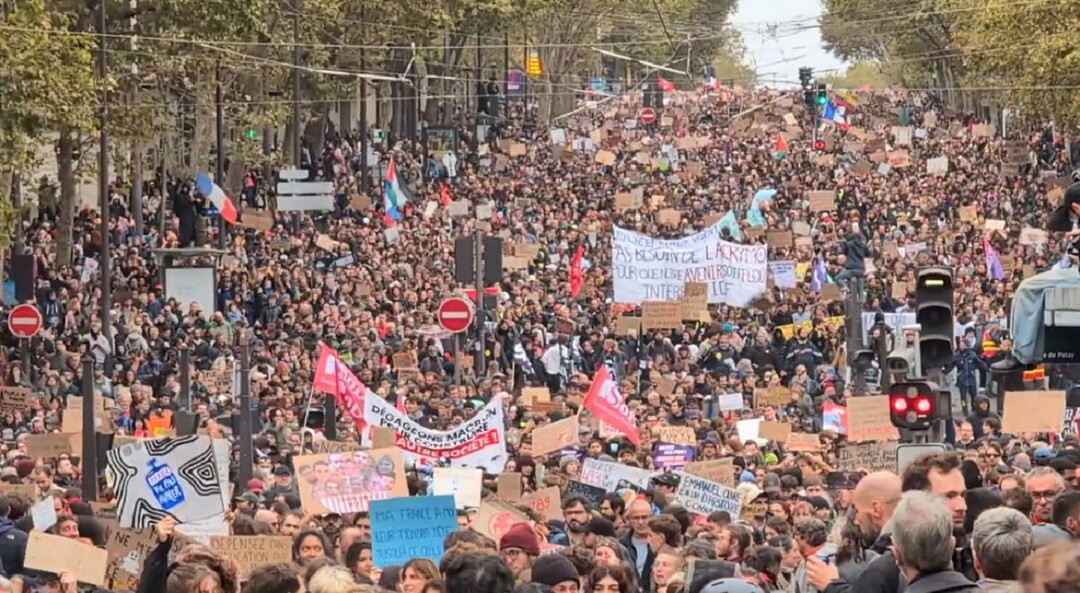
PARIS — While recent waves of looting in the French capital have largely subsided, tens of thousands of demonstrators continue to march through Paris each weekend. What began in mid-September as a localized high school protest over severe classroom overcrowding has snowballed into a months-long nationwide movement. Today, students, labor unions, and civic groups have united to demand wage increases and relief from persistent inflation, with demonstrations expected to continue through the holiday season.
To understand the scale of French civil unrest, international data offers a stark picture. According to 2025 figures from the Armed Conflict Location & Event Data Project (ACLED), France recorded 6,519 demonstrations—accounting for roughly a quarter of all 26,000 protests logged across 27 European nations. This figure easily surpasses neighbors like Spain (4,100), Italy (3,200), and Germany (2,800). Even when compared to global leaders in protest volume like India, France maintains a higher rate of demonstrations per capita. Labor statistics further highlight this trend: France loses an average of 127 workdays per 1,000 employees annually due to strikes, nearly ten times Germany's rate of 17 days.
Historical Roots and Fragmented Unions
France’s tolerance for street politics is deeply ingrained in its national identity. From the 1789 Revolution to the May 1968 civil unrest that dissolved parliament, and the 1986 student strikes that successfully halted university reforms, public mobilization is widely viewed across generations as an essential democratic right.
However, modern structural factors play an equally critical role in prolonging these disputes. Unlike countries with centralized labor movements, France’s union landscape is heavily fragmented across students, teachers, and administrators. Because no single union holds an absolute majority, the government cannot negotiate with one unified representative. Often, an agreement requires the consensus of all five major labor confederations; if even one remains dissatisfied, strikes persist. Furthermore, French marches typically lack a central stage or unified leadership—groups march independently and disperse, leaving authorities without a clear negotiating partner. Compounding the deadlock is the government's tight fiscal space. Unable to fund sweeping financial concessions, officials have offered incremental remedies that critics dismiss as mere "breadcrumbs," failing to appease the public.
Anatomy of Protest Violence
While French demonstrations often make global headlines for burning barricades and shattered storefronts, over 95% of participants are peaceful citizens engaging in debate, music, and orderly marches. Violence is driven by two distinct fringe elements:
Black Blocs: Accounting for roughly 500 individuals in a crowd of 100,000, these black-clad anarchists appear near the end of marches to clash directly with police. Rather than attempting to occupy government buildings, their primary objective appears to be resisting state authority itself.
Casseurs (Looters): Operating in the chaos sparked by police clashes, these opportunistic groups smash windows and loot stores. Law enforcement notes that casseurs are not strictly political; similar looting occurs during major sporting celebrations. Although suspects coordinate via small group chats, authorities have found no evidence of a broader centralized organization. Light judicial penalties—with many arrested suspects released after claiming they merely picked up abandoned items—further complicate deterrence.
Looking Ahead
With a presidential election slated for next spring, France is entering a period of heightened political sensitivity, which historically fuels further street mobilization. Yet, following the shock of last month's widespread property damage, the deployment of military personnel to safeguard public order has tempered the unrest. For the immediate future, France's deeply rooted culture of protest is expected to persist, albeit in a more restrained form.
[Copyright (c) Global Economic Times. All Rights Reserved.]