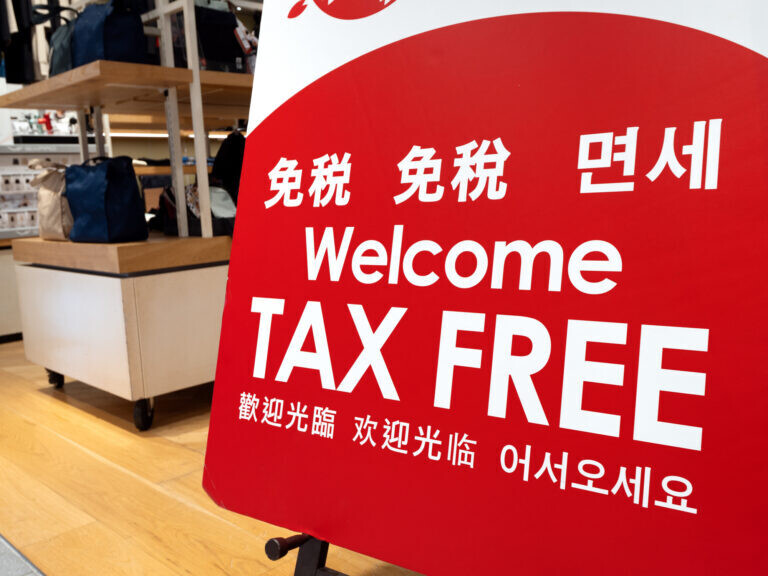
SEOUL — Recent changes to tourist tax-refund systems in neighboring Asian destinations are reshaping how travelers shop abroad. While Japan has moved away from instant at-the-register discounts to combat illegal resale, South Korea continues to streamline its duty-free process, allowing foreign visitors to receive immediate tax deductions at checkout.
Japan Overhauls Duty-Free System After 74 Years
Under a policy change implemented on the first of this month, travelers visiting Japan must now pay the standard consumption tax upfront at the register and claim a refund upon departure after customs verifies that the goods are leaving the country.
Previously, tourists could present their passports at checkout and pay a tax-exclusive price. Under the new "refund model," shoppers pay the full tax-included price—for example, paying 11,000 yen for a 10,000-yen item, with 1,000 yen in consumption tax.
To secure a refund, departing travelers must clear baggage checks and customs at airports or ports. Using dedicated terminals, visitors scan the passport used during purchase to verify their items against purchase logs. Once verified, refunds are issued through the merchant or a designated refund provider via bank transfer, credit card, app remittance, or airport cash desks.
The core purchase thresholds remain unchanged: shoppers must spend at least 5,000 yen (excluding tax) at the same store on the same day. Refunds must be claimed within 90 days of purchase. Because verification is conducted on a receipt-by-receipt basis, missing even a single item listed on a receipt invalidates the entire receipt’s refund eligibility. Consumed food items or opened cosmetics are automatically excluded.
Japan eliminated several legacy regulations as part of the overhaul, including the rigid distinction between general goods and consumables, the 500,000-yen cap on consumable purchases, and special packaging mandates. The primary driver behind the shift is curbing illegal domestic resale of duty-free items.
However, industry observers warn that the new procedures introduce airport congestion, potential refund omissions, and added stress for travelers. Facing complex exit-day procedures, some tourists are choosing to forgo tax refunds altogether.
South Korea Offers Seamless, Immediate Deductions
In contrast, South Korea continues to prioritize convenience for foreign visitors. Tourists—including Japanese nationals—need only present their passports at checkout to receive an immediate deduction on eligible purchases.
For instance, a Japanese visitor purchasing 110,000 won worth of cosmetics at a participating store receives an instant deduction of the tax amount at the register, provided they meet qualification and limit criteria.
The system applies to single purchases ranging from 15,000 won to under 1 million won (inclusive of tax), with a cumulative purchase ceiling of 5 million won for instant refunds per trip. The 5 million won cap refers to the total value of eligible items rather than the refunded tax amount.
This immediate refund service is available at approximately 23,000 designated tax-free retail locations across the country, including major department stores and cosmetics shops. Eligible participants must be foreign visitors residing in South Korea for less than six months and must export purchased goods within three months without using them domestically.
Because South Korea’s value-added tax (VAT) is structured as 10% on pre-tax prices (meaning a 100,000-won pre-tax item costs 110,000 won total), the actual tax component is 10,000 won. After deducting processing fees, actual refunds typically range between 5% and 8% of the purchase value.
For purchases exceeding 1 million won, visitors can utilize post-departure refund channels at ports and airports, which have no upper spending limit. City refund counters also handle single purchases up to 6 million won under specific collateral requirements.
Expanding Access and Departure Cost Differences
South Korea has steadily lowered barriers for shopping tourists. In 2024, the government doubled the single-purchase instant refund limit from under 500,000 won to under 1 million won, and raised the cumulative stay limit from 2.5 million won to 5 million won. In April, cruise passengers were also granted access to instant and city-center refund systems through integrated customs and manifest databases.
Travelers face distinct departure expenses as well. South Korea levies a 7,000-won departure tax on air travelers, whereas Japan’s international tourist tax amounts to approximately 25,000 won (3,000 yen). Both fees apply equally to citizens and foreign visitors, separate from standard airport usage fees.
Meanwhile, visitor volume between the two countries remains asymmetric. According to data from the Japan National Tourism Organization (JNTO) and South Korean tourism authorities, 8,262,700 South Koreans visited Japan between January and September of this year, compared to approximately 3.12 million Japanese visitors to South Korea—making outbound travel from South Korea to Japan 2.65 times higher.
[Copyright (c) Global Economic Times. All Rights Reserved.]