SEOUL — As soaring electricity demand from artificial intelligence (AI), data centers, and semiconductor manufacturing collides with ongoing global energy supply disruptions, South Korea must double down on electrification and domestic low-carbon power generation to safeguard its energy security, according to a new report by the International Energy Agency (IEA).
In its World Energy Outlook 2026, released on November 19, the Paris-based agency warned that the 2026 energy transit crisis in the Strait of Hormuz has triggered the most severe supply shock since the 1970s oil crises. With roughly 80% of oil and 90% of liquefied natural gas (LNG) passing through the strait bound for Asia, cumulative losses of 2.8 billion barrels of oil and 60 billion cubic meters of natural gas through November have sent global diesel prices past $200 a barrel, placing acute pressure on major energy importers like South Korea and Japan.
To break away from structural reliance on imported fossil fuels, the IEA outlined a dual-track strategy for South Korea: aggressively electrifying the transport, industrial, and building sectors while scaling up domestic nuclear and renewable power.
Reshaping the 2040 Power Mix
Under the IEA’s Stated Policies Scenario (STEPS), South Korea’s power generation landscape is projected to undergo a significant transformation over the next decade and a half:
Nuclear Stability: Nuclear output is forecast to grow from roughly 185 terawatt-hours (TWh) today to more than 230 TWh by 2040, consistently accounting for about 30% of the nation's total electricity supply.
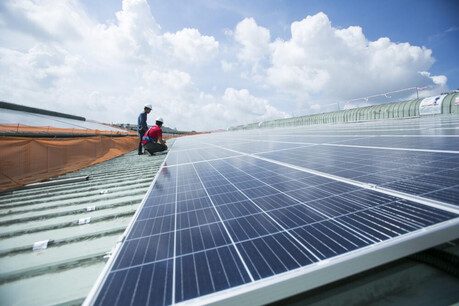
Renewable Surge: Incorporating Seoul’s May 2026 renewable roadmap—which targets 100 gigawatts (GW) of renewable capacity by 2030 and a minimum 30% generation share by 2035—wind power is expected to jump dramatically from under 5 TWh to over 130 TWh by 2040, complementing rapid solar expansion.
Shifting Role of Natural Gas: Gas-fired generation is projected to drop from around 175 TWh to below 120 TWh by 2040. Rather than serving as a primary baseload provider, LNG-based power plants will increasingly act as grid-balancing assets to offset the intermittency of solar and wind power.
Meanwhile, rapid adoption of electric and hydrogen vehicles—backed by Seoul's goal to have zero-emission models make up 50% of new car sales by 2030—is expected to triple transport electricity demand across South Korea and Japan by 2035. Consequently, electricity is projected to represent over 40% of final energy consumption in both countries by 2040, rising above 45% if governments enact stronger policy interventions under the agency's Additional Response Case (ARC).
Grid Bottlenecks and Supply Chain Risks
Despite strong momentum in clean energy deployment—including a twofold surge in South Korean EV sales following the 2026 Middle East shock—the IEA cautioned that generation capacity alone will not guarantee energy security.
The agency stressed that South Korea must urgently expand high-voltage transmission networks to connect upcoming offshore wind farms with major industrial hubs and power-hungry data centers. Scaling up utility-scale battery energy storage systems (ESS), pumped-hydro storage, and demand-response programs will also be critical to maintaining grid frequency and stability.
Furthermore, the report noted that transitioning away from imported fossil fuels carries new risks if supply chains for critical minerals, batteries, and grid equipment remain overly concentrated. The IEA advised policymakers to pair infrastructure investments with resilient equipment sourcing, robust grid cybersecurity, and careful management of electricity rates to shield consumers from the upfront costs of the energy transition.
[Copyright (c) Global Economic Times. All Rights Reserved.]