![[등록] 2026-09-01 15:48:31](/support/_updata/banner2/tl181982910_6749.png)


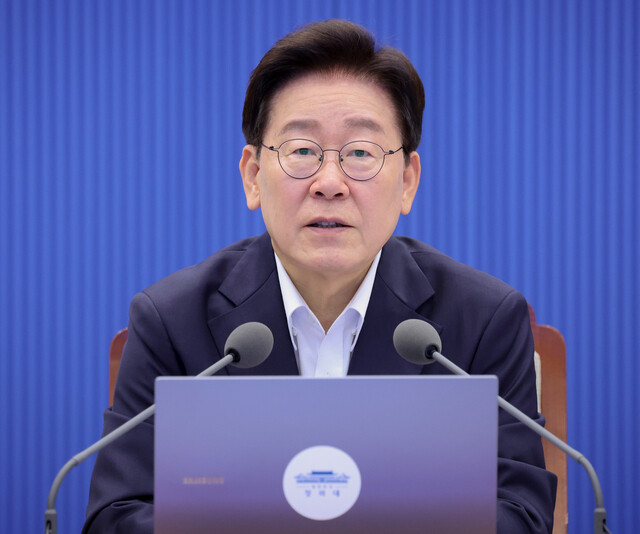
SEOUL — President Lee Jae-myung declared on Thursday that the government must be ready to modify any policy without "sacred cows" if it fails to deliver tangible benefits or causes harm to the public, signaling a pragmatic pivot in state management from long-term planning to rapid execution.
Speaking during the opening remarks of the 42nd Senior Presidential Secretaries' Meeting held at the Yeomin-gwan office in the Blue House on the afternoon of August 6, President Lee stressed the urgency of action as the government enters its next phase.
"Even policies initiated with good intentions are worse than doing nothing if citizens cannot feel their effects or if they end up harming people’s lives. With approximately 1,400 days remaining in our term, swift execution matters far more than grandiose blueprints."
— President Lee Jae-myung
"If problems are identified, we need flexible and proactive administration to correct anything without sanctuary," Lee instructed, calling for a flexible, pragmatism-first approach across all ministries.
Senior Presidential Press Secretary Kang Yu-jung clarified in a subsequent briefing that the President’s statement was not aimed at specific controversial issues such as criminal procedure reforms or real estate policies. Rather, it represents an overarching governance principle: while policies must be driven with momentum, public benefit remains the ultimate benchmark, and course corrections will be made whenever necessary.
Judiciary Issues & Real Estate Agenda
The presidential office also addressed sensitive judicial and housing matters. Spokesperson Kang dismissed rumors suggesting the Blue House supported the impeachment of Chief Justice Jo Hee-de, stating, "It is entirely untrue." Regarding delays in appointing Supreme Court justices, Kang emphasized that appointments must proceed swiftly according to statutory procedures.
Attention is also turning to housing supply strategies. Ahead of the scheduled "2nd Real Estate Review Follow-up Meeting," Kang noted that objections raised by Seoul Mayor Oh Se-hoon regarding the use of Yongsan Park and greenbelt zones had not been discussed internally, but affirmed that multifaceted plans to accelerate housing delivery would be closely reviewed.
Youth Welfare, Misinformation, and Climate Emergency
Addressing youth affairs, President Lee labeled young adults as an increasingly "vulnerable class" in the current economic landscape. He ordered a comprehensive redesign of youth support programs, consolidating fragmented ministerial schemes into life-cycle-centered services and suggesting an AI-powered online notification system to proactively match citizens with applicable benefits.
On public information integrity, the President mandated a strict response against misinformation. "Information serving as the basis for public judgment must be accurate and objective," Lee noted, directing departments to actively correct malicious or erroneous reports locally and internationally.
Regarding a recent proposal on improving social media environments for teenagers, Lee urged caution. Citing the need for consistency with other social thresholds such as voting rights and marriage eligibility, he called for deeper deliberation among stakeholders before imposing regulatory limits.
On economic policy, caution was expressed regarding universal support policies aimed at reducing wealth disparity. President Lee instructed officials to avoid administrative convenience, emphasizing that such measures require sensitive and nuanced handling.
Finally, President Lee designated the ongoing severe heatwave as a "national climate disaster." He ordered immediate administrative resources deployed to safeguard high-risk populations and instructed that funding for climate infrastructure—such as cooling equipment in traditional market halls—be reflected in the 2027 national budget proposal.
[Copyright (c) Global Economic Times. All Rights Reserved.]