![[등록] 2026-09-01 15:48:31](/support/_updata/banner2/tl181982910_6749.png)


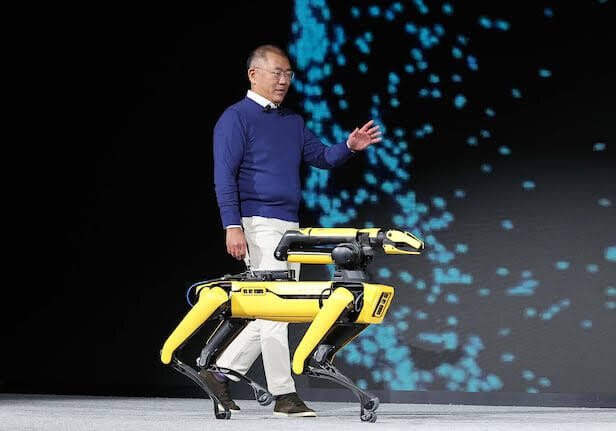
SEOUL — Marking his 6th anniversary as Chairman of Hyundai Motor Group, Euisun Chung has successfully expanded the group's business footprint far beyond traditional automobiles into the realms of robotics and artificial intelligence (AI). Building upon solid global market foundations driven by electrification and the Genesis luxury brand, the group is now accelerating investments in autonomous driving and robotics.
With future technologies swiftly transitioning from concepts to real-world applications in vehicles and manufacturing sites, Hyundai's strategic vision to transform from a conventional automaker into a comprehensive "mobility solution provider" is rapidly taking concrete shape.
According to the automotive industry on the 7th, Chairman Chung has spent the past six years simultaneously bolstering the competitiveness of the core automotive sector—through electrification and premium branding—while scaling up strategic investments in future technologies like Software-Defined Vehicles (SDVs), autonomous driving, and robotics.
Most recently, the group has accelerated its structural transformation by introducing "Physical AI"—the convergence of automotive manufacturing prowess with AI and robotics—as its new growth engine.
Strengthening Core Automotive Competitiveness: Electrification and Premium Brands
Within the automotive sector, electrification and premiumization have cemented themselves as the twin pillars of competitive strength. Hyundai Motor Group has expanded its EV lineup using the dedicated E-GMP platform, rolling out the Ioniq and EV series. In response to recent growth slowdowns in global EV demand, the group is aggressively diversifying its electrification strategy by increasing hybrid sales and pursuing the introduction of Extended Range Electric Vehicles (EREVs).
Concurrently, Genesis has successfully established its presence as a global luxury brand. Following the strong sales footing secured by models like the G80 and GV80 in domestic and U.S. markets, the brand is expanding its boundaries through the high-performance "Magna" lineup and entry into motorsports.
Boston Dynamics and the Rise of 'Physical AI'
While electrification and premiumization represent the pillars of current competitiveness, robotics vividly embodies Chairman Chung's vision for the group's future business structure.
In 2021, just a year after Chung took office, Hyundai acquired the U.S. robotics firm Boston Dynamics. While the massive investment in a robotics company raised eyebrows at a time when its direct synergy with automobiles wasn't immediately obvious, Boston Dynamics has since evolved into a core anchor of Hyundai's Physical AI strategy.
At the center of this transformation is the humanoid robot, Atlas. At CES 2026 in Las Vegas, Hyundai Motor Group unveiled the next-generation electric Atlas and announced plans to deploy it sequentially across actual automobile manufacturing plants. The company is currently conducting work-training simulations using real automotive parts at the Hyundai Motor Group Metaplant America (HMGMA) in Georgia, USA.
The roadmap is clear: Hyundai plans to deploy Atlas for parts-sequencing tasks at HMGMA by 2028, expanding its role to more complex assembly processes by 2030. To support this, the group is establishing a dedicated robot production system in the U.S. with an annual capacity of 30,000 units.
The overarching design is to utilize automobile plants simultaneously as testing grounds and learning spaces for robots, feeding real-world workplace data back into performance enhancements in a continuous virtuous cycle.
This aligns seamlessly with Chairman Chung’s emphasis on "Physical AI." By integrating the production technologies and data accumulated throughout vehicle manufacturing into AI and robots, Hyundai aims to cultivate advanced technologies capable of perceiving, judging, and acting in physical spaces. The strategy leverages the manufacturing capabilities of Hyundai and Kia, the component technology of Hyundai Mobis, and the logistics infrastructure of Hyundai Glovis to create expansive business opportunities across the entire group.
Accelerating SDVs and Autonomous Driving
Parallel advancements are underway in vehicle software transformation. Hyundai Motor Group is actively building its SDV architecture centered around the mobility software brand "Pleos." Alongside the development of 42dot's AI-driven autonomous driving technology, "Atria AI," the group is accelerating the commercialization of autonomous driving through initiatives like Motional's Ioniq 5 robotaxi and strategic collaborations with Waymo.
The Road Ahead: Turning Future Tech into Tangible Profits
Ultimately, the transformation driven by Chairman Chung over the past six years transcends merely nurturing cars, robots, and AI as isolated new businesses. The core focus lies in creating an interconnected ecosystem: bridging the technology and production capabilities secured through vehicle manufacturing with autonomous driving and robotics, and subsequently channeling the data and insights gained from those fields back into enhancing factory efficiency and vehicle competitiveness.
However, translating these future technologies into concrete, sustainable profitability remains the primary next challenge for the Chung administration.
An industry insider noted, "While Chairman Chung has successfully elevated the competitiveness of the core automotive business and laid the groundwork for future ventures like robotics and AI over the past six years, the critical task ahead is translating these achievements into tangible, bottom-line profitability."
[Copyright (c) Global Economic Times. All Rights Reserved.]