![[등록] 2026-09-01 15:48:31](/support/_updata/banner2/tl181982910_6749.png)


SEOUL — Amid ongoing debates over expanding non-face-to-face (telehealth) medical services to enhance healthcare accessibility for vulnerable populations, a recent pharmacist survey and field investigation have shed light on a starkly different reality: a system heavily skewed toward commercial convenience, young demographics, and non-reimbursable lifestyle drugs.
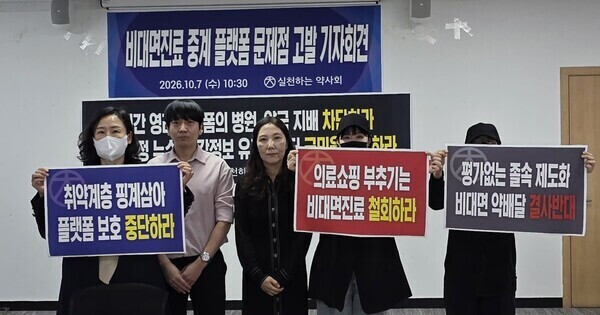
On October 7, the Action Pharmacists Alliance (hereafter "Practical Pharmacists") held a press conference at the Seoul Metropolitan Pharmacists Association Hall to release the results of a nationwide survey conducted among 3,170 pharmacists regarding telehealth and medicine delivery policies, alongside findings from their own investigations into telehealth platform operations.
"The problems exposed during the telehealth pilot project have remained unaddressed for years," said Vice President Hwang Eun-kyung. "We must not push for institutionalization and the expansion of medicine delivery without adequate evaluation and safety safeguards."
Hwang emphasized that although Practical Pharmacists investigated telehealth platforms back in 2023 and raised issues concerning patient identity verification, identical vulnerabilities remain rampant three years later. Notably, these findings are backed not merely by anecdotes, but by active verification: when suspicious cases were reported through their channels, representatives personally used telehealth platforms to test whether problematic prescriptions could actually be secured.
"The Vulnerable Were Nowhere to Be Found": Dominated by 2030s and Non-Reimbursable Drugs
Presenting the survey results, Pharmacist Kim Tae-soo asked, "Who on earth is telehealth for right now?"
He pointed out that contrary to the government's initial justification of improving accessibility for medical and healthcare-vulnerable populations, current telehealth has rapidly morphed into a structure where users "shop" for medical care and medications via private platforms.
Out of 3,170 participating community and employed pharmacists, approximately 90% had experience dispensing telehealth prescriptions. However, 73% of pharmacies handled fewer than 10 telehealth prescriptions per month, indicating that prescriptions are heavily concentrated in specific platform-affiliated pharmacies rather than distributed evenly.
Furthermore, utilization by the elderly and high-vulnerability groups was negligible. Instead, individuals in their 20s and 30s accounted for roughly 97% of users—demographics heavily adept at app usage. Prescriptions were overwhelmingly concentrated in lifestyle categories such as hair loss, dermatology, cosmetics, artificial tears, and diet medications.
"Vulnerable groups were invisible, and non-reimbursable treatments took center stage," Kim noted. "A structure has been created where patients pick medications and prices first, and only afterward choose a medical institution and pharmacy."
Key Issues Uncovered in the Field Investigation
-60-Day Diabetes Prescriptions Without Blood Glucose Tests A 26-year-old patient who suspected themselves of having diabetes due to fatigue requested a first-time telehealth consultation. Without a single blood glucose test, a 60-day supply of blood-sugar-regulating medication was prescribed. Practical Pharmacists stressed that chronic conditions like diabetes, hypertension, and hyperlipidemia require objective diagnostic tests, not patient self-diagnosis. Similar shortcuts were found with initial high blood pressure prescriptions issued without any blood pressure measurements.
-Diet Injections: 12 Pens Acquired in Two Days Without Duplicate Warnings Investigating weight-loss injectables, organizers found that a single patient used two different telehealth platforms over two days to successfully prescribe and purchase a total of 12 pens. Cross-platform or cross-institution duplicate warnings failed to trigger. Furthermore, despite Ministry of Health and Welfare guidelines prohibiting the over-the-counter or remote sale of self-injectables in original packaging for home delivery, the practice continued unchecked.
-Hair Loss Drugs: 630-Day Stockpiling and "Loophole" Insurance Claims A single patient used telehealth platforms across seven different medical institutions in one day, securing a 90-day supply of hair-loss medication from each for a total of 630 days' worth. In another disturbing case, a 30-year-old patient requested their hair-loss medication (finasteride) to be falsely prescribed under a prostate condition diagnosis to secure health insurance coverage and lower out-of-pocket costs—revealing how telehealth can facilitate insurance fraud and fiscal drain on the National Health Insurance service.
-Flawed Identity Verification: Family ID Misuse in 13 Seconds Investigators confirmed that a spouse successfully registered using a partner's resident registration number and secured a telehealth prescription. The communication with medical staff lasted a mere 13 seconds, with zero phone authentication or identity verification steps.
Pharmacists Sound the Alarm on Medication Delivery Expansion
With 99.9% of surveyed pharmacists opposing the expansion of direct-to-consumer medicine delivery, Practical Pharmacists warned that bundling telehealth with courier delivery would only compound risks like drug abuse, personal data centralization, and platform monopolies.
The alliance urges the government to halt fast-tracked legislation until comprehensive evaluations of the pilot project are released, insisting that reforms must prioritize patient safety, medical public interest, and true care for the vulnerable over private platform expansion.
[Copyright (c) Global Economic Times. All Rights Reserved.]