In an effort to ease traffic congestion along Cheomseong-ro—a core tourist axis spanning the Eastern Historic Sites District and the Hwangridan-gil area—the City of Gyeongju plans to abolish on-street parking lots and introduce a circulating bus system. However, nearby merchants and residents are strongly pushing back, citing threats to the local commercial district and a lack of effective alternatives, while calling for viable measures.
On the 27th, Gyeongju City held a "Resident Information Session on the Cheomseong-ro On-Street Parking Lot Redevelopment and Traffic Environment Improvement Project" at the Hwangnam-dong Community Center, with some 30 local residents and government officials in attendance.
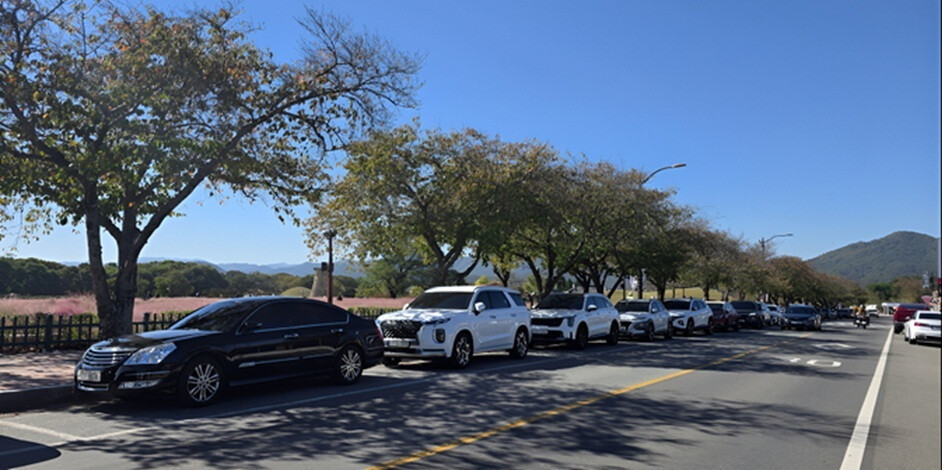
The project targets a 1.2-kilometer section stretching from Seondeok Intersection to the former Hwangnam Elementary School Intersection. This road has long faced criticism: traffic congestion peaks every weekend due to vehicles waiting to find parking spaces, and cars parked along the roadsides obstruct views of Gyerim Forest and Cheomseongdae Observatory, giving tourists a cramped impression.
To address this, the city plans to completely eliminate 120 on-street parking spaces currently spanning 2 meters in width, while expanding the existing 3-meter pedestrian walkway to 5 meters to improve walking conditions. As an alternative to the parking lot removal, the city intends to utilize the large-scale Hwangridan-gil Public Parking Lot—a facility boasting 894 spaces built at a cost of 18 billion won in the Sajeong-dong area (Lot 428), which was completed last January.
Additionally, to ensure a smooth influx of visitors from the public parking lot to major tourist attractions, the city plans to establish new urban circulation bus routes (Woljeong No. 2) and historic site circulation routes (Woljeong No. 3). Notably, electric low-floor double-decker buses are scheduled to be deployed on the historic site circulation route starting in March 2027.
Through these measures, the city aims to break away from blocked views, secure open scenery with a refreshing atmosphere, and shift Gyeongju’s tourism paradigm from vehicle-centric transit to pedestrian-centric, stay-oriented tourism.
However, some residents attending the briefing raised strong objections to the city's plan. They argued that immediately removing the parking lots would not only cause severe parking inconveniences but also deal a direct blow to the livelihoods of local business owners.
"Even though a large parking lot was built in Hwangridan-gil, traffic congestion around Cheomseong-ro remains severe," a resident at the meeting said, raising their voice. "If the on-street parking lots are unilaterally removed, nearby merchants will inevitably suffer an immediate blow to their livelihoods. Urgent, realistic countermeasures are needed, such as designating the area as one-way traffic or separately creating a new public parking lot near Cheomseong-ro."
The plan to introduce new circulating buses also came under fire. Another resident pointed out, "While the intention of introducing double-decker buses is good, entrusting new routes entirely to city bus companies that already receive massive annual subsidies is a textbook example of wasting taxpayer money."
In response, an official from Gyeongju City stated, "This improvement project is an essential process to transform Gyeongju’s tourism paradigm—clearing blocked scenery into open views and shifting from vehicle-focused transit to walking- and experience-centered stay tourism. We will comprehensively review the concerns and suggestions raised by residents during the briefing to prepare reasonable supplementary measures that minimize parking inconveniences and commercial shrinkage."
[Copyright (c) Global Economic Times. All Rights Reserved.]