![[등록] 2026-09-01 15:48:31](/support/_updata/banner2/tl181982910_6749.png)


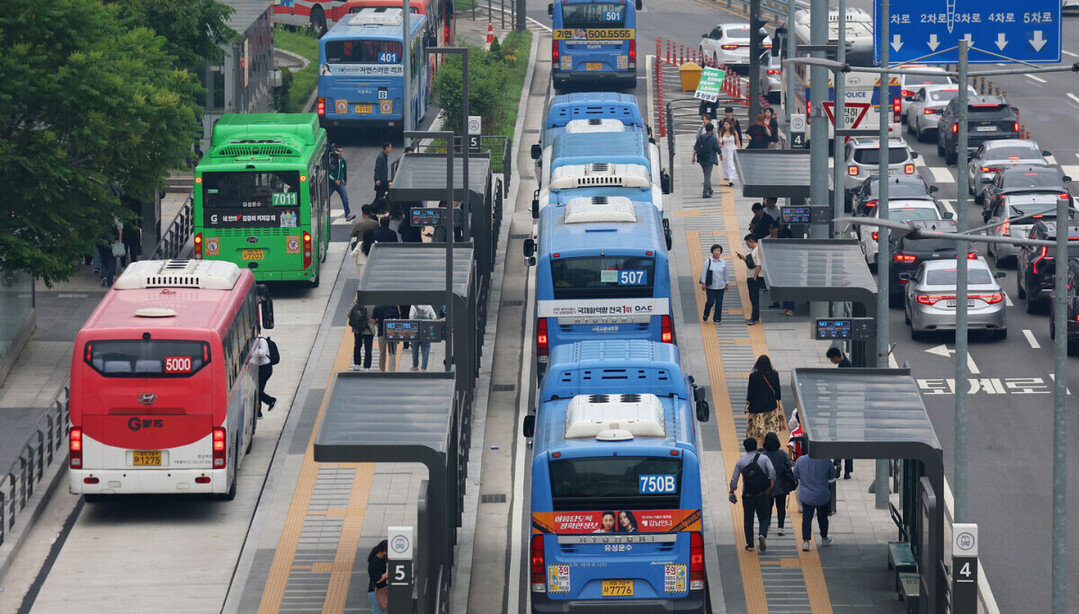
The Seoul city bus labor and management dramatically reached a final agreement in the early hours of the 16th, averting a major public transportation disruption. As a result, all Seoul city buses are operating normally without any strikes.
According to the Seoul City Bus Labor Union and the Seoul City Bus Transport Association, the two sides reached a consensus after prolonged negotiations during the second adjustment meeting held at the Seoul Regional Labor Relations Commission starting at 2:00 PM the previous day. The agreement was finalized after approximately 12 hours of intense discussions.
Under the new agreement, both sides agreed to a 3.2% wage increase for this year. However, the core contentious issue regarding the standard calculation hours for ordinary wages was left unresolved and postponed for future discussions.
Around 10:00 PM the previous day, Park Jeom-gon, the head of the Seoul City Bus Labor Union, and other union negotiators briefly walked out of the meeting, raising concerns that negotiations had broken down. Fortunately, a remaining union representative continued the talks, and Chairman Park returned to the negotiation table around 1:00 AM on the 16th, leading to a last-minute breakthrough.
Although the strike was successfully averted, embers of the labor conflict still remain because the two sides failed to completely resolve the ordinary wage issue. The dispute stemmed from how to calculate ordinary wages reflecting regular bonuses, following the Supreme Court's full bench ruling in December 2024.
The core point of contention is the standard number of hours used to calculate the hourly ordinary wage. The hourly wage is derived by dividing the monthly ordinary wage by these standard hours. Naturally, a shorter standard hour benefits workers by increasing their hourly rate.
The union argued that based on the Supreme Court's ruling on the Dong-A Transport lawsuit in April, the standard hours should be fixed at 176 hours. On the other hand, the management association insisted on applying 209 hours to restructure the wage system first, and then retroactively readjust it based on future lawsuit outcomes. Due to this significant gap, both sides decided to continue discussions while monitoring ongoing legal proceedings related to ordinary wages in Seoul city buses.
Kim Jeong-hwan, chairman of the Seoul City Bus Transport Association, stated, "We tried our best to resolve the ordinary wage issue, but failed to reach a consensus. This issue will continue to be a heavy burden for both management and labor."
Park Jeom-gon, head of the union, remarked, "Although we are not entirely satisfied, I am glad that things were settled smoothly. The ordinary wage issue will now be judged in accordance with the law."
Following the agreement, the Seoul Metropolitan Government lifted its emergency transportation countermeasures prepared in advance for the potential strike. Public transportation continues to operate as usual. Supplemental measures such as municipal and district shuttle buses were not deployed, and extended subway operations were cancelled.
Supplemental Background and Context on the Dispute
To better understand the backdrop of this negotiation, it is helpful to look at the broader context of South Korea's public transit labor disputes and the legal complexities surrounding ordinary wages.
In recent years, South Korean labor laws have seen major shifts regarding what constitutes "ordinary wages" (tongsang imgeum). Regular bonuses, which historically were sometimes excluded from base calculations for overtime and severance, have increasingly been factored in following landmark Supreme Court rulings. This has massive financial implications for labor-intensive industries like public transportation, where operating costs and labor overhead make up a significant portion of municipal budgets.
For commuters in the greater metropolitan area, including cities neighboring Seoul like Bucheon, Incheon, and satellite cities in Gyeonggi-do, a Seoul bus strike would have triggered severe gridlock and immense commuter hardship, forcing heavy reliance on the Seoul Metropolitan Subway lines. The dramatic pre-dawn resolution prevented what could have been a massive logistical crisis during the morning rush hour.
While the immediate threat of a strike has dissipated, transportation authorities note that structural debates over wage systems and labor costs in public transit will likely resurface in future bargaining cycles as the legal framework surrounding ordinary wages continues to evolve in South Korean courts.
[Copyright (c) Global Economic Times. All Rights Reserved.]