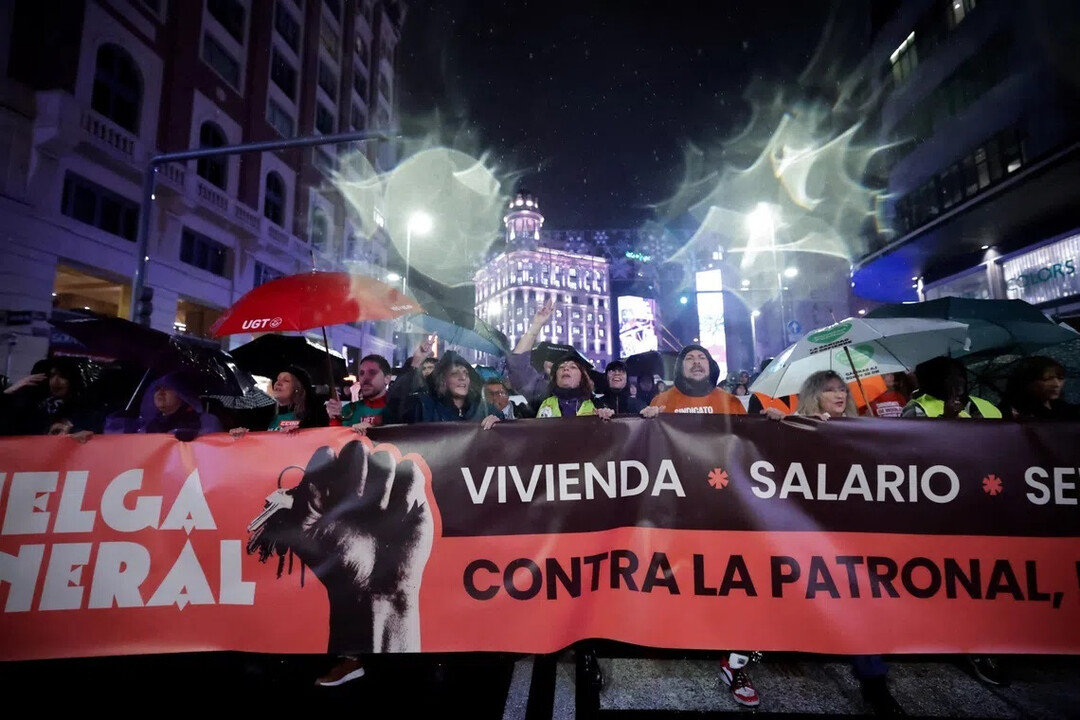
MADRID — Frustration over skyrocketing housing expenses boiled over across Spain this week as the nation faced its first general strike in 14 years. Propelled by severe affordability pressures, hundreds of thousands of citizens took to the streets to protest rents that consume a major portion of average wages, transforming a socio-economic grievance into a major political flashpoint ahead of the upcoming snap elections.
The nationwide mobilization, organized by Spain's leading labor confederations—Workers' Commissions (CC OO) and the General Union of Workers (UGT)—drew massive crowds, including an estimated 120,000 protesters in Madrid and over 50,000 in Barcelona. The labor action disrupted municipal public transit networks and government services. While peaceful demonstrations made up the majority of the protests, clashes broke out in Barcelona as groups of demonstrators vandalized storefronts and ignited street bins, prompting police responses involving crowd-control measures and arrests.
At the heart of the protests is an acute housing crunch. Recent real estate data indicates that the average monthly rent for a modest 50-square-meter apartment in Madrid climbed to 1,170 euros—approaching 50 percent of the national average monthly income of 2,460 euros. This far exceeds recommended financial guidelines stipulating that housing costs should remain below 30 percent of household earnings.
Public outrage intensified following the tragic death of an 87-year-old Madrid resident, Maricarmen Abascal, who passed away in a hospital weeks after being forced out of a home she had occupied for seven decades. The eviction occurred after an investment firm acquired the property and tripled the rent, catalyzing widespread outrage over urban gentrification and housing insecurity.
Uniquely, the movement originated outside traditional labor channels. It was initially spearheaded by grassroots tenants' rights organizations before being adopted by major labor unions, shifting the focus from standard wage-and-hour negotiations to a broader demand for guaranteed housing rights.
The strikes have rapidly become a central theme in the run-up to the national elections on the 29th. Prime Minister Pedro Sánchez publicly supported the demonstrators, framing the strike as a continuation of historical labor struggles for social protections. Meanwhile, conservative opposition leaders criticized the timing and nature of the protests, accusing political factions of leveraging social discontent for electoral gain, while business associations argued that housing affordability falls outside the scope of industrial labor relations.
Labor representatives countered that the widespread participation reflects deep-seated economic pressures, pointing to stagnant wage growth relative to inflation and an escalating number of labor disputes nationwide.
[Copyright (c) Global Economic Times. All Rights Reserved.]