• 2026.06.05 (Fri)
  • All articles
  • LOGIN
  • JOIN
Global Economic Times
fashionrunwayshow2026
  • Synthesis
  • World
  • Business
  • Industry
  • ICT
  • Distribution Economy
  • Well+Being
  • Travel
  • Eco-News
  • Education
  • Korean Wave News
  • Opinion
  • Arts&Culture
  • Sports
  • People & Life
    • International Student Report
    • With Ambassador
  • Column
    • Cho Kijo Column
    • Cherry Garden Story
    • Ko Yong-chul Column
    • Kim Seul-Ong Column
    • Lee Yeon-sil Column
  • Photo News
  • New Book Guide
MENU
 
Home > Synthesis

President Lee Asserts ‘Self-Reliant Defense’ as Crucial, Vows Swift Recovery of Operational Control

KO YONG-CHUL Reporter / Updated : 2026-03-27 20:59:09
  • -
  • +
  • Print
- "Relying excessively on U.S. alliance is unwise" despite its essential role in Peninsular peace. - President presides over first meeting of top military commanders; calls for transition to "Smart Armed Forces."


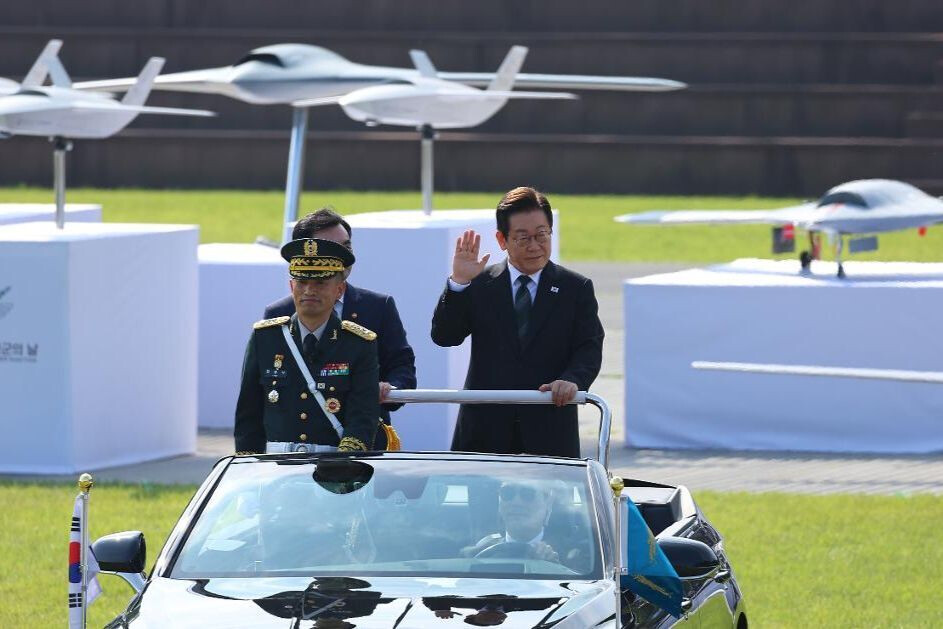
President Lee Jae-myung emphasized a "self-reliant defense" posture on Friday, signaling a strategic shift toward reclaiming wartime operational control (OPCON) and modernizing the nation’s military into a future-oriented force.

During his first presiding of the Major Commanders' Conference at the Ministry of National Defense in Seoul on March 27, President Lee underscored that while the South Korea-U.S. alliance remains a cornerstone of regional stability, the nation must reduce its "excessive dependence" on foreign military power.

The Path to Sovereignty: OPCON Transfer and Responsibility
"To respond to the rapidly shifting security environment, self-reliant defense is not an option, but a necessity," President Lee told the assembled top brass. "While the ironclad South Korea-U.S. alliance is a vital element for peace on the Korean Peninsula, excessive reliance is forbidden. The recovery of wartime operational control will be pursued expeditiously."

The President linked the timeline of the OPCON transfer directly to the military's own resolve. He urged commanders to possess the "responsibility and determination" to protect the nation's territory and citizens through their own strength under any circumstances, stating that such a mindset is exactly what will "accelerate the recovery of operational control."

Building a "Smart" and Modernized Military
Beyond structural sovereignty, the President focused on technical and personnel reforms to keep pace with modern warfare. He called for a transition to a "Smart Strong Military" to dominate future battlefields.

As a key pillar of this reform, President Lee mentioned the "selective conscription system," a policy aimed at refining the military's human resources and professionalizing the ranks. "As the Commander-in-Chief, I will build a stronger, more trusted military," he asserted, urging the Ministry of National Defense to speed up the pace of comprehensive defense reforms.

Monitoring Regional Crises and Defense Readiness
Following the policy address, President Lee received a comprehensive briefing from Defense Minister Ahn Kyu-back regarding current internal and external security conditions, including the volatile situation in the Middle East and surrounding regional dynamics.

According to Presidential Spokesperson Kang Yu-jung, the conference involved in-depth discussions on several critical defense agendas:

Strengthening the "K-3 Axis" system to counter nuclear and missile threats.
Protecting overseas citizens in conflict zones, specifically in the Middle East.
Maintaining stable military management in border areas.
Enhancing capabilities based on lessons learned from recent global conflicts.

A Symbolic Visit to the Command Center
After the formal session, President Lee visited the underground Command and Control Center to encourage personnel on duty. In a moment of high symbolic significance, the President met with Colonel Cho Seong-hyeon, the commander of the 1st Security Brigade of the Capital Defense Command.

Colonel Cho gained public recognition during the "December 3rd Insurrection" for his pivotal role in upholding constitutional order, famously ordering his troops "not to cross the Sogang Bridge" to prevent the escalation of the coup. The meeting was seen as a gesture of presidential support for officers who prioritize democratic principles and the chain of command.

[Copyright (c) Global Economic Times. All Rights Reserved.]
  • #Korea
  • #Seoul
  • #Hallyu
  • #USA
  • #Economy
  • #Busoness
  • #Global
  • #World
  • #Consumer
  • #Export
  • #Import
  • #Hanguel
  • #Travel
  • #Tour
  • #Food
KO YONG-CHUL Reporter
Reporter Page

Popular articles

  • BMW Korea Ignites May with Exclusive 9-Model Online Limited Edition Lineup

  • U.S. Intelligence: Iran’s Nuclear Capabilities Remain Intact Despite Two Months of Strikes

  • Kakao Hits Record Q1 Performance: Operating Profit Surges 66% as Focus Shifts to "Agentic AI"

I like it
Share
  • Facebook
  • X
  • Kakaotalk
  • LINE
  • BAND
  • NAVER
  • https://globaleconomictimes.kr/article/1065614190782783 Copy URL copied.
Comments >

Comments 0

Weekly Hot Issue

  • Samsung Electronics Super-Enterprise Union Loses Majority Status Amid Backlash Over Bonus Disparities
  • Samsung to Embed Vital Signs and Heart Health Scores in Upcoming Galaxy Watch9 Lineup
  • Apple Honors Digital Excellence: 12 Exceptional Apps and Games Celebrated at the 2026 Design Awards
  • Nexon Revamps Signature Youth Coding Competition into AI-Driven 'Nexon Young Programmers Cup'
  • Tech University of Korea Gathers 200 Game and AI Researchers to Discuss Industrial Expansion
  • Major Korean Telcos Trim Online-Exclusive Plans by Up to 50% Amid Shift to Unified Mobile Tariffs

Most Viewed

1
From a moment of collective sacrifice to a moment of collective democracy: The Timing of the Election in Ethiopia and Korea
2
U.S. Holds Off on Immediate Comprehensive Semiconductor Tariffs, but Pressure Mounts for Samsung and SK Hynix to Accelerate Domestic Investments
3
[Interview] "Halal is Not a Religious Regulation, but a 'Trust Infrastructure'… Creating a Premium 'K-Halal' Centered on Data and Platforms"
4
‘600 Million Won Bonus’ at Samsung Electronics Triggers Deep Sense of Relative Deprivation Among Korean Workers
5
Musk’s SpaceX Secures Space Hegemony with Flawless Starship V3 Recovery Ahead of Historic IPO
광고문의
임시1
임시3
임시2

Hot Issue

Murata Unveils Next-Gen Resin Electrode MLCC for Automotive Applications

Samsung to Embed Vital Signs and Heart Health Scores in Upcoming Galaxy Watch9 Lineup

L&F Plus Secures KRW 220 Billion from National Growth Fund to Anchor South Korea’s First Mass LFP Cathode Production

Samsung Electronics Super-Enterprise Union Loses Majority Status Amid Backlash Over Bonus Disparities

Fashion Runway Show 2026

Global Economic Times
korocamia@naver.com
CEO : LEE YEON-SIL
Publisher : KO YONG-CHUL
Registration number : Seoul, A55681
Registration Date : 2024-10-24
Youth Protection Manager: KO YONG-CHUL
Singapore Headquarters
5A Woodlands Road #11-34 The Tennery. S'677728
Korean Branch
Phone : +82(0)10 4724 5264
#304, 6 Nonhyeon-ro 111-gil, Gangnam-gu, Seoul
Copyright © Global Economic Times All Rights Reserved
  • 에이펙2025
  • APEC2025가이드북TV
  • 반달곰 프로젝트
Search
Category
  • All articles
  • Synthesis
  • World
  • Business
  • Industry
  • ICT
  • Distribution Economy
  • Well+Being
  • Travel
  • Eco-News
  • Education
  • Korean Wave News
  • Opinion
  • Arts&Culture
  • Sports
  • People & Life 
    • 전체
    • International Student Report
    • With Ambassador
  • Column 
    • 전체
    • Cho Kijo Column
    • Cherry Garden Story
    • Ko Yong-chul Column
    • Kim Seul-Ong Column
    • Lee Yeon-sil Column
  • Photo News
  • New Book Guide
  • Multicultural News
  • Jobs & Workers