![[등록] 2026-09-01 15:48:31](/support/_updata/banner2/tl181982910_6749.png)


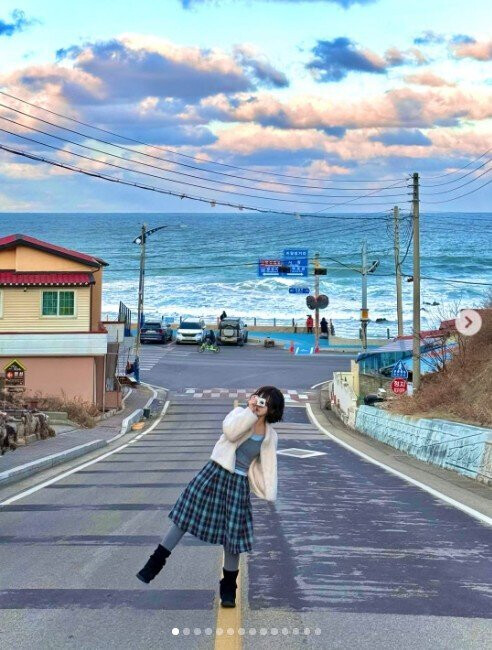
(C) Instagram
MUKHO, South Korea — Move over Gangneung and Sokcho. A new coastal underdog is capturing the hearts—and camera lenses—of South Korea’s trend-conscious youth. The quiet port city of Mukho, located on the nation’s rugged east coast, has rapidly transformed from a sleepy fishing hub into the "it" destination for the 2030 generation (those in their 20s and 30s).
The "Slam Dunk" Effect: Korea’s Answer to Japan
The driving force behind this sudden surge in popularity is a singular, cinematic view. A railway crossing overlooking the East Sea has earned the nickname "The Korean Gamakura," referring to the iconic seaside location in Japan made famous by the legendary anime Slam Dunk.
Even in the biting chill of a February afternoon with temperatures plunging to -10°C, dozens of young travelers can be found lined up at the crossing. They aren't waiting for a train; they are waiting for the perfect "proof shot" (인증샷) that mimics the nostalgic, summery aesthetic of the famous animation.
"I saw this crossing on Instagram and decided right then that I had to come," said a 20-year-old traveler identified as C. "I didn't even look up other tourist spots. I just headed straight to Mukho for this one frame."
Data Confirms the "Mukho Boom"
This isn't just a fleeting social media glitch; the numbers back it up. According to Google Search Trends, interest in Mukho skyrocketed starting in December 2025, maintaining a search volume index of 80–99% through early 2026. This is a massive leap from the 20–30% range recorded during the same period last year. On Instagram, the hashtag #Mukho (#묵호) has surpassed 48,000 posts, a testament to its status as a digital landmark.
The accessibility of the city has been the primary catalyst for this growth. The expansion of the KTX-Eum line on December 30, 2025—connecting Gangneung to Busan—has integrated Mukho into a high-speed rail network. Travelers from Seoul or Cheongnyangni can now reach Mukho Station in roughly 2.5 hours without a single transfer.
Korail statistics reveal the impact: passenger traffic at Mukho Station jumped from approximately 20,000 in late 2024 to over 54,000 in January 2026.
Local Charm vs. Urban Franchises
For a generation weary of cookie-cutter urban franchises, Mukho offers a "local-chic" alternative. The city's appeal lies in its blend of gritty maritime history and modern creative energy.
Nongoldam-gil: A hillside village featuring winding alleys decorated with murals and small boutiques.
Singsings: A youth-led "Cheongnyeon Mall" (Youth Mall) repurposed from an old building next to the traditional market, housing independent souvenir shops and bookstores.
Eodal Beach: Known for its minimalist cafes where visitors spend hours staring at the horizon—a practice known locally as "mung-it" (spacing out) by the sea.
Growing Pains: The Infrastructure Gap
However, Mukho’s sudden stardom has outpaced its infrastructure. The "hidden gem" status that attracts visitors also brings logistical headaches. Many local restaurants and cafes, accustomed to a slower pace of life, operate on irregular schedules or close early due to "ingredient exhaustion."
"If you want to eat at the places you see on SNS, you have to start moving at dawn," complained D, a traveler in her mid-20s. "We arrived at a famous spot only to find it closed without prior notice on their social media. It’s frustrating."
Lines of three to five meters are now common at popular eateries, and the lack of digital queueing systems—standard in larger cities—has led to some friction between locals and visitors.
The Future of "Small City Travel"
Despite these teething architectural and service issues, the Mukho phenomenon represents a broader shift in South Korean travel trends. The 2030 generation is moving away from family-oriented, famous landmarks in favor of "undiscovered" small towns that offer a sense of personal discovery.
As one visitor put it, the fact that Mukho is "just now being discovered" is its greatest draw. In an age of over-tourism in Jeju and Busan, the quiet, salty air of Mukho provides a rare, authentic sanctuary—at least until the next train arrives.
[Copyright (c) Global Economic Times. All Rights Reserved.]