In an unusual leap for telecommunications engineering, Mitsubishi Electric has introduced a prototype wireless antenna that relies on ordinary tap water flowing through clear acrylic tubing.
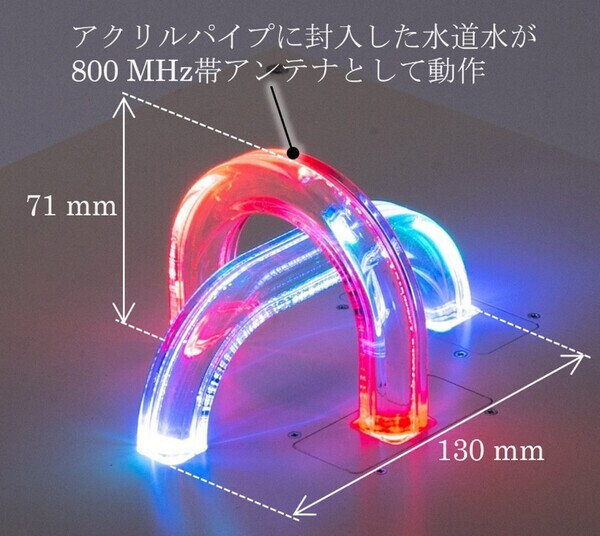
The device, dubbed "Liqutenna," recently passed connectivity trials for smartphones in a collaborative effort alongside Japanese telecommunications operator KDDI. Measuring roughly 7.1 cm in height and 13 cm in width, the system features a pair of curved, fluid-filled pipes intersecting in a cross pattern. By carefully engineering the dimensions and thickness of these channels, the developers achieved signal transmission efficiency that rivals traditional metallic antennas.
Because the apparatus is transparent and uses everyday water, it is virtually unnoticeable against architectural backgrounds. This design makes it a promising solution for preserving the aesthetic integrity of heritage sites and historical landmarks, where standard metal transmission towers or hardware are typically restricted. Furthermore, the unit can be integrated with ambient lighting to harmonize with its environment.
Mitsubishi Electric and KDDI plan to continue field evaluations to verify transmission stability and signal reliability as they prepare to scale the technology for broader deployment.
[Copyright (c) Global Economic Times. All Rights Reserved.]