The ration book (libreta de abastecimiento), for decades a symbol of the Cuban communist system, has been dismantled in practice amid a severe food crisis, unaffordable prices, and widespread poverty that today leaves millions of Cubans without regular access to basic food.
The "ration book," the regulated family basket created in 1962 via Law 1015 and consolidated in 1963 with the OFICODAS (Supply Control Offices), was for over six decades the emblem of the Cuban communist model. Historically, almost all communist or centrally planned economy states implemented ration card systems. But Cuba is the sole country where the system remained active continuously for more than six decades... until today, when it appears to be slowly "evaporating."
The card "guaranteed" each family unit a fixed monthly quota of basic food at state-subsidized prices. Until the Soviet collapse, it covered a good portion of needs; after the Special Period of the 1990s, it was progressively reduced.
Although the libreta has not been abolished by decree, it has been dismantled de facto. A universal subsidized system has shifted to an expensive market supply, controlled in part by GAESA and private actors, amid high food insecurity, chronic delays, and generalized poverty. Access to food has become a source of foreign exchange generation for the elite, while the majority survives on minimal rations, donations, or skipping meals.
Import Dependency and Collapsing Production
Cuba has historically depended on imports: it imports around 80% of the food it consumes, with an annual cost close to $2.4 billion. National production plummeted between 2018 and 2023: rice dropped by 87%, beans by 70%, milk by 58%, and pork by 95%, according to data from the National Office of Statistics and Information (ONEI), incorporated into World Food Programme plans.
In 2026, the subsidized food quota system has effectively disappeared, although no formal law has repealed it. The regime—from Raúl Castro's policies of eliminating "undue subsidies and gratuities" to statements by Manuel Marrero—has pushed the transition "from subsidizing products to subsidizing vulnerable individuals."
In June 2026, it was confirmed that the basic basket would cease to be universal and would focus on retirees, families with chronically ill children, and individuals identified as vulnerable (around 883,000 receive a reduced monthly module: five pounds of rice, one of sugar, and one of legumes).
From Grocery Bodega to "Neighborhood Market"
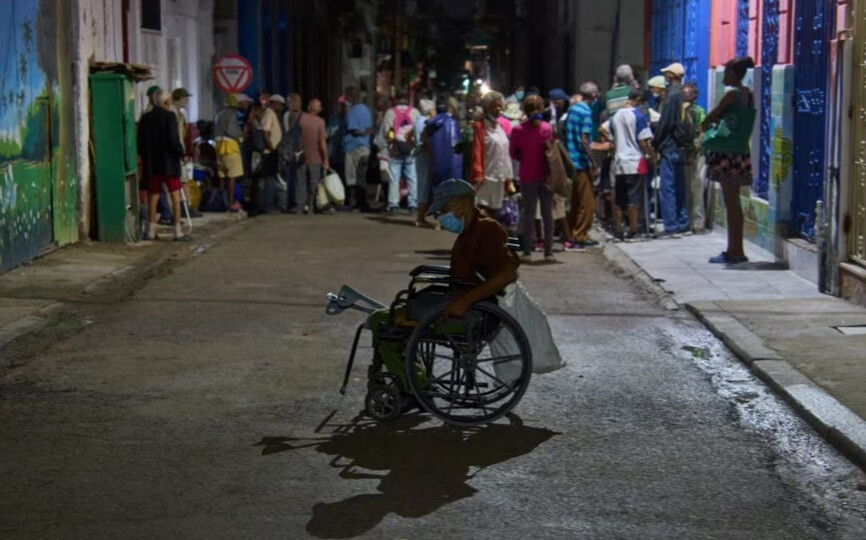
In October 2026, an AFP tour of Havana found bodegas closed, empty, or converted into "neighborhood markets." Only about 1,913 bodegas (16% of the network) will be maintained for the most needy.
At a neighborhood market in Placetas, sugar prices were recorded at 530 CUP/lb, beans at 620, native rice at 370, powdered milk at 1,900, and chicken at 1,890 for two pounds. Citizens remark: "With a pension, you can't buy for the month." Economist Omar Everleny Pérez told Todo Noticias in Argentina: "Truly, the ration book no longer exists." It might not even be physically distributed in December 2026.
Citizen Testimonies Confirm the Void
Regla Lomas, a resident of Mayabeque, told IPS Cuba: "Nothing arrives at the libreta, not even bread for months. The saving grace are backyards and people helping each other, but bread and other things can't be found, not even expensively from private sellers."
At the beginning of 2026, the capital had rationed products pending from October–December 2025, and the rice delivered included delayed pounds from July and August. The January quota provided only two pounds of rice, 1.5 of sugar, and 10 ounces of split peas, with uneven coverage. Chicken, eggs, and coffee were no longer delivered.
The State has shirked the historical responsibility of the communist pact. A Cubanet article notes that "the distribution system for aid is as useless as everything else that has been improvised."
A retiree with 3,125 pesos a month (about three dollars) is not considered vulnerable if they live with a doctor daughter who earns 5,800 pesos, even though a pound of chicken costs 650 pesos and a carton of eggs ranges between 3,000 and 3,600.
In an agricultural market in Centro Habana, a man commented on pumpkin priced at 200 pesos a pound: "A seed that grows by itself, man... Whoever wants to celebrate the end of the year will have to rob a place."
There is more supply in neighborhood markets, MSMEs, private shops, and GAESA-linked establishments, but it is out of reach for pensions and salaries. The minimum wage hovers around 3,210 CUP, the average state salary around 7,354 CUP, and minimum pensions are close to 3,000 CUP.
"In Cuba there is food, what there isn't is money... In these places everything is very expensive, but you have to buy it anyway, because if not, you don't eat," said Cuban citizen Brianita (known on TikTok as @brianitalacubana_1). She showed what she bought with nearly 20,000 pesos at a private shop: four bottles of oil (3,840), six packs of spaghetti (1,860), three of beans (1,350), a pound of chorizo (1,100), a pound of gouda cheese (2,100), two sauces (1,000), a 10-lb pack of chicken (4,000), and four pounds of loin (4,000), totaling 19,250 CUP—more than two average salaries.
Basic root vegetables and greens spark outrage. A photo of a street stall (shared by Panorama Santiago) shows tomatoes at 2,000 CUP a pound, green bell peppers at 1,200, and guavas at 700. Users from Santiago, Havana, Cienfuegos, and other provinces confirmed similar figures. "With a pound of tomato and a pound of chili, my month's salary is gone," one person wrote.
Worse off are single mothers, the elderly, or disabled individuals. A reel uploaded to Facebook shows an elderly disabled woman repeating: "A little help, my son, to buy a sweet potato to eat today."
A Cuban identified as Hugo Mutis posted a photo of five small, spoiled sweet potatoes for which he paid 200 Cuban pesos (CUP), with a question that summarizes the despair of millions: "What prosperous and sustainable socialism are these lunatics talking about?"
30 Salaries to Eat for a Month
The Ninth Social Rights Survey published in August 2026 by the Cuban Observatory for Human Rights found that 94% of Cubans live in extreme poverty; 68% of households report monthly incomes below 20,000 Cuban pesos (about $30); 63% have difficulty even buying the most essential goods; 80% of Cubans have stopped eating breakfast, lunch, or dinner due to a lack of money or food; and 30% barely manage to cover basic needs.
Sociologist Mayra Espina estimates that 66% of the population lives in economic poverty, with incomes below a minimum basic basket of about 11,400 CUP per capita. Economist Javier Pérez Capdevila estimated that about 96,000 pesos monthly are needed to cover basic necessities (about 30 times the minimum wage). Neighborhood markets promised 15–30% discounts, but in practice they are 7–12%.
Christmas and New Year with Fried Egg?
December approaches, and the traditional roast pork for Christmas Eve and New Year's Eve is out of reach for the majority. Users report pork meat priced between 1,700 and 2,200 CUP per pound (1,900 in Santa Fe and Havana, 2,000 in San Antonio de los Baños). "Who will eat pork for the end of the year? Nobody knows, but it will be very few. I think by New Year's Eve they will eat rice, a fried egg, and some root vegetable or other," one user estimated. Another calculated that 80% of families will have no access. Before the monetary overhaul, it cost 25 pesos; now "that meat is for the rich," they said.
Rice, the staple of the Cuban diet, has risen so much that many families substitute it with yucca. Dainelys Morales posted a photo of yucca with picadillo and asked about the price of rice... In Mayabeque it is between 390 and 450 CUP/lb; in Santa Clara and Bauta around 450; in Havana a kilo reaches 1,100 CUP. Yucca costs about 70 CUP/lb. "How they have degraded us. Seeing this shames me. Rice was normal in a home and now look where they have brought us," Daynelis commented.
Decree 156/2026 eliminated the national price cap of 155 CUP/lb for rice that had been in effect since March 2025.
The Long Shadow of Food Insecurity
According to FAO/UN definitions, food insecurity occurs when people lack regular access to sufficient, safe, and nutritious food. It is mild when irregularities occur; moderate if there is a reduction in quality and quantity and families skip meals; and severe if days pass without eating.
Reports from the Food Monitor Program (FMP) document sustained deterioration in Cuba. The 2025 National Food Security Survey (2,513 valid responses across 16 provinces) found that 33.9% of households had at least one member go to sleep hungry in the past 30 days (up from 24.6% in 2024); 94.9% lost some degree of access to food purchases, and 47.1% experienced a considerable or total loss. 79.4% allocate 80% or more of their income to food, and 40.6% spend 100%. 78% consider the current crisis worse than the Special Period.
FMP presented a report to the UN Special Rapporteur on the Right to Food holding the military-business conglomerate GAESA responsible for worsening the crisis: GAESA monopolizes foreign currency, imports, and distribution chains, channels resources toward exports or the diaspora (digital platforms extracting remittances), and discourages domestic production (a 67% drop in five years).
"The rent-seeking logic of the military elite curbs the growth of national production in favor of imports," FMP points out, concluding that they have turned food access into a foreign exchange generation source.
[Copyright (c) Global Economic Times. All Rights Reserved.]