• 2026.06.05 (Fri)
  • All articles
  • LOGIN
  • JOIN
Global Economic Times
fashionrunwayshow2026
  • Synthesis
  • World
  • Business
  • Industry
  • ICT
  • Distribution Economy
  • Well+Being
  • Travel
  • Eco-News
  • Education
  • Korean Wave News
  • Opinion
  • Arts&Culture
  • Sports
  • People & Life
    • International Student Report
    • With Ambassador
  • Column
    • Cho Kijo Column
    • Cherry Garden Story
    • Ko Yong-chul Column
    • Kim Seul-Ong Column
    • Lee Yeon-sil Column
  • Photo News
  • New Book Guide
MENU
 
Home > Synthesis

President Lee Jae-myung Pushes for 'Smart and Elite Military' Amidst Defense Shifts

Yim Kwangsoo Correspondent / Updated : 2025-09-21 19:33:36
  • -
  • +
  • Print


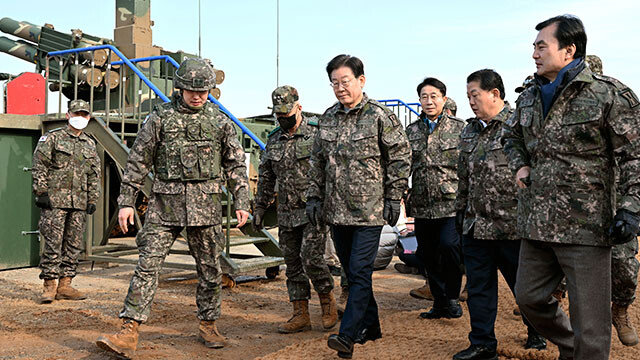
President Lee Jae-myung is calling for a major overhaul of the South Korean military, pushing for a move away from traditional, personnel-heavy forces and towards a high-tech, 'smart and elite military.' The president's statements, made on June 21, are seen as a direct challenge to what he calls a "submissive mindset" that believes national defense is impossible without foreign military assistance. This comes amidst ongoing discussions about modernizing the U.S.-South Korea alliance, which includes potential changes to the role of U.S. forces in Korea and debates over defense cost-sharing.

The president's comments also follow a series of recent accidents involving casualties among military personnel, suggesting his message is aimed at tightening discipline and accountability within the armed forces. On his Facebook page, President Lee wrote that "powerful, autonomous, and self-reliant national defense is our most important task at this time." He emphasized the need to grow national power, increase defense spending, foster a high-morale "smart and strong military," and vigorously develop the defense industry. This statement appears to be a direct rebuttal to concerns that modernizing the U.S.-South Korea alliance could weaken South Korea's own defense capabilities.

A Shift to AI-Powered Defense 

To underscore his vision, President Lee linked a news article titled "270,000 ROK Troops vs. 1.13 Million DPRK Troops by 2040... Population Cliff to Erode Forces." He argued that South Korea's military must transform from a "past-style, human-wave tactics-dependent force" into a "competent and specialized smart elite force" equipped with unmanned and multi-system complexes. He specifically mentioned AI-powered combat robots, autonomous drones, and ultra-precise attack and defense missile systems as key components of this future force. He also highlighted that South Korea's annual defense budget is 1.4 times North Korea's GDP and that it ranks fifth globally in military power, asserting that the South already has a decisive advantage in economic power and population.

Recalling President Roh Moo-hyun's 'Disgraceful' Remarks 

In a powerful move to reinforce his message, President Lee invoked the words of former President Roh Moo-hyun, who famously criticized military leaders with what Lee called the "excessive phrase 'poop stars.'" President Roh's fiery 2005 remarks targeted military officers, asking, "You created a military that can't even properly command its own operations, and now you go around bragging, 'I'm the Minister of National Defense,' 'I'm the Chief of Staff,' with all those stars on your shoulders? You should be ashamed of yourselves."

Analysts suggest that by recalling Roh's strong stance, President Lee is not only reaffirming his own commitment to self-reliant defense but also directly targeting military officials who may have shown complacency in their response to recent military accidents. The use of such a historical reference adds weight to his call for a more responsible and effective military leadership.

Critiques and Strategic Gaps 

However, some critics have pointed out what they see as a significant gap in President Lee's defense strategy: the absence of a clear nuclear deterrence plan. Kim Dong-joong, a professor of international studies at Korea University, noted that the most crucial aspect of the U.S. Forces Korea is their deterrent effect against North Korea's nuclear capabilities. He argued that while the push for overwhelming self-reliant defense is important, it must be accompanied by a strategic vision to complement nuclear deterrence. The debate highlights the complex challenges facing South Korea as it seeks to balance a modern, autonomous military with the realities of regional threats.

[Copyright (c) Global Economic Times. All Rights Reserved.]
  • #globaleconomictimes
  • #micorea
  • #mykorea
  • #Lifeplaza
  • #nammidonganews
  • #singaporenewsk
  • #Samsung
  • #Daewoo
  • #Hyosung
  • #A
Yim Kwangsoo Correspondent

Popular articles

  • AIDC Emerges as New Growth Engine for Telcos, Filling the Void Left by Stagnant Wireless Revenues

  • U.S. World Cup "Host City Boom" Fizzles: Hotel Bookings Slump One Month Before Kickoff

  • "Countdown to Renewed Strikes on Iran?" At Least 50 U.S. Aerial Refueling Tankers Massed at Israeli Airport

I like it
Share
  • Facebook
  • X
  • Kakaotalk
  • LINE
  • BAND
  • NAVER
  • https://globaleconomictimes.kr/article/1065609048020726 Copy URL copied.
Comments >

Comments 0

Weekly Hot Issue

  • Samsung Electronics Super-Enterprise Union Loses Majority Status Amid Backlash Over Bonus Disparities
  • Samsung to Embed Vital Signs and Heart Health Scores in Upcoming Galaxy Watch9 Lineup
  • Apple Honors Digital Excellence: 12 Exceptional Apps and Games Celebrated at the 2026 Design Awards
  • Nexon Revamps Signature Youth Coding Competition into AI-Driven 'Nexon Young Programmers Cup'
  • Tech University of Korea Gathers 200 Game and AI Researchers to Discuss Industrial Expansion
  • Major Korean Telcos Trim Online-Exclusive Plans by Up to 50% Amid Shift to Unified Mobile Tariffs

Most Viewed

1
From a moment of collective sacrifice to a moment of collective democracy: The Timing of the Election in Ethiopia and Korea
2
U.S. Holds Off on Immediate Comprehensive Semiconductor Tariffs, but Pressure Mounts for Samsung and SK Hynix to Accelerate Domestic Investments
3
[Interview] "Halal is Not a Religious Regulation, but a 'Trust Infrastructure'… Creating a Premium 'K-Halal' Centered on Data and Platforms"
4
‘600 Million Won Bonus’ at Samsung Electronics Triggers Deep Sense of Relative Deprivation Among Korean Workers
5
Musk’s SpaceX Secures Space Hegemony with Flawless Starship V3 Recovery Ahead of Historic IPO
광고문의
임시1
임시3
임시2

Hot Issue

Murata Unveils Next-Gen Resin Electrode MLCC for Automotive Applications

Samsung to Embed Vital Signs and Heart Health Scores in Upcoming Galaxy Watch9 Lineup

L&F Plus Secures KRW 220 Billion from National Growth Fund to Anchor South Korea’s First Mass LFP Cathode Production

Samsung Electronics Super-Enterprise Union Loses Majority Status Amid Backlash Over Bonus Disparities

Fashion Runway Show 2026

Global Economic Times
korocamia@naver.com
CEO : LEE YEON-SIL
Publisher : KO YONG-CHUL
Registration number : Seoul, A55681
Registration Date : 2024-10-24
Youth Protection Manager: KO YONG-CHUL
Singapore Headquarters
5A Woodlands Road #11-34 The Tennery. S'677728
Korean Branch
Phone : +82(0)10 4724 5264
#304, 6 Nonhyeon-ro 111-gil, Gangnam-gu, Seoul
Copyright © Global Economic Times All Rights Reserved
  • 에이펙2025
  • APEC2025가이드북TV
  • 반달곰 프로젝트
Search
Category
  • All articles
  • Synthesis
  • World
  • Business
  • Industry
  • ICT
  • Distribution Economy
  • Well+Being
  • Travel
  • Eco-News
  • Education
  • Korean Wave News
  • Opinion
  • Arts&Culture
  • Sports
  • People & Life 
    • 전체
    • International Student Report
    • With Ambassador
  • Column 
    • 전체
    • Cho Kijo Column
    • Cherry Garden Story
    • Ko Yong-chul Column
    • Kim Seul-Ong Column
    • Lee Yeon-sil Column
  • Photo News
  • New Book Guide
  • Multicultural News
  • Jobs & Workers