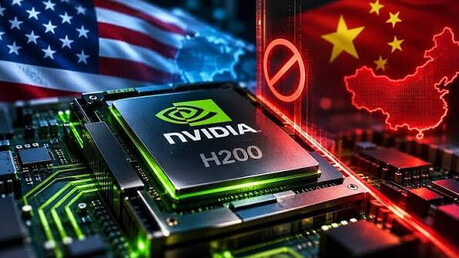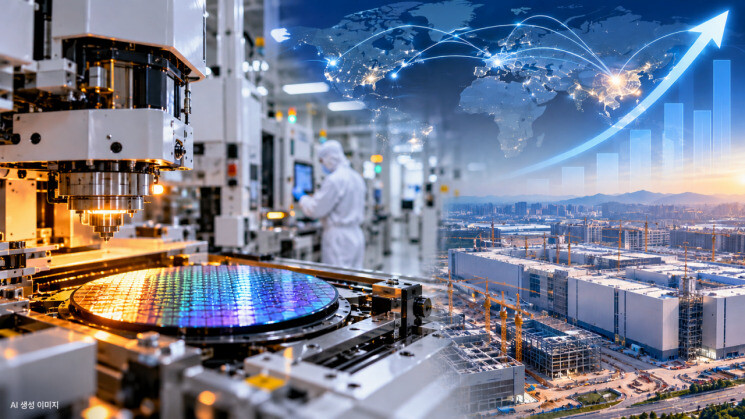
A state-run research institute has proposed investing a portion of the excess corporate tax revenue generated during the semiconductor boom into non-semiconductor flagship industries to overcome South Korea's heavy reliance on chips. The move aims to insulate the country's exports from severe shocks when the semiconductor cycle eventually turns downward.
In a report released on the 27th titled "The $1 Trillion Era of Korean Exports: Sustainability Diagnosis and Policy Tasks," the Korea Institute for Industrial Economics and Trade (KIET) presented these measures to address the reality that Korea’s export performance is heavily dictated by the market conditions of a single sector: semiconductors.
KIET noted the need to examine whether Korea’s achievement of $1 trillion in annual exports represents structural growth or a temporary boom, pointing out that "the effect of rising semiconductor unit prices played a major role" in reaching this milestone.
The share of semiconductors in total exports expanded from 35.5% in the first quarter of this year to 41.4% in the second quarter, and 46.4% in the third quarter, nearing half of all exports at 48.9% in October. The year-on-year growth rate of chip exports also surged from 139.1% in Q1 to 218.7% in Q3.
Rising memory chip prices were a primary driver behind this export surge. KIET analyzed that roughly half of Korea's total export growth this year stemmed from unit price increases, such as fixed contract prices for memory chips.
Even within the semiconductor sector, concentration in memory chips stood out. In the first three quarters of this year, DRAM export growth hit 369.0%—about 28 times higher than system semiconductors (13.1%). Regarding this gap, the institute analyzed that it "suggests export growth is heavily reliant on unit price effects from rising memory prices and the expansion of high-value products like High Bandwidth Memory (HBM), rather than volume."
Korea's export concentration is more severe than that of Germany and China, which previously surpassed the $1 trillion export mark. As of 2024, the top 10 export items accounted for 50.2% of Korea's total exports, more than 20 percentage points higher than Germany (28.5%) and China (27.4%). Korea's figure rose from 52.4% last year to 66.0% in the January–September period this year.
How can this be overcome? KIET stated that the policy goal should not be to artificially lower the share of semiconductor exports, but rather to grow the export scale of other industries enough to absorb the shock of falling chip prices.
To this end, the institute proposed establishing an advance principle to "prioritize using part of the excess corporate tax revenue from the semiconductor boom for facility and supply chain investments in non-semiconductor flagship items." Additionally, it stated that "policy financial institutions need to link their non-semiconductor facility fund limits to concentration indicators—such as the semiconductor export share—so that investment capacity for non-chip sectors expands as export concentration intensifies."
KIET also suggested intensively fostering items that are already gaining prominence in the global market. As of 2024, all 19 export items with over $100 million in exports that were climbing the global ranks between 2nd and 10th place were non-semiconductor products. These include tanks and armored vehicles (3rd), mixing and crushing industrial machinery (3rd), automotive drive axles (6th), and forklifts (6th). The proposal involves providing temporary support aimed at elevating these items to No. 1 in global exports. Support would end once an item reaches the top spot, and if its ranking fails to rise within three years, the suitability of the support would be re-evaluated.
The institute also noted that upgrading existing key industries into higher value-added sectors and diversifying sub-items must proceed simultaneously—such as electrification and autonomous driving components in the auto industry, and liquefied natural gas (LNG) and ammonia-powered vessels in shipbuilding.
Furthermore, KIET proposed regularly monitoring and announcing the semiconductor export share alongside the gap between export value and volume growth rates, issuing a "concentration alert" if they exceed certain thresholds.
In particular, the institute emphasized checking whether newly crowned global No. 1 export items are concentrated in semiconductor-related products, such as solid-state drives (SSDs) and chip inspection equipment. KIET stated, "An increase in global No. 1 items may look like diversification on the surface, but if the newly top-ranked items ride the same business cycle as semiconductors, chip dependency may actually be worsening, making it necessary to examine the nature of the items as well."
[Copyright (c) Global Economic Times. All Rights Reserved.]