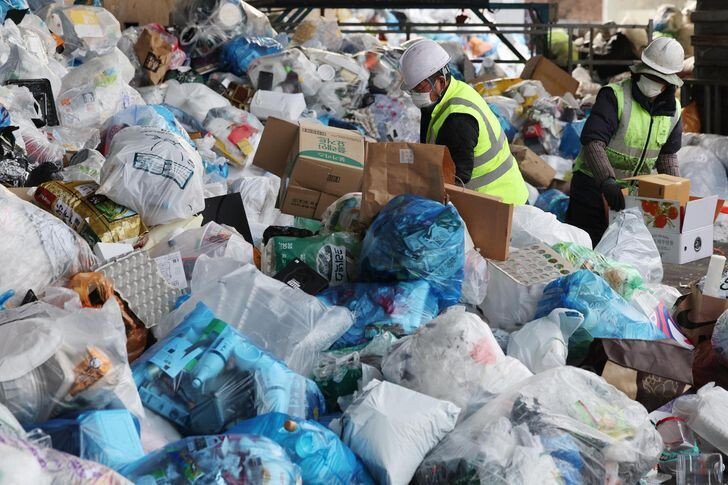
During the recent autumn festival season in Changwon, a massive volume of garbage was generated, with the flagship chrysanthemum festival alone discarding hundreds of standard trash bags daily. While the city has been promoting the use of reusable containers to curb waste, local environmental groups are calling for a more systematic and rigorous management approach.
According to recent local reports, the Masan Gagopa Chrysanthemum Festival—held from late October to early November—produced an average of about 400 large 75-liter waste bags per day, excluding Sundays, during its active collection period. Meanwhile, the MAMF multicultural festival generated around 60 to 70 bags per day over a three-day span, and the one-day Changwon Food Culture Festival accounted for roughly 30 to 40 bags of the same capacity.
However, officials noted that calculating exact waste weight based solely on the number of bags is difficult. Under current municipal regulations, a 75-liter waste bag is permitted to weigh up to 19 kilograms, but actual weights vary widely depending on the contents.
An official from Changwon City’s Resource Circulation Division explained that general household waste often falls short of the maximum weight limit. Due to the rapid and continuous disposal pattern at festivals, the density of the garbage inside the bags is expected to be even lower. Furthermore, accurately isolating festival-specific waste remains a challenge. Because municipal waste trucks follow routine collection routes and mix festival refuse with standard household garbage before heading to incineration plants, tracking precise volume trends remains complicated.
Burnable waste collected from these events is processed at local resource recovery facilities. Changwon currently operates two out of its three incineration plants—Seongsan and Masan—with a combined daily capacity of 600 tons. A third facility in Jinhae was closed in October as part of a regional integration plan with Gimhae.
To address ongoing environmental concerns, the city introduced reusable containers for the first time at this year’s Masan Gagopa Chrysanthemum Festival, utilizing roughly 200,000 reusable items across food zones. City officials believe this initiative successfully reduced overall waste volume and plan to expand the program moving forward.
Despite these efforts, environmental organizations argue that expanding reusable container policies is not enough; the city must also establish a systematic inspection and management framework to ensure compliance on the ground.
Jung Eun-ah, secretary-general of the Gyeongnam Korea Federation for Environmental Movement, pointed out that while reusable items are becoming more common, the city must evaluate their actual effectiveness in food booths. Citing examples from other regional festivals, she noted that municipal-run booths typically adopt reusable ware smoothly, whereas privately run booths often lag behind, highlighting the need for active local government oversight.
Jung further emphasized that environmental impact should be prioritized right from the planning stages of public events. "Environmental considerations are just as crucial as festival safety," she stated. "The core issue is ensuring that climate crisis response policies are visibly and effectively integrated into every civic event."
[Copyright (c) Global Economic Times. All Rights Reserved.]