![[등록] 2026-09-01 15:48:31](/support/_updata/banner2/tl181982910_6749.png)


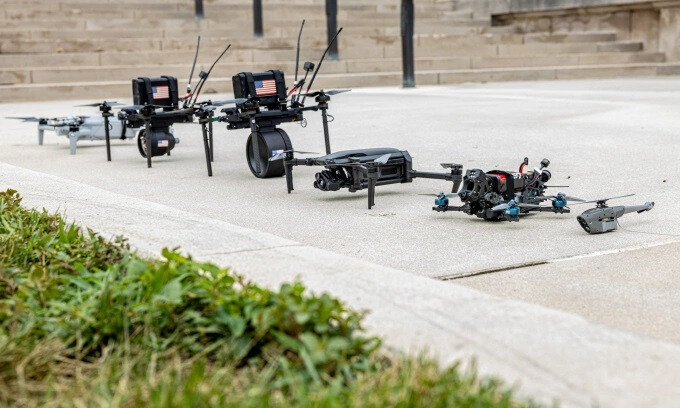
Bureaucratic procedures and complex procurement processes are delaying the U.S. military's drone development and adoption, contrasting sharply with the growing importance of drones in modern warfare.
On July 21, the U.S. Army released a training video showing a small drone dropping a live grenade during exercises in Germany. The video, posted with the caption "Ever seen a drone drop a grenade?", immediately drew criticism on social media and from military experts. Many pointed out that drone-based explosive drops have been common in conflict zones worldwide since 2017, questioning why the U.S. Army was presenting it as if it were new technology. Tyler Rogoway, editor of the military news outlet 'War Zone,' quipped, "I've been pointing out that the Pentagon is ridiculously behind in the low-cost drone field, and this post proved it."
U.S. Military's Drone Weaknesses Revealed in Alaska Exercise
This regression in U.S. military drone technology was clearly evident during a four-day exercise hosted last month in Alaska by the Defense Innovation Unit (DIU) under the Department of Defense. During this exercise, manufacturers funded by the U.S. Department of Defense tested several models of kamikaze drones designed to attack pre-set targets. Simultaneously, U.S. soldiers conducted training to defend against drones using electronic warfare equipment.
During the exercise, one long-range drone missed its target, crashing 24 meters away, another crashed immediately after takeoff, and yet another collided with a mountain, exhibiting serious flaws. U.S. military officials and drone experts admitted that the U.S. is falling behind Russia and China not only in drone production but also in drone usage and defense training. Trent Emeneker of the DIU stated, "Everyone knows we are not providing what soldiers need to survive on the battlefield today. If war were to happen tomorrow, would we have enough of what we need? The answer is 'no,' and we are working to fix that."
Barriers of Outdated Regulations and Complex Procurement Procedures
Pete Hegseth, U.S. Secretary of Defense, acknowledged that Washington is lagging in drone technology and announced new policies and investments to close the gap with other nations. In a message released in mid-month, he pointed out that outdated regulations and procurement procedures severely hinder the U.S. military from purchasing drones and training soldiers. Secretary Hegseth criticized, "Our adversaries are producing millions of low-cost drones while we are bogged down in complex bureaucratic processes."
In June, U.S. President Donald Trump signed an executive order titled 'Unleashing American Drone Dominance,' directing federal officials to accelerate the permitting process for drone manufacturers and protect the U.S. drone supply chain from "undue" foreign interference. However, U.S. media analyzed that it would take considerable time and money to develop a domestic drone industry with the production capacity to meet U.S. military demands.
According to Ryan Carver, spokesperson for the Association for Uncrewed Vehicle Systems International, there are currently about 500 drone manufacturers in the U.S. capable of producing approximately 100,000 drones per year. However, most of these are startup companies with limited production and sales experience.
Technical Difficulties and Training Limitations
The Alaska exercise demonstrated that drone design is a very challenging task for U.S. companies. An AeroVironment drone prototype nearly crashed into soldiers standing near a jammer after its GPS signal was blocked. A drone from the startup Dragoon failed to accurately hit its target due to engine and navigation system issues. On the last day of the exercise, this drone identified an M113 armored personnel carrier as a target and collided with it, but this was not the intended target. Emeneker said, "Things didn't go as smoothly as hoped. Clearly, there are some significant technical challenges that remain to be overcome."
Soldiers participating in the exercise, mostly from the 11th Airborne Division's electronic warfare unit, also struggled with drone jamming missions. They set up six jammers on a mountaintop to suppress control signals between drones and their operators, but these devices, over 10 years old, had little effect. Even more modern drone defense equipment carried by some soldiers in their backpacks did not work. Special anti-drone guns were also issued, but soldiers were reluctant to use them, saying, "They didn't work at all."
Lessons from the Ukrainian Battlefield
Nevertheless, soldiers showed gradual improvement, finding more effective ways to use jammers on the fourth day of the exercise. Soldiers reported that the 'Magpie,' a suitcase-sized box-shaped jammer, was particularly effective.
However, Scott Smith, commander of the 11th Division's Non-Lethal Operations Unit, pointed out that this exercise showed the U.S. has a lot to do to prepare for conflicts involving drones. He stated, "Their equipment was not as effective as expected in countering the latest technology."
Chris Bonzagni, a drone consultant who supported the exercise organization, stated that many drone models supplied by the U.S. to Ukraine early in the conflict used outdated technology or were easily jammed by Russian forces, failing on the battlefield. Bonzagni emphasized, "In Ukraine, companies that provide technology to soldiers must always be with them and observe firsthand what works and what doesn't."
Currently, Ukraine has become a global hub for drone production because soldiers and engineers have had to master technology for their survival. This is a situation Americans have not yet experienced.
The Future and Challenges of the U.S. Drone Industry
One promising company in the U.S. drone industry is Neros. This company is currently supplying approximately 6,000 drones to Ukraine, and U.S. leaders describe it as the optimal alternative to China's DJI, the world's largest drone manufacturer.
Neros' drone model, the 'Archer,' showed effective jamming resistance capabilities in the Alaska tests and has a strong advantage in its low price of about $2,000 per unit. However, due to its manual assembly process and 15 employees, Neros can currently produce only about 1,500 Archer drones per month.
Soren Monroe-Anderson, co-founder and CEO of Neros, stated that he wants to expand production and build a factory capable of producing a million drones per year. He also has ambitions to compete with DJI but admits it is a very difficult goal. Monroe-Anderson said, "They are better than any company in the world."
The reality of the U.S. falling behind in the drone sector is not just a technological gap; it is directly linked to national security and future battlefield dominance. Streamlining complex administrative procedures, increasing investment in research and development, and boosting the production capacity of domestic industry appear to be urgent tasks. Without these efforts, the U.S. military will continue to fall behind in the drone competition, a key weapon in modern warfare.
[Copyright (c) Global Economic Times. All Rights Reserved.]