![[등록] 2026-09-01 15:48:31](/support/_updata/banner2/tl181982910_6749.png)


Transformation of Namwon Medical Center into ‘National Medical Center Namwon Branch’ to Build a State-Run System
A state-established and operated National School of Medicine will be built in Namwon, Jeonbuk. With this realization of regional efforts spanning eight years since the initial establishment decision in Namwon in 2018, Jeonbuk Special Self-Governing Province is launching full-scale preparatory measures for successful school establishment and educational infrastructure development, aiming for its first student enrollment in 2030.
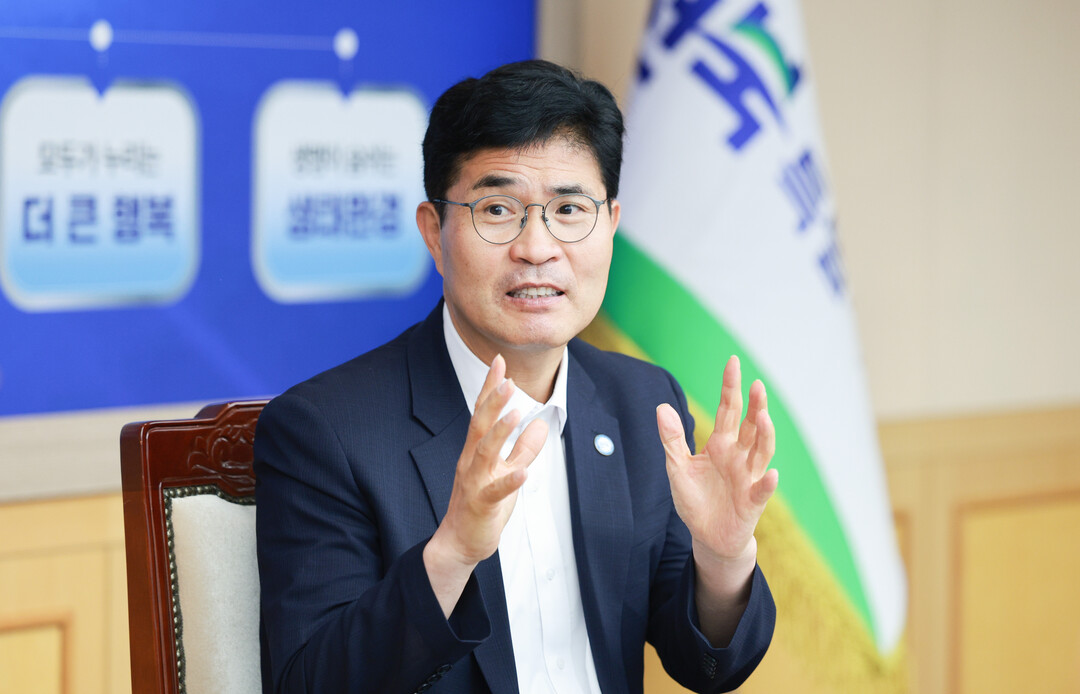
On the 1st, Jeonbuk Special Self-Governing Province held a joint briefing in the provincial government press room to coincide with the Ministry of Health and Welfare's official announcement confirming Namwon as the location for the National School of Medicine (National School of Medicine). Governor Lee Won-taek explained the significance of the decision and future response directions alongside Provincial Council Chairman Kim Hee-su, Namwon Mayor Yang Choong-mo, and Namwon City Council Chairwoman Han Myeong-sook.
Having overcome numerous hurdles such as bill abolitions and suspended policy discussions, the National School of Medicine establishment project has now secured the foundation to proceed in earnest, following the enactment of legislation, securing of budgets, and final confirmation of the location. A system where the state trains public healthcare personnel and deploys them to necessary fields is now taking concrete shape with Namwon as its base.
This is highly significant as state policies aimed at reducing medical disparities between regions are moving into full-scale execution. For Namwon, it marks a new turning point to recover the medical education infrastructure lost with the closure of Seonam University’s medical school in 2018 and to leap forward as a hub for cultivating public healthcare talent in South Korea.
Key Overview of the National School of Medicine
Institution Type: State-funded 4-year graduate school operated in the form of a special corporation.
Annual Quota: 100 students.
Student Support: Full coverage of admission fees, tuition, textbook costs, and dormitory expenses.
Mandatory Service: 15 years of mandatory service in public medical institutions upon graduation.
Site Location: Wolrak-dong area (64,792 square meters) near Namwon Medical Center.
Construction Budget: 64.0 billion KRW entirely funded by the state (final project costs subject to adjustment during government master planning and design).
Legal and Budgetary Status: The "Act on the Establishment and Operation of the National School of Medicine" was promulgated on May 26 and takes effect on November 27. The government budget for this year reflects 3.9 billion KRW for related expenses.
Jeonbuk Special Self-Governing Province plans to swiftly advance preliminary procedures, such as securing remaining land parcels and urban planning, alongside Namwon City while responding to the government's master plan. Collaborating with regional political circles, the province aims to secure national budget allocations for design costs in 2027 and provide systematic administrative and institutional support as the establishment plan takes concrete shape.
The educational and clinical training system will be further fleshed out during the Ministry of Health and Welfare's establishment of the master plan and curriculum. To ensure a stable education and clinical practice base centered around Namwon, Jeonbuk Special Self-Governing Province plans to drastically enhance the functions and educational capacity of Namwon Medical Center.
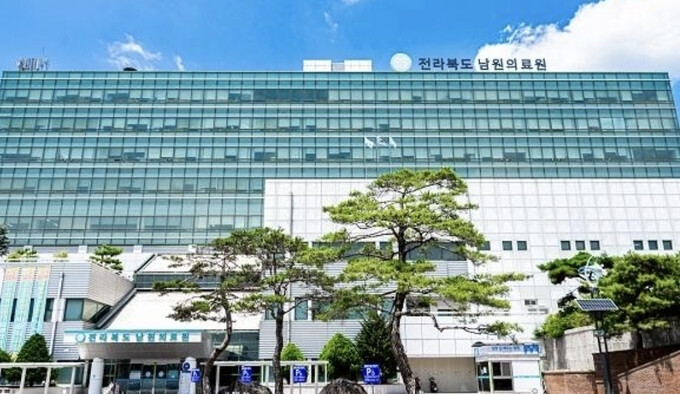
In particular, the province will consult with the government to transform Namwon Medical Center into the ‘National Medical Center Namwon Branch’, building a state-operated system and expanding it to approximately 500 beds in phases. Furthermore, by specializing treatment functions around high-demand areas such as cardiovascular diseases and dementia, the center will strengthen its role as a regional and public medical clinical training and regional base hospital.
In addition, building on the business agreement signed on September 28 by Jeonbuk Province, Namwon City, Jeonbuk National University Hospital, Wonkwang University Hospital, Jesus Hospital, and Namwon Medical Center, the cooperative framework between medical institutions will be materialized. Centering on Namwon Medical Center, the province plans to link exceptional medical resources—including provincial medical institutions and the National Medical Center—to establish an educational foundation where students can accumulate diverse clinical experiences.
Governor Lee Won-taek stated, "Despite many hardships, we reached this point because provincial residents, Namwon citizens, local political figures, and related organizations united with one heart. We will concentrate our administrative power on successful establishment and opening preparations so that the National School of Medicine can establish itself as a state educational institution responsible for regional, essential, and public healthcare."
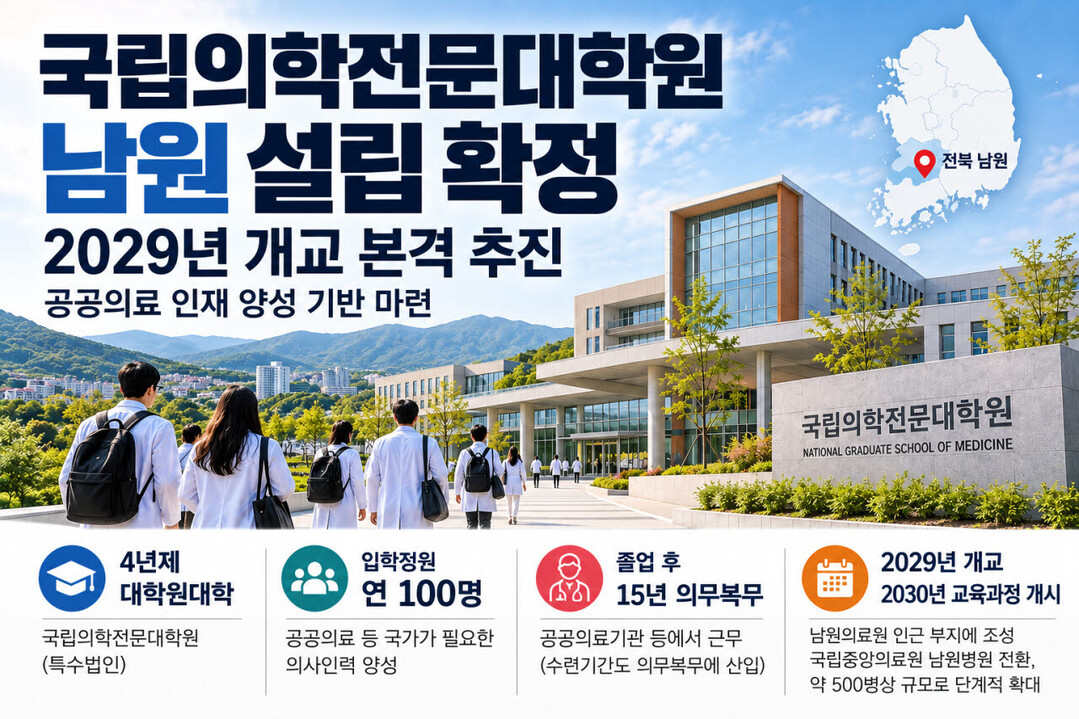
National School of Medicine in Namwon: Time to Fill Educational Substance
With the site for the National School of Medicine confirmed as Namwon, the tasks for Jeonbuk and Namwon have become much more concrete. While the past eight years focused on laying the legal and policy foundations for establishment, the core tasks moving forward are building the school seamlessly and equipping an educational system that will produce doctors responsible for regional, essential, and public healthcare.
1. Doctor Training Directly Managed by the State: A Turning Point in Healthcare Policy
The establishment of the National School of Medicine is significant because it institutionally links doctor training with service in public healthcare fields. Under the existing medical education system, post-graduation career paths were left to individual choices, presenting limitations in stably securing necessary personnel for medically vulnerable areas and essential medical fields.
The National School of Medicine operates on a system where the state selects and educates students, and students are mandatorily deployed to public healthcare fields after graduation. By going beyond simply training doctors to ensuring they work in necessary fields, the state strengthens its responsibility to resolve regional medical disparities.
This is also a vital turning point for Jeonbuk and Namwon. Through the establishment of a national public healthcare talent training institution, the region recovers the local medical education foundation lost due to the closure of Seonam University's medical school in 2018. It also carries great significance in establishing Namwon, a non-capital mid-sized city, as a national-level medical talent training hub.
Project implementation conditions have also changed since 2018. At that time, Namwon's establishment was decided politically, but the legislation to support it failed to pass. This time, following the enactment of the National School of Medicine Act, the location was confirmed after government procedures including reviews by the Establishment Preparation Committee and Specialized Committee. With legal and administrative foundations in place, the core task is now to flawlessly implement the subsequent procedures required for establishment and opening.
2. Eight Years Since Seonam University's Closure, Unyielding Regional Efforts
Discussions on establishing the National School of Medicine in Namwon began with the closure of Seonam University’s medical school in February 2018. In April of the same year, a ruling-opposition party agreement decided on the establishment of the National Public Health Medical University in Namwon, and in December, the area near Namwon Medical Center was selected as the establishment site.
However, the legislative process was not smooth. Related bills were repeatedly put on hold during National Assembly Health and Welfare Committee reviews and eventually discarded due to the expiration of the 20th National Assembly term. In September 2020, discussions were postponed until stabilization of COVID-19 per medical-government agreements. In the 21st National Assembly, although the bill passed the full meeting of the Health and Welfare Committee in December 2023, it failed to lead to final legislation.
Even when the project stalled for a long period, the region never stopped preparing. Jeonbuk Special Self-Governing Province led joint statements by governors and mayors and continuously petitioned the President, Prime Minister, Minister of Health and Welfare, and ruling-opposition leadership for legislation. The province requested inclusion in national policy tasks to emphasize the necessity of relaunching the project.
Namwon City proceeded with urban planning facility determinations and site consultation compensations, while the Provincial Council formed a special committee to support public medical school recruitment. Namwon citizens and civil society also urged swift legislation through statement announcements and one-person protests in front of the National Assembly.
These combined efforts by administration, political circles, and civil society bore fruit in the 22nd National Assembly. Reflecting national tasks in 2025 and securing 3.9 billion KRW in establishment-related budgets for the 2026 government budget, the legislation providing the basis for the establishment and operation of the National School of Medicine was promulgated this May.
3. Building a State Operation System via Transition to ‘National Medical Center Namwon Branch’
Along with the establishment of the National School of Medicine, the transition of Namwon Medical Center into a state-operated hospital is also being pursued. The Ministry of Health and Welfare plans to convert Namwon Medical Center into the ‘National Medical Center Namwon Branch’ and expand it in phases to a scale of 500 beds. By specializing treatment functions for cardiovascular diseases and dementia, it will strengthen its role as a regional and public medical clinical training and regional base hospital.
Accordingly, Namwon Medical Center is expected to expand its functions as a base that supports regional medical education and clinical practice for National School of Medicine students while providing essential medical services to residents. Enhancing education/practice infrastructure and bolstering treatment capacity together are expected to improve medical accessibility for residents in Namwon and eastern Jeonbuk while reinforcing local essential medical infrastructure.
The National School of Medicine curriculum will be operated centering on Namwon, with clinical practices linked to various public medical institutions in parallel. Students receive support for educational expenses—including admission fees, tuition, textbook costs, and dormitory expenses—and fulfill 15 years of mandatory service in administrative and public medical institutions after graduation. The objective is to systematically support and manage individuals from education to training, career management, and field placement, thereby cultivating necessary personnel for medical-vulnerable areas and essential/public medical fields.
The expansion of school and hospital functions is also anticipated to inject vitality into the local economy. Increased local consumption and residential service demands resulting from the influx of students, faculty, and medical personnel are expected to strengthen settlement infrastructure, while the development of educational facilities and improvement of medical conditions serve as opportunities to boost residential foundations.
Jeonbuk Special Self-Governing Province plans to cooperate with related agencies such as the Ministry of Health and Welfare, Namwon City, and the National Medical Center to ensure that the establishment of the National School of Medicine and the enhancement of Namwon Medical Center's functions proceed without a hitch. Through this, the province plans to foster Namwon as a hub where public medical talent training and regional healthcare develop together.
4. Learning in Namwon, Gaining Experience Nationwide: Cultivating Talent
Jeonbuk Special Self-Governing Province envisions establishing a stable educational infrastructure in Namwon while linking outstanding medical resources nationwide to elevate educational quality. The province judges that doctors responsible for regional, essential, and public healthcare require an understanding of local medical sites alongside diverse clinical experiences in critical care, emergency, trauma, infectious disease, and cancer.
To achieve this, the province will formulate measures to enhance the functions and educational capacity of Namwon Medical Center and cooperate with provincial medical institutions to build conditions where education and clinical practice can take place centering on Namwon. The province also plans to consult with the government on measures to broaden students' clinical capabilities in connection with national public and specialized medical institutions.
Specific curricula and roles for each training institution will be detailed through discussions by the National School of Medicine Establishment Preparation Committee's Curriculum Specialized Committee. Jeonbuk Special Self-Governing Province plans to respond to ensure that securing internal educational foundations in Namwon and diverse clinical education opportunities are reflected together during this process. The ultimate goal is to cultivate outstanding public medical talent with Namwon as a base and connect the outcomes of cooperation between education and medical institutions to the improvement of regional medical standards.
Governor Lee Won-taek stated, "We will ensure that the National School of Medicine is not just a school with its name in Namwon, but an institution that trains medical talent responsible for Korea’s regional, essential, and public healthcare. Centering on the National Medical Center Namwon Branch and linking with regional medical institutions, we will build a foundation where residents can stably receive necessary medical services right within their region."
[Interview]
Governor Lee Won-taek: "The Center of Education Is Namwon, Connected with Nationwide Medical Resources"
"We have waited eight years. Now, we must build it properly."
On the 1st, Jeonbuk Special Self-Governing Province Governor Lee Won-taek evaluated regarding the establishment of the National School of Medicine in Namwon, "The greatest significance of this site confirmation is that our preparation over the past eight years has transitioned into the full-scale establishment phase." He added, "The focus of discussion has now shifted from 'where to establish it' to 'how to successfully establish it and educate properly.'"
Governor Lee found the significance of this decision in policy continuity and regional preparation. He explained that despite numerous difficulties since the 2018 establishment decision in Namwon—such as bill abolitions and suspended discussions—the region continued its establishment preparations with one heart. He noted, "Provincial residents, Namwon citizens, local political figures, and related organizations did not give up and joined forces. With the legal basis and establishment location secured, we must now translate preparations into concrete execution."
As urgent tasks, he selected the flawless execution of follow-up procedures such as the government master plan and architectural design. Alongside this, he presented future tasks: ▲ flawless implementation of establishment procedures such as design and architecture, ▲ establishment of practical educational foundations encompassing the functions and educational capacity of Namwon Medical Center, and ▲ close cooperation between the government and the region until school opening.
Regarding the educational direction, he emphasized securing internal foundations within Namwon. Governor Lee stated, "The center of the National School of Medicine is clearly Namwon. Since the school is being established in Namwon, conditions for basic education and clinical practice must also be properly established in Namwon."
In particular, the plan is to convert Namwon Medical Center into the ‘National Medical Center Namwon Branch’, scale it up in phases to approximately 500 beds, and strengthen its role as a regional and public medical clinical training and regional base hospital through function specialization in areas such as cardiovascular diseases and dementia.
Furthermore, building on the business agreement signed on September 28 by Jeonbuk Province, Namwon City, Jeonbuk National University Hospital, Wonkwang University Hospital, Jesus Hospital, and Namwon Medical Center, the cooperative framework between medical institutions will be materialized. Centering on Namwon Medical Center, the province plans to link exceptional medical resources—including provincial medical institutions and the National Medical Center—to establish an educational foundation where students can accumulate diverse clinical experiences.
He also unveiled a long-term blueprint. Governor Lee stated, "With the National School of Medicine and the National Medical Center Namwon Branch as axes, education, research, clinical practice, and regional/essential healthcare must organically mesh together. By equipping a system where provincial medical institutions and national public medical institutions participate together, we will grow Namwon into a hub for public medical education, research, and clinical practice in South Korea."
Governor Lee concluded, "The site confirmation is the fruit of long efforts and a new starting point. We will responsibly prepare until the day the school opens."
[Copyright (c) Global Economic Times. All Rights Reserved.]