• 2026.10.17 (Sat)
  • All articles
  • LOGIN
  • JOIN
Global Economic Times
[등록] 2026-09-01 15:48:31
  • Synthesis
  • World
  • Business
  • Industry
  • ICT
  • Distribution Economy
  • Well+Being
    • Pet Life
    • Halal Horizon
  • Travel
  • Eco-News
  • Education
  • Korean Wave News
  • Opinion
  • Arts&Culture
  • Sports
  • People & Life
    • International Student Report
    • With Ambassador
  • Column
    • Cho Kijo Column
    • Cherry Garden Story
    • Ko Yong-chul Column
    • Kim Seul-Ong Column
    • Lee Yeon-sil Column
  • Photo News
  • New Book Guide
MENU
 
Home > Well+Being > Halal Horizon

Malaysia Solidifies Its Global Leadership in the Halal Economy at the 2026 International Halal Economic Conference

Greace Nunez Correspondent / Updated : 2026-10-17 15:49:50
  • -
  • +
  • Print


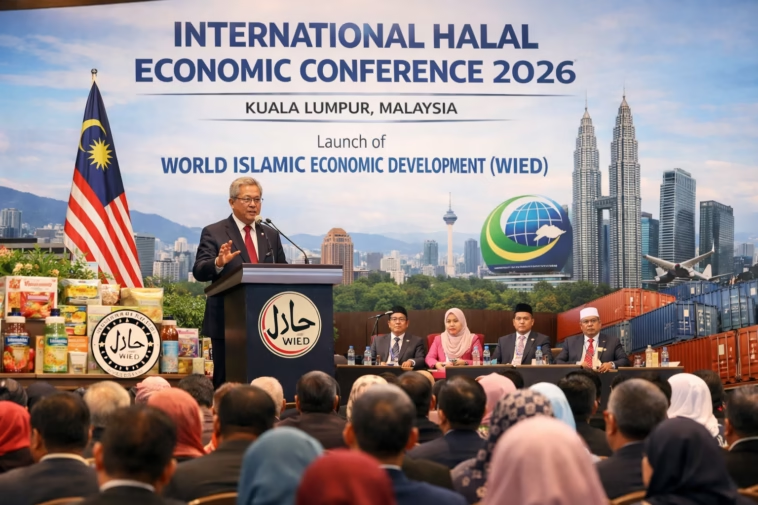
KUALA LUMPUR — Malaysia has once again underscored its status as a frontrunner in the global halal industry, unveiling ambitious new initiatives and economic milestones at the International Halal Economic Conference 2026.

The high-profile event convened political figures, business leaders, industry experts, and financial institutions from around the globe to discuss the future of the halal market. A major highlight of the conference was the official launch of the World Islamic Economic Development (WIED), a groundbreaking global initiative designed to structure and accelerate the growth of the halal economy worldwide.

Delivering the opening address, Deputy Prime Minister II Fadillah Yusof emphasized that the halal concept extends far beyond a mere commercial label. Instead, he described it as a fundamental commitment rooted in trust, responsibility, and justice aimed at serving society as a whole.

A Booming Economic Engine

The halal sector has cemented its role as a vital growth engine for Malaysia. In 2025, the industry accounted for 7.94% of the nation's Gross Domestic Product (GDP), translating to approximately 118.2 billion ringgit. Currently, the sector supports over 1,500 registered halal exporters nationwide.

While food remains a cornerstone of the industry, officials stressed that the halal economy spans a diverse array of sectors—including Islamic finance, pharmaceuticals, cosmetics, logistics, tourism, technology, and energy. Globally, the halal economy is estimated to be worth nearly $40 trillion, encompassing over 90 key sectors.

Malaysia’s strong positioning is anchored by its globally recognized halal certification system, developed through rigorous standards aligned with the Organization of Islamic Cooperation (OIC). Furthermore, the nation officially recognizes more than 90 foreign halal certification bodies, streamlining international trade and building consumer trust across both Muslim and non-Muslim demographics.

A Sustainable Vision for the Future

The introduction of WIED marks a critical step toward addressing the current fragmentation within the global halal market. By fostering closer coordination among nations, businesses, and financial institutions, the initiative aims to build a more coherent, sustainable, and inclusive international framework.

Aligning with these global ambitions, Malaysia is slated to roll out its comprehensive National Halal Policy this year. The roadmap will guide the development of a complete halal ecosystem—covering research, innovation, professional training, investment, and governance—with a particular focus on empowering small and medium-sized enterprises (SMEs) to access international markets.

To safeguard consumer trust and maintain the integrity of the certification, authorities also highlighted rigorous enforcement measures, noting that several hundred halal-related complaints were addressed with seizures and sanctions between 2023 and 2025.

Looking Ahead to 2030
With clear long-term goals in sight, Malaysia aims to expand the value of its halal industry to over 230 billion ringgit by 2030, projecting that the sector’s contribution to GDP will rise to 10.8%.

By championing international cooperation and ethical economic practices, Malaysia continues to demonstrate that the halal economy can serve as an efficient, transparent, and globally beneficial model for future generations.

[Copyright (c) Global Economic Times. All Rights Reserved.]

  • #Petlife
  • #Halalhorizone
  • #Hormuz Impasse
  • #globaleconomictimes
  • #micorea
  • #mykorea
  • #nammidonganews
  • #singaporenew
Greace Nunez Correspondent

Popular articles

  • Physical AI Innovation in Robot Automation... "What Matters is the Robot's Fingertip"

  • Google Hit with €403 Million Fine by Irish Regulator Over GDPR Location Data Violations 

  • US Media Outlets Boycott Trump Video Coverage, File Lawsuit Over White House Press Bans

I like it
Share
  • Facebook
  • X
  • Kakaotalk
  • LINE
  • BAND
  • NAVER
  • https://globaleconomictimes.kr/article/1065595728966941 Copy URL copied.
Comments >

Comments 0

Weekly Hot Issue

  • Will South Korea Introduce a Pet Tax? Balancing Welfare and Financial Burdens
  • Fall Outdoor Gear Boom for Dogs Sweeps the Market: The Secret Behind the Popularity of Ruffwear and Kurgo Korea
  • The Rise of "No-Pet Zones": Balancing Pet Ownership and Public Comfort
  • Pet Owners Surpassing 10 Million: South Korea's Pet Industry Expands Beyond Food and Shelter into Wellness and Experiential Services
  • Seoul Cracks Down on Unregistered Home-Based Pet-Sitting Services amid Safety Concerns
  • South Korea’s Animal Cafes Face Strict Deadline as Animal Welfare Regulations Tighten

Most Viewed

1
30% of Employees Replaced by AI Expected to Be Rehired by 2029, Predicts Gartner
2
US Deploys Third Carrier and 10,000 Troops to Middle East Amid Rising Tensions with Iran
3
Offshore Wind Orders Gaining Momentum: LS Marine Solution Responds with Major Wins and Fleet Investments
4
LG CNS Partners with General Atlantic to Co-Invest in Enterprise Software and AI
5
KT Expands Healthcare AX Business with New 'Medical Standard Model'
체리가든 스토리
nutri huevos
로타리
동포저널

Hot Issue

Massive Bloc CPTPP Stitched with 14% of Global GDP... A Hot Potato in the Trump Era

"Lowering Interest Rates Alone Can’t Save the Economy"... The Solution Emphasized by the Nobel Laureate in Economics

Trump Unilaterally Announces: "South Korea Invests $50B, Taiwan $80B, Japan $21B"

Stay in the U.S. Starting at $70K? "It Means Go Back to Your Country," Students Reeling from Shock

Fashion Runway Show 2026

Global Economic Times
korocamia@naver.com
CEO : LEE YEON-SIL
Publisher : KO YONG-CHUL
Registration number : Seoul, A55681
Registration Date : 2024-10-24
Youth Protection Manager: KO YONG-CHUL
Singapore Headquarters
5A Woodlands Road #11-34 The Tennery. S'677728
Korean Branch
Phone : +82(0)10 4724 5264
#304, 6 Nonhyeon-ro 111-gil, Gangnam-gu, Seoul
Copyright © Global Economic Times All Rights Reserved
  • 향기네무료급식
  • BCB부천방송
  • 반달곰 프로젝트
Search
Category
  • All articles
  • Synthesis
  • World
  • Business
  • Industry
  • ICT
  • Distribution Economy
  • Well+Being 
    • 전체
    • Pet Life
    • Halal Horizon
  • Travel
  • Eco-News
  • Education
  • Korean Wave News
  • Opinion
  • Arts&Culture
  • Sports
  • People & Life 
    • 전체
    • International Student Report
    • With Ambassador
  • Column 
    • 전체
    • Cho Kijo Column
    • Cherry Garden Story
    • Ko Yong-chul Column
    • Kim Seul-Ong Column
    • Lee Yeon-sil Column
  • Photo News
  • New Book Guide
  • Overseas Koreans
  • Multicultural News