• 2026.09.13 (Sun)
  • All articles
  • LOGIN
  • JOIN
Global Economic Times
[등록] 2026-09-01 15:48:31
  • Synthesis
  • World
  • Business
  • Industry
  • ICT
  • Distribution Economy
  • Well+Being
  • Travel
  • Eco-News
  • Education
  • Korean Wave News
  • Opinion
  • Arts&Culture
  • Sports
  • People & Life
    • International Student Report
    • With Ambassador
  • Column
    • Cho Kijo Column
    • Cherry Garden Story
    • Ko Yong-chul Column
    • Kim Seul-Ong Column
    • Lee Yeon-sil Column
  • Photo News
  • New Book Guide
MENU
 
Home > New Book Guide

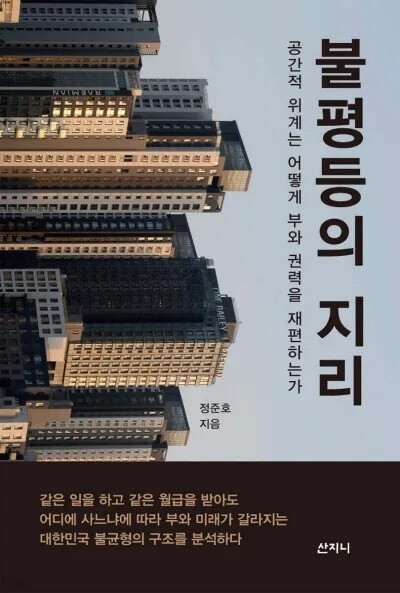
The Geography of Inequality: How Location Shapes Wealth and Power in South Korea

Hwang Sujin Reporter / Updated : 2026-09-13 13:41:19
  • -
  • +
  • Print


Even with the same job and the same salary, a person's wealth and future can drastically diverge depending on where they live. In his recent book, "The Geography of Inequality" (Sanzini, 38,000 KRW), Professor Jung Joon-ho of Kangwon National University explores the structural roots of South Korea's severe regional imbalances. Moving beyond conventional views that attribute regional disparities merely to income gaps or population decline, the book investigates how economic activities are spatially organized and how geographical hierarchies reinforce power structures. 

At the heart of this dynamic is spatial division of labor—often described as a "branch plant economy"—where corporate headquarters, research and development, and financial power concentrate in the capital region, while non-capital regions are relegated to production and manufacturing. This structural asymmetry leads to a geographical mismatch in income, which subsequently translates into housing-centric asset accumulation. Specifically, surging housing prices and asset premiums in the metropolitan area act as quasi-financial assets, widening the wealth gap between those who own property in the capital and those who do not. 

Ultimately, this cycle fuels the hyper-concentration of financial and political power in the capital, accelerating regional extinction and socioeconomic polarization. The book delivers a critical message: addressing South Korea's deep-rooted inequality requires rethinking space not merely as a physical location, but as a fundamental socioeconomic order that distributes capital, opportunity, and future prosperity.

[Copyright (c) Global Economic Times. All Rights Reserved.]

  • #\ormuz Impasse
  • #globaleconomictimes
  • #micorea
  • #mykorea
  • #nammidonganews
  • #singaporenewsk
  • #Samsung
  • #Daewoo
  • #Hyos
Hwang Sujin Reporter

Popular articles

  • South Korea to Revive Pro-Japanese Asset Recovery: New Law Targets "Disposed" Property

  • "The Era of Automatic Alliance Protection is Over": South Korea’s New 'Four-Pillar' Survival Strategy

  • South Korean Police Officer Suspended for Stealing AirPods at Gym, Caught via Bluetooth

I like it
Share
  • Facebook
  • X
  • Kakaotalk
  • LINE
  • BAND
  • NAVER
  • https://globaleconomictimes.kr/article/1065588037806212 Copy URL copied.
Comments >

Comments 0

Weekly Hot Issue

  • South Korean Court Grants Refugee Status to Iranian Convert Facing Potential Death Penalty for Apostasy
  • Japan Ground Self-Defense Force Under Fire for Covert Surveillance of Civilians, Including Ideology and Sexual Orientation
  • Miracle in the Bering Sea: 15-Year-Old Alaska Boy Rescued After Days Adrift on Capsized Boat 
  • China’s AI Industry Pivots from Model Development to Token-Driven Monetization via AI Agents
  • Hwang Hee-chan’s Brilliant Schalke Debut Secures First Win in Dramatic Fashion
  • Prospects of a Historic Face-to-Face Meeting: Ukrainian President Zelenskyy Conditions Attendance at Miami G20 Summit on Putin's Presence

Most Viewed

1
Bridging Nations, Building Futures: Reflections of Ethiopia's Ambassador to the Republic of Korea
2
Connecting Generations and Cultures through the Sound of Drums: Master Lee Kyung-hwa Holds Successful Jindo Buk-chum Workshop in Berlin
3
10 Minutes Before Flood: “Run to High Ground Right Now”… 900 Students’ Lives Saved by Urgent Response
4
Concerns Over Earnings Illusion: "AI Big Tech Sees $220 Trillion in Equity Valuation Gains from Stakes in Other Companies"
5
First Private-Led "World Hansang Global Convention" Outlined... 3,000 People Gather in Incheon 
광고문의
임시1
임시3
임시2

Hot Issue

Seoul Metropolitan Government Announces Comprehensive Chuseok Measures for 2026: Extended Public Transit, Emergency Medical Services, and Welfare Support

President Lee Jae-myung Congratulates Director Lee Chang-dong on Venice Film Festival Win: "Hoping to Broaden the Diversity of Korean Cinema"

National Tax Service to Provide Proactive Guidance and Refunds for Jointly Owned Home Comprehensive Real Estate Holding Tax

Lotte and KAIST Complete New R&D Center to Spearhead Climate Change and Carbon Neutrality Solutions

Fashion Runway Show 2026

Global Economic Times
korocamia@naver.com
CEO : LEE YEON-SIL
Publisher : KO YONG-CHUL
Registration number : Seoul, A55681
Registration Date : 2024-10-24
Youth Protection Manager: KO YONG-CHUL
Singapore Headquarters
5A Woodlands Road #11-34 The Tennery. S'677728
Korean Branch
Phone : +82(0)10 4724 5264
#304, 6 Nonhyeon-ro 111-gil, Gangnam-gu, Seoul
Copyright © Global Economic Times All Rights Reserved
  • 향기네무료급식
  • BCB부천방송
  • 반달곰 프로젝트
Search
Category
  • All articles
  • Synthesis
  • World
  • Business
  • Industry
  • ICT
  • Distribution Economy
  • Well+Being
  • Travel
  • Eco-News
  • Education
  • Korean Wave News
  • Opinion
  • Arts&Culture
  • Sports
  • People & Life 
    • 전체
    • International Student Report
    • With Ambassador
  • Column 
    • 전체
    • Cho Kijo Column
    • Cherry Garden Story
    • Ko Yong-chul Column
    • Kim Seul-Ong Column
    • Lee Yeon-sil Column
  • Photo News
  • New Book Guide
  • Overseas Koreans
  • Multicultural News