![[등록] 2026-09-01 15:48:31](/support/_updata/banner2/tl181982910_6749.png)


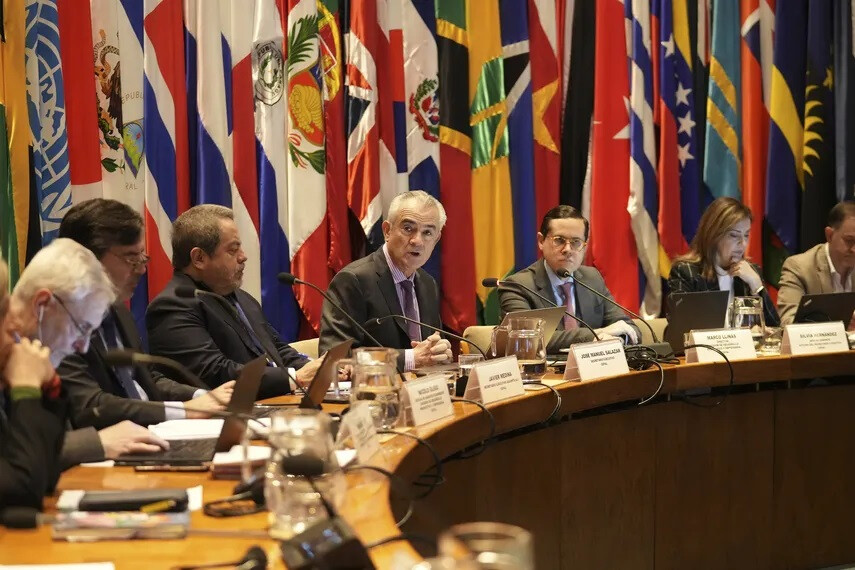
SANTIAGO, Chile – According to the 'Fiscal Panorama of Latin America and the Caribbean 2025' report, released by the Economic Commission for Latin America and the Caribbean (ECLAC) at its 37th Regional Seminar on Fiscal Policy in May [date unclear, likely May 27, 2025], countries in the region have largely succeeded in reducing their fiscal deficits. However, they are struggling to secure fiscal health due to high debt levels and increasing interest payments. The report particularly highlights that a contraction in public investment is hindering the establishment of a foundation for long-term economic growth.
Fiscal Deficit Reduction and Its Underside
ECLAC noted in its report that some countries, including Argentina, Ecuador, Honduras, and Paraguay, have significantly reduced their fiscal deficits. This is attributed to the respective governments' austerity efforts and adherence to fiscal discipline. Paraguay, in particular, saw a positive impact on its fiscal health due to a substantial increase in corporate income tax revenue, driven by the recovery of agricultural production and profitability in 2023.
However, a darker shadow lurks behind these positive indicators. The report pointed out that countries in the region tended to reduce capital expenditure, or public investment, to cover their fiscal deficits. Capital expenditure, which involves fixed asset investments aimed at improving infrastructure, promoting economic growth, and enhancing long-term productivity, has either stagnated or contracted in most countries in 2024. This is explained as an effort to close fiscal gaps or re-achieve fiscal rule targets.
ECLAC Executive Secretary José Salazar emphasized, "Limited fiscal space, persistent deficits, high public debt levels, and increasing debt costs are hindering Latin American countries' ability to use fiscal policy as a development tool." This statement warns of a vicious cycle where short-term fiscal goals are achieved at the expense of long-term growth drivers.
Snowballing Interest Payments
A greater concern is the continuous increase in interest payments. In 2024, interest payments continued to rise, exacerbating the trend observed in the previous year. This increase was largely influenced by rising public debt in some countries, coupled with high domestic and international interest rate environments.
ECLAC analyzed that long-term domestic interest rates related to public debt remain significantly higher than pre-2020 levels. The impact of these high interest rates was particularly pronounced in countries that required more financing in 2023 or faced significant debt maturities in 2024.
Paraguay and Ecuador, for instance, faced unfavorable fluctuations in international benchmark interest rates, such as the yields on 10-year US Treasury bonds. This affected variable-rate debt instruments and some multilateral and bilateral debts. Currently, Paraguay's public debt stands at $19.0234 billion, which accounts for 41.2% of its Gross Domestic Product (GDP). While this is relatively lower compared to other countries in the region, such as Argentina (estimated at 45.3%), the growing interest burden is pressuring its fiscal operations.
Paraguay's Economic Reality and Challenges
Paraguay traditionally has an economy heavily reliant on agriculture, with soybean exports significantly influencing its economic growth. While the recovery of the agricultural sector in 2023 contributed to increased tax revenue, the volatility of international agricultural commodity prices can be a vulnerability for Paraguay's economy. Furthermore, despite its immense hydroelectric power potential, industrial diversification and infrastructure expansion remain crucial challenges.
The ECLAC report suggests that agriculture-dependent countries like Paraguay can be vulnerable to external shocks. A decline in agricultural prices or poor harvests due to climate change could directly impact fiscal revenue, which in turn could lead to a deterioration in fiscal health and a reduction in public investment. Therefore, the Paraguayan government must pursue structural reforms and industrial diversification efforts for long-term economic stability and growth, beyond just short-term fiscal management.
The Dilemma of Latin American Fiscal Policy
The average fiscal outcomes for Latin American countries in 2024 appeared relatively stable, but this reflects the diverse situations of individual nations. While countries like Argentina, Ecuador, Honduras, and Paraguay significantly reduced their fiscal deficits, Colombia and Panama saw their fiscal deficits expand due to a decline in public revenue.
Through this report, ECLAC clearly illustrated the fiscal dilemma faced by Latin American countries. While austerity measures are essential for ensuring fiscal health, they can lead to a contraction in public investment, which in turn undermines long-term economic growth potential. Moreover, the global high-interest-rate environment and high debt levels are leading to increased interest payments, reducing the flexibility of fiscal operations.
Therefore, countries in the region should not solely focus on fiscal deficit reduction but also establish sustainable fiscal management strategies. This should include: efforts to diversify and enhance the efficiency of the tax base; strengthening debt management strategies to ensure the soundness of public debt; exploring ways to contribute to long-term productivity improvements through selective and effective public investment; and preparing for volatility in international financial markets.
ECLAC plans to continue providing support and policy recommendations to help Latin American countries achieve their development goals through fiscal policy, even amidst these challenging fiscal circumstances. Ultimately, however, strong political will from individual governments and sustained efforts towards structural reforms will be necessary to overcome current fiscal constraints and pursue a path of sustainable growth.
[Copyright (c) Global Economic Times. All Rights Reserved.]