"I feel like I can’t live without them anymore..."
Wet wipes have become an indispensable part of modern daily life, used everywhere from restrooms to restaurants. People now reach for them out of pure habit.
However, few people realize that these convenient wipes can cause unexpected damage.
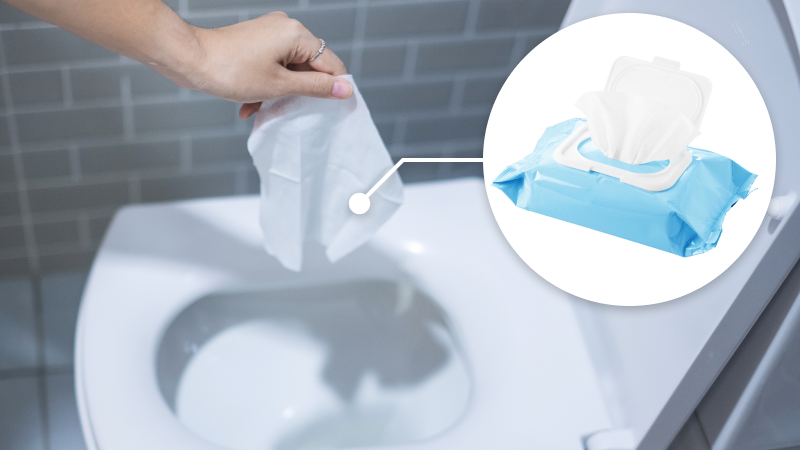
The most common issue is blocked sewage pipes. Wet wipes flushed down the toilet entangle with grease to form massive sludge masses, sometimes even causing sewage to back up into homes.
The reason is simple: they do not easily dissolve in water. Contrary to what their name suggests, most are made of "plastic" components.
Wipes that wash into rivers and streams break down into microplastics, negatively threatening aquatic life, including fish.
The problem is so severe that some countries have enacted laws banning the sale of wet wipes entirely. In South Korea, however, production continues to rise.
According to the Ministry of Food and Drug Safety, domestic production of wet wipes for food-service establishments reached 67.5 billion won last year, a 19% increase from the previous year. Compared to 2021 (43.0 billion won), production surged by 57% in just four years.
Disposal volume has also increased significantly. According to the National Waste Statistics Survey published by the Ministry of Environment, the average amount of wet wipes discarded per person in standard trash bags between 2021 and 2022 was 22.49g, more than double the 10.59g recorded five years prior.
It is easy to think of wet wipes as simply "paper soaked in water." But many commercially available wet wipes are made of plastic-based synthetic fibers rather than paper. Materials such as polyester and polypropylene are typical, allowing the wipes to remain tough and tear-resistant even when wet.
While convenient to use, disposal tells a different story. Regular toilet paper dissolves relatively easily in water. In contrast, plastic-based wet wipes maintain their original shape underwater for a long time.
Consequently, flushing wet wipes can clog the interior of sewage pipes and disrupt water flow. When accumulated wipes mix with cooking oil grease from food, they form massive masses known as "fatbergs."
Damage from wet wipes has reached serious levels abroad. According to the UK government, wet wipes are involved in approximately 94% of sewer blockages. Water utility companies spend about £200 million (approx. 350 billion KRW) annually just to resolve this.
Hundreds of billions of won are spent clearing pipes and repairing broken infrastructure. The environmental impact is equally severe. Escaping into rivers and oceans, wet wipe components do not easily degrade in nature. Over time, they break down into microplastics.
UK government data revealed that between 2015 and 2020, an average of 20 wet wipes were found per 100 meters of coastline on British beaches. These microplastics are ingested by fish and other aquatic life, harming marine ecosystems.
What about flushable wet wipes labeled "safe to flush"? Not necessarily. While flushable options designed to dissolve in water are available, the speed and degree of dissolution vary by product.
Even plastic-free products can clog sewage pipes if they do not dissolve as quickly as regular toilet paper. Consequently, the UK government advises throwing even "flushable" wet wipes into the trash bin.
Even eco-friendly, biodegradable wet wipes cannot be fully trusted. A March study by Kangwon National University researchers on 15 types of wet wipes sold in Korea found toxicity to aquatic life in extracts from some biodegradable products.
Nor do they vanish quickly in nature. Cardiff University researchers tested two types of biodegradable wet wipes across 10 actual rivers, finding that most remained intact even after five weeks.
As environmental pollution from wet wipes worsens, overseas governments are pursuing stringent regulations. The UK is a prime example, passing a law last November banning the sale and supply of single-use wet wipes containing plastic.
Rollouts begin in Wales this December, followed sequentially by England and other regions next year. Not all wet wipes are banned; plastic-free products are exempt, along with certain medical items.
Still, designating everyday wet wipes as sales-restricted items is noteworthy, signifying a regulatory approach starting from production and distribution to curb environmental damage.
Conversely, critics point out that South Korea remains in a blind spot for environmental regulation regarding wet wipes. A report published this January by the National Assembly Research Service noted that 80% to 90% of "screenings"—debris caught in domestic sewage treatment facilities—consist of wet wipes.
This indicates that wet wipes place a heavy burden on Korean sewage facilities. Yet, they are not currently included under single-use product restrictions in the Wastes Control Act.
While facial/cleansing wipes are managed as cosmetics and food-service wipes as sanitation items, regulations to curb environmental pollution generated during plastic use and disposal remain inadequate. Consequently, calls are growing to include wet wipes under single-use regulations and strengthen producer responsibility.
The National Assembly Research Service emphasized, "The UK's case marks a turning point, viewing the wet wipe issue not merely as garbage management, but as a national infrastructure and environmental protection issue," adding, "A prevention-focused approach at the production stage is also needed in domestic policy."
[Copyright (c) Global Economic Times. All Rights Reserved.]