• 2026.03.06 (Fri)
  • All articles
  • LOGIN
  • JOIN
Global Economic Times
fashionrunwayshow2026
  • Synthesis
  • World
  • Business
  • Industry
  • ICT
  • Distribution Economy
  • Well+Being
  • Travel
  • Eco-News
  • Education
  • Korean Wave News
  • Opinion
  • Arts&Culture
  • Sports
  • People & Life
    • International Student Report
    • With Ambassador
  • Column
    • Cho Kijo Column
    • Cherry Garden Story
    • Ko Yong-chul Column
    • Kim Seul-Ong Column
    • Lee Yeon-sil Column
  • Photo News
  • New Book Guide
MENU
 
Home > Business

South Korea to Pursue Tariff Reductions Following Japan's Precedent with Large-Scale Investment in the US... Anticipating Turbulences in Trade Environment

Global Economic Times Reporter / Updated : 2025-07-24 11:59:32
  • -
  • +
  • Print

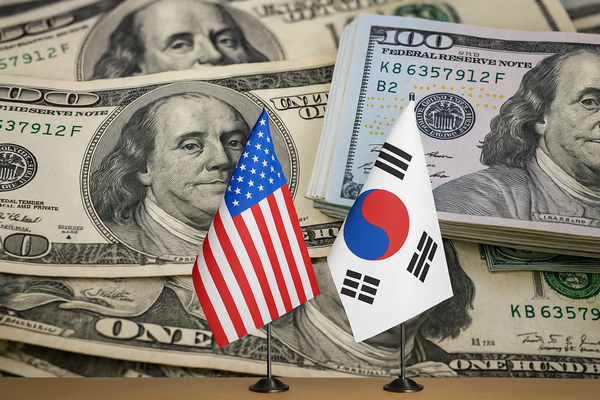
The South Korean government is reportedly considering creating a fund for investment in the United States as a way to lower the 25% reciprocal tariff imposed by the US to 15%, similar to the Japanese case. This move follows Japan's recent agreement to invest $550 billion in the US, reducing reciprocal and automobile tariffs to 15%, and opening its agricultural markets (including rice and beef) and digital markets. It is understood that the US is also demanding several hundred billion dollars in investment commitments from South Korea in the current trade negotiations, and it is highly likely that an agreement to expand US purchases of South Korean key industrial products will be included.

The imposition of a 25% reciprocal tariff by the US on South Korea is attributed to a surging trade deficit. The US trade deficit with South Korea, which was $17.9 billion in 2018, more than tripled to $65.8 billion last year, mainly due to increased exports of South Korean automobiles and semiconductors. The US claims that South Korea imposes a 50% tariff on US products and has therefore applied 25% as a reciprocal tariff. Concerns are rising about a decrease in South Korean exports to the US in industries such as textiles, apparel, fine chemicals, and computers. This reciprocal tariff is based on the Trump administration's International Emergency Economic Powers Act (IEEPA) and is the highest level among FTA signatory countries with the US.

South Korea's investment in the US is already active. Last year, 43% of South Korea's overseas investment flowed into the US, the highest since 1988. South Korean companies are actively participating in US manufacturing resurgence policies, such as Samsung Electronics' investment in a Texas foundry plant, proving themselves as key partners in the global supply chain. In particular, due to the impact of the US CHIPS Act and Inflation Reduction Act (IRA), investment in manufacturing sectors such as semiconductors and secondary batteries in the US is expected to continue. This aligns with the trend of expanding economic exchange between South Korea and the US, as evidenced by South Korean exports to the US surpassing those to China to rank first in December last year.

Meanwhile, the 'South Korea-US 2+2 Trade Consultation,' originally scheduled to be held on the 25th (local time) in Washington D.C., has been postponed due to a scheduling conflict for US Treasury Secretary Scott Bessent. This consultation was significant as it was the first inter-governmental meeting where both countries' finance and trade ministers were to discuss concerns related to US tariff policies. However, the visit schedules of South Korean Minister of Trade, Industry and Energy Kim Jung-kwan and Minister for Trade Yeo Han-koo to the US will proceed as planned. They are scheduled to meet with US Commerce Secretary Howard Lutnick and USTR Representative Jamieson Greer, respectively, to discuss reciprocal tariffs and product-specific tariffs. At the 2+2 trade consultation held last April, South Korea strongly requested tariff exemptions and exceptions from the US, emphasizing the negative impact on the automotive sector. The government plans to focus on preparing a 'July Package' with the goal of tariff abolition before July 8th, when the reciprocal tariff grace period ends. Future trade negotiations between South Korea and the US are expected to be a major turning point in assessing the economic interests and trade policy directions of both countries.

[Copyright (c) Global Economic Times. All Rights Reserved.]

  • #globaleconomictimes
  • #micorea
  • #mykorea
  • #Lifeplaza
  • #nammidonganews
  • #singaporenewsk
  • #Samsung
  • #Daewoo
  • #Hyosung
  • #A
Global Economic Times Reporter
Reporter Page

Popular articles

  • A New Milestone for Ukraine’s Post-War Reconstruction: The Birth of ISVP

  • About mexican food 

  • War Memorial Association Launches Youth Education Program Idea Contest

I like it
Share
  • Facebook
  • X
  • Kakaotalk
  • LINE
  • BAND
  • NAVER
  • https://globaleconomictimes.kr/article/1065581943815062 Copy URL copied.
Comments >

Comments 0

Weekly Hot Issue

  • The Illusion of a "Stress-Relieving" Smoke: Study Finds Smokers More Prone to Depression
  • From Table to Space: Japan Unveils Edible Spoons Made of Cookies
  • Luckin Coffee Shakes Up Global Market with Blue Bottle Acquisition
  • U.S. Private Sector Hiring Hits 7-Month High in February, ADP Reports
  • Self-Employed Loan Delinquency Rates Double in a Decade Amid Economic Headwinds
  • Multi-Homeowner Loan Balance Hits 103 Trillion Won; Half Concentrated in Seoul and Gyeonggi

Most Viewed

1
Adwa’s Echo in Korea: A Shared Story of Dignity and Freedom
2
2026, The Grand Year of Hangeul Celebration — The River of History Where Five Streams Converge
3
A New Milestone for Ukraine’s Post-War Reconstruction: The Birth of ISVP
4
Mexican currency and the powerful history behind its designs
5
Revised and Expanded Edition of ‘Failure of Negotiations with North Korea: Truth and Solutions’ Published
광고문의
임시1
임시3
임시2

Hot Issue

South Korean Markets Shaken by "Iran Shock": KOSPI Suffers Historic Rout Amid Soaring Oil and FX Rates

Self-Employed Loan Delinquency Rates Double in a Decade Amid Economic Headwinds

U.S. Private Sector Hiring Hits 7-Month High in February, ADP Reports

Industrial Output Dips in January Amid Semiconductor Adjustments; Middle East Tensions Loom as Wild Card

Let’s recycle the old blankets in Jeju Island’s closet instead of incinerating them.

Global Economic Times
korocamia@naver.com
CEO : LEE YEON-SIL
Publisher : KO YONG-CHUL
Registration number : Seoul, A55681
Registration Date : 2024-10-24
Youth Protection Manager: KO YONG-CHUL
Singapore Headquarters
5A Woodlands Road #11-34 The Tennery. S'677728
Korean Branch
Phone : +82(0)10 4724 5264
#304, 6 Nonhyeon-ro 111-gil, Gangnam-gu, Seoul
Copyright © Global Economic Times All Rights Reserved
  • 에이펙2025
  • APEC2025가이드북TV
  • 독도는우리땅
Search
Category
  • All articles
  • Synthesis
  • World
  • Business
  • Industry
  • ICT
  • Distribution Economy
  • Well+Being
  • Travel
  • Eco-News
  • Education
  • Korean Wave News
  • Opinion
  • Arts&Culture
  • Sports
  • People & Life 
    • 전체
    • International Student Report
    • With Ambassador
  • Column 
    • 전체
    • Cho Kijo Column
    • Cherry Garden Story
    • Ko Yong-chul Column
    • Kim Seul-Ong Column
    • Lee Yeon-sil Column
  • Photo News
  • New Book Guide
  • Multicultural News
  • Jobs & Workers