![[등록] 2026-09-01 15:48:31](/support/_updata/banner2/tl181982910_6749.png)


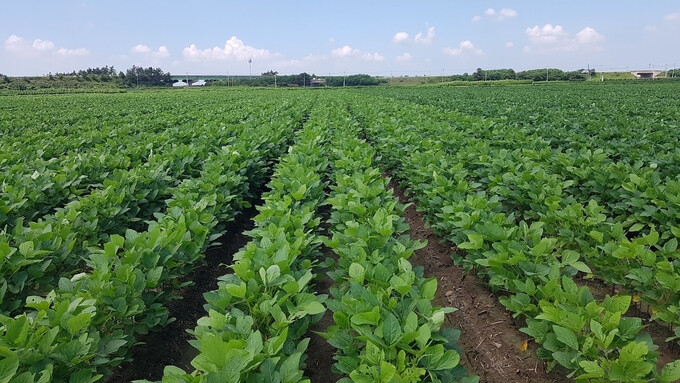
In the face of escalating threats from climate change, the South Korean government is intensifying its efforts to enhance national food security. A key strategy involves actively encouraging farmers to adopt dual-cropping systems in rice paddies, specifically the cultivation of soybeans or a rotation of wheat followed by soybeans. To underpin this policy, the Rural Development Administration (RDA) has unveiled a suite of high-yielding wheat and soybean varieties specifically bred for dual-cropping suitability.
The newly developed wheat varieties, ‘Hwanggeumal,’ ‘Baekgyeong,’ and ‘Hanmyeon,’ alongside the soybean varieties ‘Jangpung,’ ‘Seonyu 2ho,’ and ‘Pyeongan,’ boast shorter growth periods, making them ideal for integration into dual-cropping cycles. Furthermore, these cultivars exhibit excellent adaptability to mechanization and deliver high yields, crucial factors for widespread adoption.
‘Hwanggeumal’ stands out as a bread-making wheat variety demonstrating exceptional adaptability to rotation with both rice and soybeans. It exhibits superior resistance to lodging (falling over) and pre-harvest sprouting compared to existing varieties. With a protein content of 14% and a gluten content of 10%, ‘Hwanggeumal’ produces well-risen bread with a soft crumb. Consumer sensory evaluations in 2023 placed its quality on par with imported wheat, with descriptive analysis even suggesting a softer texture. Currently, 505 tons of ‘Hwanggeumal’ seeds are being distributed to farmers nationwide through the National Seed Resources Center's government-supported seed production system.
‘Baekgyeong,’ another high-yielding bread wheat (538 kg per 10 ares), is characterized by its strong resistance to cold and lodging. Its superior gluten protein composition contributes to excellent dough stability and large bread volume. In 2024, baking suitability assessments by a major food processing company (SPC) demonstrated that ‘Baekgyeong’’s specific volume and loaf volume rivaled that of premium imported hard wheat flour, positioning it as a top-tier domestic bread wheat variety.
‘Hanmyeon’ is a high-yielding (548 kg per 10 ares) noodle wheat variety with a rapid maturation period. Its protein content of 10.8% and sedimentation value of 56.0 ml surpass those of conventional varieties, making it well-suited for dry noodle production. It also exhibits high brightness and excellent extensibility. Consumer preference tests in 2024 indicated a higher preference for ‘Hanmyeon’ over imported wheat for ramen production. ‘Baekgyeong’ and ‘Hanmyeon’ are slated for expanded government-supported distribution following high-purity seed production in three regions, including Jeollabuk-do, through the RDA’s New Variety Utilization Promotion Project.
Among the soybean varieties, ‘Jangpung’ features a high pod-setting height of approximately 25 cm, 7-8 cm taller than existing varieties, a key attribute for mechanized harvesting. Its limited branching (averaging 1.1 branches) minimizes harvest losses during combine harvesting, and it exhibits resistance to pod shattering at maturity. The elevated pod height also helps mitigate damage from flooding during summer typhoons, a significant advantage in low-lying paddy fields. Its low branching characteristic also allows for successful cultivation in denser planting arrangements.
‘Seonyu 2ho’ boasts a short growth duration, enabling harvesting by mid-October when planted in mid-June, making it ideal for dual-cropping with winter crops like wheat and onions. It exhibits resistance to pod shattering, produces large seeds, and offers a high yield of 334 kg per 10 ares. However, its lower pod-setting height necessitates denser planting (1.5 times the normal density) to minimize mechanical harvesting losses. Furthermore, its seed development during hot and humid periods requires preventative fungicide application to manage fungal diseases.
‘Pyeongan’ offers a 18% yield increase over existing varieties, reaching 400 kg per 10 ares, with a pod-setting height of 19 cm. Notably, it exhibits strong waterlogging tolerance, ensuring high yields even in flood-prone areas. Following field evaluations of optimal cultivation techniques and stability in major paddy soybean cultivation complexes this year, ‘Pyeongan’ is slated for full-scale distribution.
The South Korean government aims to achieve a food self-sufficiency rate of 55.5% by 2027, with specific targets of 8% for wheat and 43.5% for soybeans. To achieve these goals, the government is accelerating the dissemination of domestically bred wheat and soybean varieties, fostering high-quality raw grain production complexes, and bolstering support for stable production technologies resilient to climate-related disasters. In line with this, the RDA is working to expand the cultivation area of domestic wheat and establish an industrialization system encompassing milling and processing, in conjunction with the Korean Wheat Industry Valley pilot project.
As part of the Wheat Industry Valley pilot project, wheat milling facilities have been sequentially completed this year in four regions: Gimje (Jeollabuk-do), Gurye (Jeollanam-do), Gumi (Gyeongsangbuk-do), and Hamyang (Gyeongsangnam-do). Since last year, the RDA has been collaborating with the pilot project to evaluate the milling and processing suitability of promising wheat lines. Currently, a localized domestic wheat product production system, integrating cultivation, milling, and product development using the ‘Hanmyeon’ variety, is being piloted in Gimje and Gurye.
Furthermore, the RDA is actively promoting water management technologies to address drainage issues and prevent flood damage, major challenges in paddy dual-cropping. These include ‘non-excavation underground drainage technology’ and ‘rice husk-filled underground drainage technology.’
Dr. Kwak Do-yeon, Director of the National Institute of Crop Science at the RDA, emphasized, "We will do our utmost to expand the distribution of machinery-optimized varieties, promote mechanization of upland farming to reduce labor and improve food self-sufficiency, and establish drainage technologies to cope with extreme weather events such as torrential rains, to ensure stable production of food and field crops like wheat and soybeans in large-scale paddy fields." These concerted efforts signify South Korea's commitment to bolstering its food security in an era of increasing climate volatility.
[Copyright (c) Global Economic Times. All Rights Reserved.]