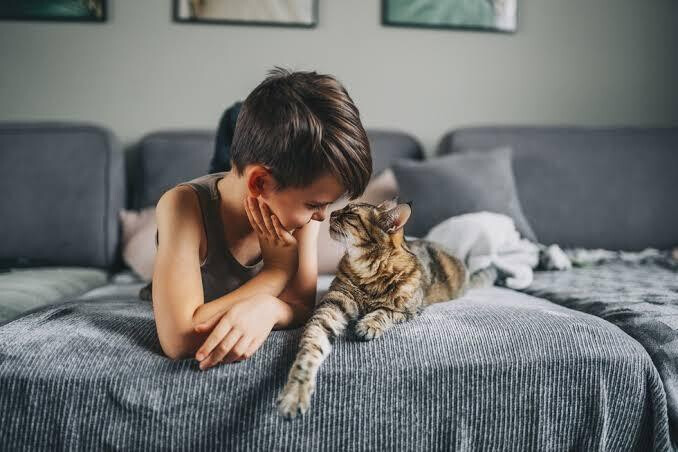
A long-term Spanish cohort study tracking nearly 1,900 families reveals that consistent care of fish, turtles, and hamsters protects young children’s emotional well-being, whereas intermittent cat ownership at ages four and five is linked to higher behavioral challenges.
MADRID — For many parents, bringing a furry or scaly friend into the home seems like a surefire way to teach children empathy and ease childhood anxiety. However, new research suggests that when it comes to a child’s psychological development, the species of the pet—and how consistently it remains in the home—matters far more than previously thought.
According to findings from the Spanish Infancia y Medio Ambiente (INMA, or Environment and Childhood) project, published in the World Journal of Pediatrics, owning a cat during early childhood was uniquely associated with an increased risk of mental health difficulties later in elementary school. Conversely, low-maintenance creatures such as fish, turtles, rabbits, and hamsters demonstrated a measurable protective effect against emotional distress.
Tracking Nearly 1,900 Households
Researchers monitored 1,893 households across four regions of Spain—Asturias, Gipuzkoa, Sabadell, and Valencia—following children from the prenatal stage through ages seven and eight. Just over half of the participating families (52.3%) owned at least one pet during the study period, with dogs, small animals, birds, and cats making up the household menagerie.
When investigators evaluated the children’s psychological profiles at ages seven to eight—measuring both "internalizing" symptoms like anxiety and depression, and "externalizing" behaviors such as aggression and rule-breaking—several distinct patterns emerged after adjusting for socioeconomic status, gender, and family background:
The Feline Factor: Children who lived with a cat specifically around ages four to five—particularly those with intermittent exposure rather than lifelong companionship—exhibited higher rates of both internalizing and externalizing behavioral issues.
The Small-Pet Advantage: Continuous ownership of small animals, including hamsters, rabbits, fish, and turtles, correlated with stronger emotional resilience in both boys and girls.
Neutral Impact of Dogs and Birds: Despite the popular belief that dogs are ideal childhood companions, neither dog nor bird ownership showed a statistically significant positive or negative impact on mental health outcomes within this age bracket.
Correlation, Not Necessarily Causation
The study’s authors caution parents against viewing cats as a direct cause of psychological harm, offering several behavioral and biological explanations for the data.
First, researchers point to the possibility of "reverse causality." Because cats are largely self-sufficient and require less hands-on maintenance than dogs, families whose children are already struggling with emotional or behavioral challenges may be more inclined to adopt a cat as a soothing, low-stress companion.
Second, the nature of human-animal interaction plays a key role. Cats tend to be independent and occasionally aloof, which may limit deep emotional bonding for a four-year-old. Unlike dogs, indoor cats also do not encourage outdoor physical exercise, a known buffer against childhood anxiety. Additionally, the researchers noted the potential biological influence of Toxoplasma gondii—a common feline parasite that has been linked in prior medical literature to subtle neurological and behavioral shifts in humans.
Why Consistency Wins
Why did humble goldfish and hamsters outperform more interactive mammals? Experts suggest that small, contained pets offer young children predictable, manageable routines. Feeding a turtle or cleaning a hamster cage provides daily lessons in responsibility and self-control without overwhelming a young child.
Furthermore, the data underscored that uninterrupted companionship yields far better outcomes than sporadic pet ownership, likely because losing or rehoming a pet during formative years can disrupt a child's sense of security. Researchers concluded that while animals can act as valuable social catalysts for youth, the true mental health benefits depend heavily on a child's developmental stage, parenting style, and the stability of the bond.
[Copyright (c) Global Economic Times. All Rights Reserved.]