


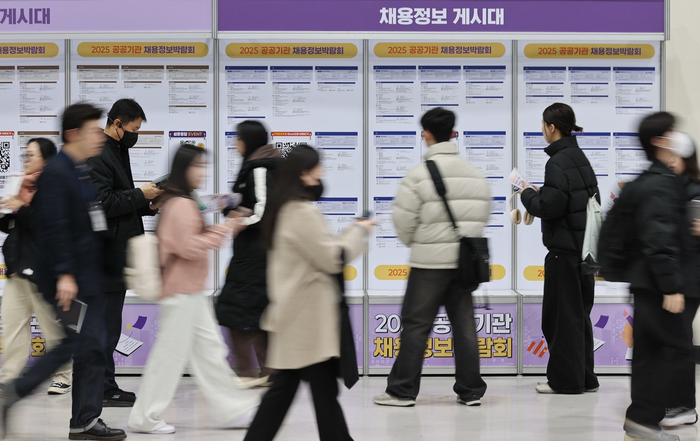
SEOUL — South Korea’s labor market has hit a major roadblock as permanent employment contracted for the first time in over 26 years, dealing a heavy blow to young job seekers. According to data released by the National Data Agency and an analysis of microdata on the economically active population on June 15, 2026, the number of permanent workers stood at 16.74 million last month, a decline of 7,000 compared to the previous year.
This marks the first drop in permanent employment since December 1999, when the nation was reeling from the Asian Financial Crisis. Permanent workers are defined as salaried employees expected to work for a year or more, a category widely seen as the backbone of stable, high-quality employment. This crucial sector had maintained an uninterrupted growth streak for 316 consecutive months since January 2000, only to reverse course last month.
The overall employment market also deteriorated, with the total number of employed individuals shrinking by 40,000, fueled in large part by the economic fallout from ongoing geopolitical conflicts in the Middle East. Paradoxically, the proportion of permanent jobs relative to total employment reached an all-time high of 57.5%, a statistical phenomenon resulting from a sharper decline in overall employment rather than market health.
Young Professionals Bear the Brunt
The contraction in stable jobs was overwhelmingly concentrated among youth and young professionals in their 20s and 30s. Permanent positions for workers in their 20s plunged by 164,000, while those for individuals in their 30s fell by 34,000. Combined, the two demographics lost 197,000 permanent jobs, marking the steepest decline since December 2020.
A sector-by-sector analysis reveals a troubling structural shift. The manufacturing industry, long the engine of the Korean economy, lost 92,000 permanent jobs for workers in their 20s and 30s. Total manufacturing employment has now extended its downward trajectory to 23 consecutive months, shedding 140,000 positions last month alone. While permanent positions for individuals in their 50s dropped by 46,000, those for workers aged 60 and older bucked the trend, rising by 18,000, highlighting a stark generational divide.
For those in their 20s, the crisis was widespread, with regular, temporary, and daily wage jobs all experiencing a downturn. Alarmingly, the 20s demographic saw a massive drop of 57,000 permanent jobs in the information and communications technology (ICT) sector, surpassing losses in manufacturing. Conversely, permanent jobs for workers in their 30s within the ICT sector grew by 26,000, hinting at a corporate hiring shift that heavily favors seasoned, experienced professionals over entry-level graduates.
Meanwhile, workers in their 30s faced a brutal correction in the professional, scientific, and technical services sectors, where permanent jobs plummeted by 76,000. This sector includes high-skill fields such as research and development, architectural engineering, legal services, and accounting. The sharp decline has raised concerns that advanced artificial intelligence (AI) is beginning to displace white-collar professionals, though the government has cautioned that it is premature to definitively attribute the hiring crunch to AI automation.
Economic Uncertainty and Government Action
The ongoing war in the Middle East remains a volatile wild card for an economic recovery. High raw material prices and accumulating corporate cost pressures have forced businesses to freeze or scale back their recruitment plans. While the government originally projected a net job growth of 160,000 for this year, officials now acknowledge that the path forward is highly uncertain.
"It is difficult to predict the timing or speed of a labor market recovery," stated an official from the Ministry of Strategy and Finance. In response to the crisis, Deputy Prime Minister and Minister of Strategy and Finance Koo Yun-chul declared that improving youth employment is the government's topmost policy priority. The administration has vowed to launch an inter-departmental review to closely monitor employment trends by sector and age group, aiming to implement immediate relief measures alongside long-term structural reforms.
[Copyright (c) Global Economic Times. All Rights Reserved.]