![[등록] 2026-09-01 15:48:31](/support/_updata/banner2/tl181982910_6749.png)


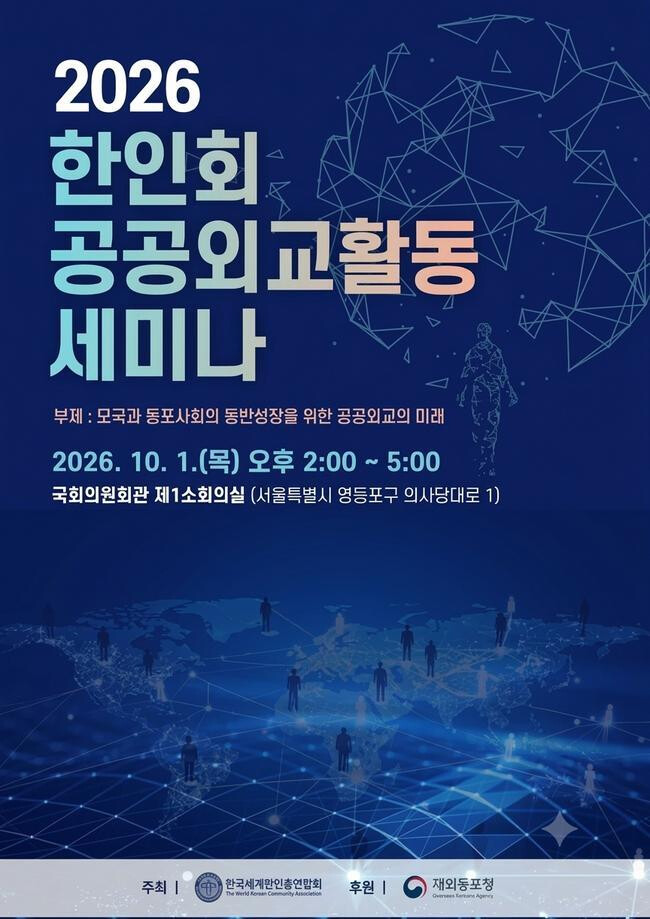
The 5th Overseas Korean Associations Public Diplomacy Seminar hosted on Oct 1 at Assembly Members' Office Building (Conference Room No. 1)
Road signs, a carton of milk, a plate of kimchi: 8 field cases that moved host societies
Special lecture by Park Ki-tae, Head of VANK: "100 Years of Memory, 100 Years of Mission"
By Yoo Kyung-jo, General Managing Director, Federation of Korean Associations, World = In the heart of a Korean town in the greater Washington D.C. area, a bilingual road sign reading "SEOUL Blvd" has been erected. In Kuala Lumpur, Malaysia, milk is delivered monthly to low-income families through the sponsorship of South Korean corporations. In Hamilton, New Zealand, local residents wear Hanbok and make kimchi.
These scenes were not created by embassies or government agencies, but by Korean associations around the world working hand-in-hand with local administrative bodies, corporations, and civil society. Rather than grandiose slogans, this is "Public Diplomacy in Daily Life," stepping directly into the daily lives of local residents to build trust and affinity for South Korea.
The Federation of Korean Associations, World (FKAW, President Koh Sang-goo) hosted the "2026 Korean Association Public Diplomacy Seminar" from 2:00 PM to 5:00 PM on October 1 at Conference Room No. 1 of the National Assembly Members' Office Building. Marking its fifth year, the seminar’s theme was "The Future of Public Diplomacy for the Co-Growth of the Motherland and the Overseas Korean Community."
The event was co-hosted by FKAW and National Assembly Member Lee Jae-kang, and sponsored by the Overseas Koreans Agency (OKA). Eight Korean associations and organizations operating in the United States, Canada, Japan, Malaysia, Cambodia, and New Zealand took the National Assembly stage to share their respective experiences and achievements.
Ruling and Opposition Parties, Along with Overseas Korean Policy Officials, Gather in One Place
The event proceeded in the order of an opening ceremony, a special lecture, case presentations, and a Q&A session. FKAW President Koh Sang-goo and Assembly Member Lee Jae-kang delivered welcoming remarks, followed by celebratory speeches from figures including Song Seok-jun, Chairperson of the National Assembly's Foreign Affairs and Unification Committee.
In his welcoming remarks, President Koh evaluated that Korean associations have gone beyond serving as a protective fence for diaspora communities, acting as the "leading protagonists of private diplomacy" to promote South Korea. He emphasized that amid a rapidly changing international order, the public diplomacy of Korean associations is a core driving force for strengthening solidarity with host societies and broadening the foundation of goodwill toward South Korea.
Through this seminar, FKAW aims to share the public diplomacy experiences of Korean associations worldwide and publicize their achievements back home, thereby elevating the status of Korean associations and the pride of the diaspora community.
The special lecture was delivered by Park Ki-tae, head of the cyber diplomatic mission VANK, under the title "100 Years of Memory, 100 Years of Mission." He discussed how to inherit the century-old history of Korean immigration as an asset for today's public diplomacy.
"SEOUL Blvd": Imprinting Korea on Public Spaces
The first theme focused on cases where traces of Korea were left in the systems and public spaces of host countries. Steve Lee, President of the Korean American Association of Greater Washington, presented on the process behind the designation of the honorary road name "SEOUL Blvd" in Annandale, Fairfax County, Virginia. Founded in 1953, the association is a representative Korean organization in the U.S. metropolitan capital region.
"SEOUL Blvd" was designated for a section of John Marr Drive, a central road in Annandale. Following approval by the Fairfax County Board of Supervisors in June 2025, the designation was finalized and officially proclaimed in October of the same year. Crucially, this is not a temporary event decoration, but an official road sign installed and managed by the local government.
In a multicultural region populated by federal public officials and numerous diplomat families, it has become a permanent public diplomacy medium where "Seoul" and the Korean alphabet (Hangul) are exposed on a daily basis. President Steve Lee has led the Korean Road Name Promotion Committee since 2013, connecting local politicians, administrative agencies, and the Korean community. This case demonstrates how cultural promotion can achieve long-lasting impact when it connects with institutions and public facilities.
From U.S. Congressional Resolutions to "Kimchi Day"
Kim Min-sun, Vice President of FKAW, took the stage as a presenter. Vice President Kim is also the director of the Museum of Korean Heritage (MOKAH) and a member of the Democratic National Committee (DNC). Her presentation was titled "Overseas Koreans and Public Diplomacy: Public Diplomacy Cases Accumulated in the U.S. Field and Policy Implications." She introduced achievements accumulated in the U.S. field, such as the congressional passage of the U.S.-Korea Alliance strengthening resolution, the enactment of "Kimchi Day," and the establishment of "Yu Gwan-sun Day" in New York State.
The core takeaway is that overseas Koreans are not merely objects of support for South Korea's public diplomacy, but "local partners." Diaspora members understand the language and systems of their host countries and are connected with local politicians, administrative agencies, and civil society. This means they possess local rootedness, continuity, and trust relationships that governments cannot easily secure in a short time. While the government creates a message, overseas Koreans ensure that message is translated into the language and culture of the local society and takes deep root, explained Vice President Kim.
Brooklyn’s Preservation of "Korean American Day"
From the Korean American Association of Greater Brooklyn, former President Park Sang-won and 21st-generation President Choi Yoon-hee presented together. Formally established in 1986, the Brooklyn Korean Association has utilized New York events commemorating "Korean American Day" on January 13 each year as a venue for public diplomacy. January 13 marks the day Korean immigrants first arrived in Hawaii in 1903.
The commemoration invites local politicians and figures from various fields, hosting award ceremonies highlighting the contributions of the Korean community alongside K-pop, Korean cuisine, and traditional cultural events. It is a method that combines historical commemoration, cultural diplomacy, and local political participation into a single event. Former President Park also serves as President of the General Association of Koreans in the World and national president of the League of Korean-Americans (LOKA-USA). Their presentation addressed not only achievements but also the practical challenge of "difficulty in recruiting association presidents" faced by Korean associations in the New York area. It offered a realistic critique that for public diplomacy to be sustainable, cultivating next-generation leaders and ensuring organizational succession are just as important as holding events.
Windsor: Connecting South Korea, Canada, and the U.S. Through Culture and Veterans Affairs
Kim Myung-jin, President of the Korean Canadian Association of Windsor, presented under the title "Connecting Korea and Canada Through Culture: Beyond Korean Culture to a Korea-Canada Bridge." The Windsor association has operated a "Korean Village" at "Carousel of Nations," a prominent local multicultural festival, introducing Korean food, performances, and traditional culture to local residents. They also consistently host Korean War veterans' memorial ceremonies and patriotic events, sharing the historical ties shared by both countries with the local community.
A notable aspect was the strategic utilization of Windsor's geographical characteristics as a public diplomacy asset. Windsor sits directly across the river from Detroit, USA. The Windsor Korean Association has established a cross-border network connecting Windsor-Essex in Canada and Detroit in the U.S. through reciprocal invitation events with the Detroit Korean Association. Combined with mobile consular cooperation with the Consulate General of Toronto, it presents a new model for a Korean association: the "Windsor-Essex-Detroit Connecting Hub." President Kim also serves as Vice President of the National Association of Korean Canadians.
Connecting Hearts in Fukuoka, Where Yun Dong-ju Rests
Shim Hyun-soo, President of the Kyushu Korean Association in Japan, delivered a presentation titled "Connecting the Hearts of Korea and Japan Through Taste and Style." The association has broadened touchpoints with Japanese citizens through traditional cooking classes hosted by its women's association, next-generation networking, and local volunteer activities. Notably, cultural projects honoring the poet Yun Dong-ju in connection with Hangeul Day drew significant attention.
The poet Yun Dong-ju ended his life in the Fukuoka Prison in February 1945. Remembering his poetry and life together in a city bearing the painful history between Korea and Japan is not about erasing the past through reconciliation, but about creating future solidarity by sharing memories. President Shim concurrently serves as the head of the Japanese Western Chapter of the Peaceful Unification Advisory Council and Vice President of the General Association of Koreans in Japan. The case of Kyushu carries deep significance in that it embraced history and memory into the realm of public diplomacy, rather than relying solely on the bright image of the Korean Wave (Hallyu).
Turning Local Residents from "Audience" to "Participants"
Koh Jeong-mi, President of the Waikato Korean Association in New Zealand, presented under the title "From a Small Korean Association to the Global Korean Community." The Waikato association has operated the "Waikato K-Festival," co-created by the diplomatic mission, the association, and the local community. The core of the festival lies in keeping local residents from remaining mere audience members watching Korean culture.
They wear Hanbok, make kimchi, taste Korean food, and experience traditional culture firsthand. It represents a shift from "culture to be watched" to "culture created together." This case was also introduced as a best practice for Korean association operations at the 2026 World Korean Association Presidents Convention.
President Koh serves as a teacher at the Waikato Korean School and representative of the K-Centre. She received the Queen's Service Medal (QSM) from New Zealand in 2012 and the National Civil Merit Medal from South Korea in 2024. The message of the Waikato model is that even a small regional Korean association can build a public diplomacy platform on par with state-level entities if it tightly connects diplomatic missions, local administrative agencies, schools, and civil society.
Public-Private Partnership Built by a Carton of Milk
Hwang Il-lok, President of the Korean Association in Malaysia, presented the low-income milk support project "Collect the Milk." Launched in November 2023, this project provides monthly milk supplies to B40 households—local low-income families. South Korean corporations such as POSCO, Hankook Tire, CJ, and SK sponsor the project on an annual basis, while the office of the Segambut Member of Parliament recruits and manages recipient households. Farm Fresh, a local dairy company, supplies the milk, utilizing QR codes and AI vending machines for distribution.
The Korean association successfully linked South Korean corporations, local political circles, local enterprises, and tech companies into a single social contribution framework. It is evaluated as a "public-private partnership model of public diplomacy" in that it goes beyond promoting Korea to jointly resolving practical livelihood issues needed by local residents. President Hwang returned to office this year as the 40th President of the Korean Association in Malaysia, having previously served as the 28th and 29th President. He has also served as President of the Korean Chamber of Commerce in Malaysia and head of the Malaysia chapter of the Peaceful Unification Advisory Council.
Cambodia Scam Crisis: Public Diplomacy as Restoring Trust
The presentation by Jung Myung-gyu, President of the Cambodian Korean Association, dealt with the heaviest subject of the seminar: "The Impact of the Cambodia Scam Incident on the Expatriate Community: Future Directions for the Development of Private Exchanges Between Korea and Cambodia." President Jung diagnosed that the fallout of the scam incident did not stop at individual crime victimization. Criminal damage cascaded into the tarnishing of Cambodia’s national image, which in turn contracted normal private exchanges with the local Korean community.
His critical awareness stems from how the livelihoods that expatriates cultivated over a long period were suddenly generalized under a single image of being a "dangerous country." He proposed the principle: "Be resolute against crime, and fair to the state and its people." Public diplomacy is not merely about publicizing a good image. Restoring trust broken by crisis and misunderstanding is also public diplomacy. The diaspora community is the entity that suffers the primary blow when a national image is shaken, and simultaneously stands at the forefront of restoring trust locally. President Jung also serves as the youth committee chair for the Federation of Korean Associations in Asia.
Three Shifts in Public Diplomacy
The thread running through all eight cases reveals three major shifts: First, a shift from "events" to "institutions." Achievements left in systems and public spaces—such as Korean road names, commemorative day designations, and congressional resolutions—continue to function on their own long after an event ends. Moving forward, the success of a Korean association's public diplomacy should be evaluated not just by attendance numbers or event frequencies, but by the institutions and relationship networks left behind.
Second, a shift from "audience" to "participants." Waikato’s kimchi-making, Windsor’s "Korean Village," and Kyushu’s traditional cooking classes prompt local residents to move their hands directly. Culture that is merely shown is easily consumed and forgotten, but experiences created together remain as human-to-human relationships.
Third, a shift from "PR" to "trust management." Malaysia's milk support project builds trust by responding to the needs of local society, while the Cambodia case illustrates the role of public diplomacy in rebuilding trust shattered during a crisis. The essence of public diplomacy does not lie in unilaterally boasting about South Korea. It lies in jointly solving problems and sharing responsibilities with the residents of the host country.
7.5 Million Overseas Koreans: South Korea’s Most Intricate Diplomatic Network
FKAW has continued to connect Korean association networks across various global regions, carrying out public diplomacy, next-generation projects, and continent-specific capacity-building activities. FKAW previously declared 2026 as the inaugural year for strengthening solidarity across the global Korean community, transcending regions and generations.
This year marks the 100th anniversary since the first Hangeul Day commemoration ceremony was held under the name "Gagyanal." As articulated in the title of Park Ki-tae’s lecture, the past century of the Korean community is "memory," and the coming century is "mission." Koreans rooted across the globe have become the widest and most intricate diplomatic network connecting the motherland and their host countries. They simultaneously understand the languages, cultures, systems, and sentiments of both sides. Deep within local communities where governments struggle to reach, they build trust, resolve misunderstandings in times of crisis, and forge paths for South Korea and host societies to coexist in daily life.
What is needed now is not to leave these roles solely to the "voluntary dedication" of individuals and Korean associations. Moving one step beyond discovering and sharing best practices, we must evaluate the sustainability and outcomes of these projects while backing them up with tailored policies, budgets, and professional personnel suited to local characteristics.
A single road sign, a carton of milk, or a plate of kimchi may seem small. Yet public diplomacy inherently begins in such small, everyday details. The eight stories shared at the National Assembly on October 1 will once again demonstrate that overseas Koreans are not the periphery of South Korean diplomacy, but the active agents driving the field forward.
[Copyright (c) Global Economic Times. All Rights Reserved.]