![[등록] 2026-09-01 15:48:31](/support/_updata/banner2/tl181982910_6749.png)


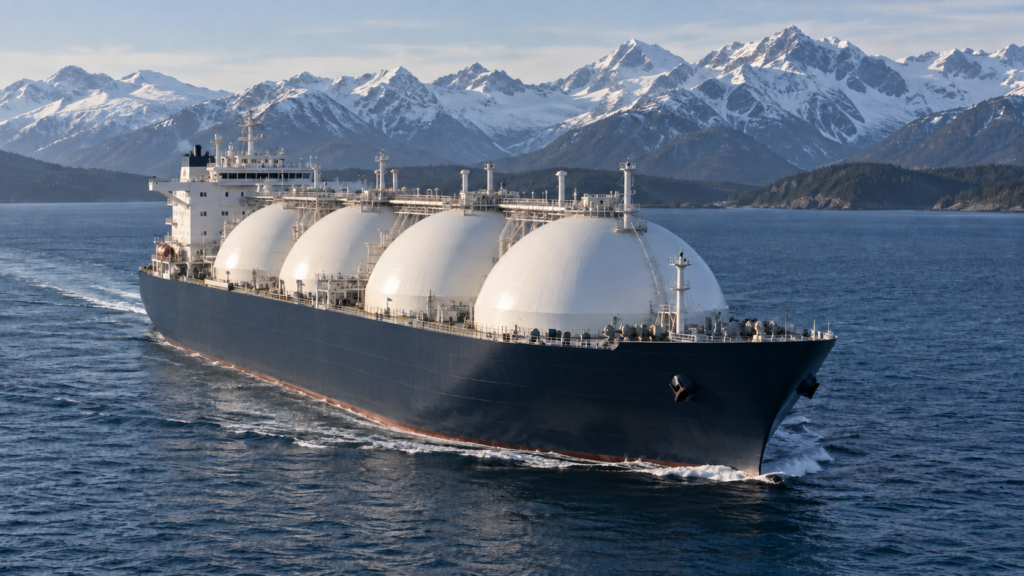
As the prolonged conflict in the Middle East has caused South Korea's imports of Middle Eastern liquefied natural gas (LNG) to plummet by more than 66% this year, imports from North America have more than doubled. Amid this shifting LNG import structure, growing pressure from the United States for South Korea to participate in the Alaska LNG development project has deepened Seoul's deliberations.
According to statistics from the Korea International Trade Association on the 17th, South Korea's total LNG imports for the first nine months of this year reached 32.87 million tons, a 6.4% decrease compared to the same period last year.
By region, Middle Eastern imports dropped 66.2% to 2.42 million tons. Imports from Central and South America and Europe also decreased by 17.8% (to 1.37 million tons) and 12.7% (to 1.42 million tons), respectively.
Notably, imports of Qatari LNG plunged 68.6% to 1.7 million tons, with zero imports recorded between April and June and August and September. While Qatar ranked as South Korea's third-largest LNG supplier last year—behind Australia and Malaysia—its supply has faced disruptions in the wake of the Middle East conflict.
Conversely, North American LNG imports surged 102.9% year-on-year to 7.82 million tons. U.S. imports rose 41.7% to 4.85 million tons, while Canadian imports skyrocketed 587.6% to 2.97 million tons.
The government has previously stated that it proactively secured alternative volumes from the U.S. and Southeast Asia to cope with Middle Eastern supply disruptions. However, supply uncertainties continue to mount as the timeline for global supply normalization remains unclear and winter demand approaches. Intensifying competition for cargo is also driving upward pressure on international prices.
According to the Korea Energy Economics Institute, JKM—the benchmark price for East Asian LNG—rose 15.2% month-on-month in August to $22.0 per MMBtu (the amount of gas generating 250,000 kcal of heat). Europe's TTF gas benchmark similarly increased 17.1% to $21.2 per MMBtu.
To diversify import channels and respond to international price volatility, the government plans to establish a stable supply environment by expanding the share of medium- and long-term contracts.
Amid these developments, the strategic value of the U.S. Alaska LNG project is gaining renewed attention. Addressing a query regarding the Alaska project during a National Assembly audit on the 6th, Minister of Trade, Industry and Energy Kim Jung-kwan stated, "Through the Middle East conflict, a new strategic value has clearly emerged."
Minister Kim explained that difficulties have arisen in introducing Middle Eastern LNG, and shipments originating from the Gulf are currently bypassing the Panama Canal disruptions by detouring around the Cape of Good Hope.
The government has previously withheld a final decision on investing in the Alaska project, maintaining that investments cannot be made without commercial rationality. However, with the strategic value of energy supply chains highlighted following the Middle East conflict, the possibility of participation appears to have been left open.
Nevertheless, securing economic feasibility remains a critical challenge. The Alaska project has long raised concerns due to its massive capital requirements and opaque profitability.
Reuters previously reported that the local project operator estimated total costs between $44.5 billion and $54.5 billion. Considering annual production capacity, Reuters noted that the cost per 1 million tons ranges from $2.2 billion to $2.7 billion—the highest level among any proposed U.S. LNG export project to date.
Permitting delays and labor shortages are also cited as roadblocks to the project's advancement.
"While the project holds strategic value in terms of supplying LNG from Alaska to South Korea across the Pacific, economic value is an entirely different matter," said Bing Hyun-ji, a senior researcher at the Korea Institute for Industrial Economics and Trade. "We need to thoroughly evaluate how much infrastructure costs can be offset and what kind of off-take rights and supply conditions can be secured at the time of investment."
It is reported that the South Korean government is continuing discussions with the U.S. on ways to enhance the project's commercial viability, with measures such as property tax relief being floated.
An official from the Ministry of Trade, Industry and Energy stated, "We are in continuous communication with the U.S. side, but it is difficult to disclose details currently under negotiation."
[Copyright (c) Global Economic Times. All Rights Reserved.]