• 2026.11.11 (Wed)
  • All articles
  • LOGIN
  • JOIN
Global Economic Times
[등록] 2026-09-01 15:48:31
  • Synthesis
  • World
  • Business
  • Industry
  • ICT
  • Distribution Economy
  • Well+Being
    • Pet Life
    • Halal Horizon
  • Travel
  • Eco-News
  • Education
  • Korean Wave News
  • Opinion
  • Arts&Culture
  • Sports
  • People & Life
    • International Student Report
    • With Ambassador
  • Column
    • Cho Kijo Column
    • Cherry Garden Story
    • Ko Yong-chul Column
    • Kim Bong-seon's Photo Column
    • Kim Seul-Ong Column
    • Lee Yeon-sil Column
  • Photo News
  • New Book Guide
MENU
 
Home > Korean Wave News

Miryang Lands in Hanoi's Tây Hồ: Piecing Together the Fragments of Memory Left Behind by Soju

Eugenio Rodolfo Sanabria Reporter / Updated : 2026-09-07 09:10:37
  • -
  • +
  • Print


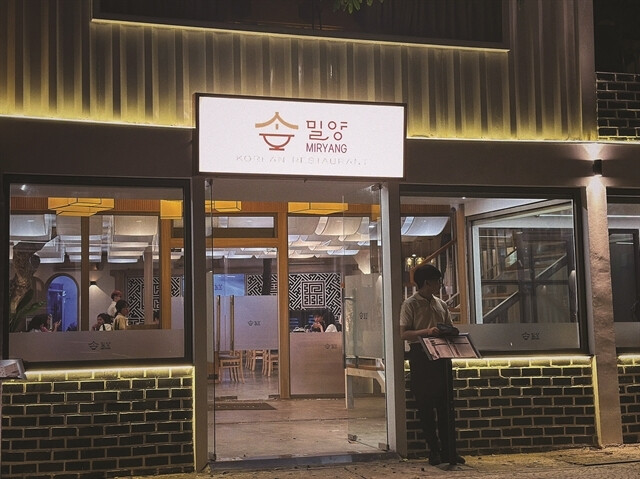
A new landscape has been added to Tây Hồ, the expatriate hub of Vietnam's capital, Hanoi. Recently opened, the Korean restaurant "Miryang" is capturing the footsteps of not only local expats but also those who love Korean food culture. Located at 98 Tô Ngọc Vân, it is a newly unveiled space by the operators of the Korean chicken franchise brand "Don Chicken." At the center of the bright and modern interior, a real tree piercing through the floor forms a unique visual focal point. The space is shared with "Kareya," a Korean-style curry specialty restaurant, adopting a structure where menu items from both eateries can be enjoyed interchangeably.

Critic AF Reeves' account of visiting the place to revive memories blurred by a bout of heavy soju drinking during a past trip to Korea is intriguing. While Korean barbecue culture enjoys massive popularity worldwide, Miryang breaks away from the grilling method, focusing instead on traditional, hearty Korean table settings where people sit together around bubbling stews, hot pots, and noodles to share broths. This marks a differentiated point from the local Korean restaurant landscape, which is predominantly driven by grilled pork belly.

Opening the meal were bone stock noodles and naengmyeon (cold noodles). The deeply brewed bone stock delivered a rich, heavy flavor ideal for hangover relief, harmonizing well with chewy noodles. The buckwheat noodles boasted a lighter, fresher appeal, proving their worth for a future rematch in a spicy version. The boiled pork slices (bossam), though slightly fatty, boasted a rich flavor and created a wonderful wrap combination when paired with leeks gently warmed from below. Unfortunately, the jokbal (trotters) menu was not available, acting as an element that builds anticipation for a future visit.

Crisp yet generously filled vegetable dumplings and the complexly nuanced, sweet-and-spicy soft tofu stew (sundubu-jjigae) also received favorable reviews. In particular, the hot pot dishes bubbling away in the center of the table vividly summoned memories of past visits to Korea. The "Rosé Dakgalbi" tasted on the first day is a trendy menu item that originated in South Korea and spread worldwide. The sauce, made by mixing cream and dairy products with gochujang (chili paste), coated the chicken, tteokbokki rice cakes, and cabbage with a smooth umami flavor.

The star of the second day was budae-jjigae (army stew). Born from surplus US military goods after the Korean War, this historic hot pot dish brings together Spam, sausages, baked beans, kimchi, ramyeon noodles, cheese, and more. Although the initial depth of the broth was somewhat lacking and the kimchi failed to play its proper role, the process of adjusting it to one's taste using the six condiments provided at the table—gochujang, pepper, salt, sugar, and saeujeot (salted fermented shrimp)—added an original, addictive quality.

The endlessly provided banchan (side dishes) elevated the completeness of the meal. Kimchi and pickled radishes, imbued with the aesthetics of fermentation, smoothed over any shortcomings of the hot pot and solidly supported the fundamentals of the table. Cool draft beer accompanied the meal as a beverage, and the addition of traditional Korean alcoholic beverages in the future would serve as the perfect punctuation mark.

Suitably proportioned for groups of three to four to visit and share various dishes, this place offers a generous table setting and attentive service at reasonable prices. The warmth and flavor rising around the earthenware pots and hot pot vessels were more than enough to revive forgotten travel memories. Miryang faithfully embodies the inherent value of Korean food culture—where people gather to share warm broths—rather than chasing flashy, stimulating trends in Hanoi.

[Copyright (c) Global Economic Times. All Rights Reserved.]

  • #\ormuz Impasse
  • #globaleconomictimes
  • #micorea
  • #mykorea
  • #nammidonganews
  • #singaporenewsk
  • #Samsung
  • #Daewoo
  • #Hyos
Eugenio Rodolfo Sanabria Reporter

Popular articles

  • Nearly 900 Schools Temporarily Closed as 'Flu' Epidemic Sweeps Japan

  • AI Companies Rush to Go Public, But Face Sudden Brakes Amid Cooling Investor Sentiment

  • Singapore and Brunei Sign Landmark MOU on Mutual Recognition of Halal Certificates

I like it
Share
  • Facebook
  • X
  • Kakaotalk
  • LINE
  • BAND
  • NAVER
  • https://globaleconomictimes.kr/article/1065571796458478 Copy URL copied.
Comments >

Comments 0

Weekly Hot Issue

  • Inha University Caught in Campus Culture Clash Over Proposed Rhee Syng-man Statue Revival
  • Honoring a Legacy: Poet Oh Dong-chun Recognized for Lifelong Dedication to Hangul and Sijo Poetry
  • Bongeunsa Temple to Host 2026 Patriotic Buddhism Cultural Festa
  • South Korea Confronts a Growing Health Crisis as Adult Obesity Rates Surge
  • Pain of Chosei Coal Mine Meets Japanese Readers: Moon Young-sook Publishes Japanese Edition of 'Black Sea'
  • Beyond the Trillion-Dollar Mark: China’s Trade Surplus and the Debate Over Global Economic Dominance

Most Viewed

1
US Army Conducts Rare Temporary Burial Drills to Prepare for Worst-Case Large-Scale War Scenarios
2
World Citizens are Flying Directly to Busan... The Era of 4 Million Foreigners is Just Around the Corner
3
Eating 100g of Baechu Kimchi Daily Linked to Lower High-Cholesterol Risks
4
Meeting Christmas Early!… Busan Dessert Sales Event "Daldal The Market" Held
5
November Shopping Festival Sparks Retail War in South Korea: Where to Find the Best Deals
체리가든 스토리
nutri huevos
로타리
동포저널

Hot Issue

Jensen Huang Faces Shareholder Class Action and Leadership Scrutiny Amid Espionage Allegations Involving Former Associate

Disgraced South Korean Scientist Hwang Woo-suk Becomes UAE Citizen

Is South Korea Heading Toward France's Path? Aging Population and Fiscal Pressures Looming Ahead

Fashion Runway Show 2026

Let’s recycle the old blankets in Jeju Island’s closet instead of incinerating them.

Global Economic Times
korocamia@naver.com
CEO : LEE YEON-SIL
Publisher : KO YONG-CHUL
Registration number : Seoul, A55681
Registration Date : 2024-10-24
Youth Protection Manager: KO YONG-CHUL
Singapore Headquarters
5A Woodlands Road #11-34 The Tennery. S'677728
Korean Branch
Phone : +82(0)10 4724 5264
#304, 6 Nonhyeon-ro 111-gil, Gangnam-gu, Seoul
Copyright © Global Economic Times All Rights Reserved
  • News K
  • 반달곰 프로젝트
  • 광고문의
Search
Category
  • All articles
  • Synthesis
  • World
  • Business
  • Industry
  • ICT
  • Distribution Economy
  • Well+Being 
    • 전체
    • Pet Life
    • Halal Horizon
  • Travel
  • Eco-News
  • Education
  • Korean Wave News
  • Opinion
  • Arts&Culture
  • Sports
  • People & Life 
    • 전체
    • International Student Report
    • With Ambassador
  • Column 
    • 전체
    • Cho Kijo Column
    • Cherry Garden Story
    • Ko Yong-chul Column
    • Kim Bong-seon's Photo Column
    • Kim Seul-Ong Column
    • Lee Yeon-sil Column
  • Photo News
  • New Book Guide
  • Overseas Koreans
  • Multicultural News