![[등록] 2026-09-01 15:48:31](/support/_updata/banner2/tl181982910_6749.png)


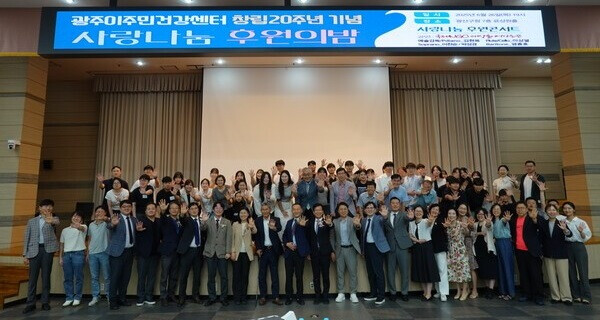
Gwangju Metropolitan City (Mayor Kang Ki-jung) announced that the 20th anniversary ceremony of the Gwangju Migrant Health Center, a non-profit medical volunteer organization, was successfully held on June 26th in the Yoon Sang-won Hall at the Gwangsan-gu Office.
Established in 2005, the Gwangju Migrant Health Center provides free medical treatment and health counseling to migrants in healthcare blind spots, including migrant workers, marriage immigrants, and foreign students. It operates a free clinic for foreign workers with support from Gwangju City.
The commemorative event was attended by over 100 people, including migrants, volunteers, medical staff, and sponsors, and proceeded in the following order: a seminar on migrant health rights, an awards ceremony for meritorious individuals, a vision declaration ceremony, and a "Love Sharing Concert."
In particular, four medical professionals (Kim Il-hwan, Yoo Kyung-tae, Choi Hee-seok, and Han Hyun-jung) who contributed to promoting migrant health rights in the region received commendations from the Mayor of Gwangju Metropolitan City. The Gwangju Migrant Health Center also declared its vision: "Health Rights Without Discrimination, Realizing an Inclusive Community."
The Gwangju Migrant Health Center has significantly contributed to ensuring migrant health rights and resolving healthcare disparities within the local community. Over the past 20 years, it has operated clinics 1,115 times, providing 98,000 medical and medication services to over 62,000 migrants from approximately 70 countries.
Notably, last year, through Gwangju City's new project, the 'Medical Interpretation Activist Training and Dispatch Support Project,' the center trained 29 professional medical interpreters in 12 language areas, supporting a total of 124 medical interpretations, thereby significantly improving migrants' practical access to healthcare.
Lee Young-dong, Director of the Women and Family Bureau, stated, "The Gwangju Migrant Health Center's activities over the past 20 years have become a significant milestone in Gwangju's journey towards becoming a city of human rights and solidarity." She added, "We will continue to provide administrative support for migrants to settle healthily in the local community."
For two decades, the Gwangju Migrant Health Center (GMHC) has stood as a beacon of hope and practical support, tirelessly working to dismantle the "healthcare blind spots" that often marginalize Gwangju's diverse migrant population. Its recent 20th-anniversary celebration, held at the Yoon Sang-won Hall in the Gwangsan-gu Office, not only commemorated a significant milestone but also reaffirmed the city's commitment to fostering an inclusive community where health rights are universally accessible, regardless of origin.
Established in 2005, the GMHC emerged from a pressing need to address the healthcare vulnerabilities faced by migrant workers, marriage immigrants, foreign students, and other expatriates who often fall through the cracks of the mainstream medical system. Operating as a non-profit medical volunteer organization, the center has, since its inception, provided crucial free medical treatments and health counseling. It further strengthens its reach by operating a dedicated free clinic for foreign workers, a vital initiative supported by the Gwangju Metropolitan City.
The anniversary event itself was a testament to the collective spirit driving the GMHC's mission, drawing over 100 attendees, including migrants themselves, dedicated volunteers, medical professionals, and generous sponsors. The program highlighted the multi-faceted approach of the center, featuring an insightful seminar on migrant health rights, a heartfelt awards ceremony honoring key contributors, a forward-looking vision declaration, and a unifying "Love Sharing Concert." A poignant moment arrived with the commendation of four medical professionals—Kim Il-hwan, Yoo Kyung-tae, Choi Hee-seok, and Han Hyun-jung—who were recognized with the Gwangju Metropolitan City Mayor's Commendation for their profound contributions to advancing migrant health rights within the region. Complementing these accolades, the GMHC boldly declared its enduring vision: "Health Rights Without Discrimination, Realizing an Inclusive Community."
Over its two decades of operation, the statistics paint a compelling picture of the GMHC's indispensable role. The center has run its clinics an astounding 1,115 times, delivering approximately 98,000 medical and medication services to over 62,000 migrants hailing from some 70 different countries. These numbers underscore not only the extensive reach of the GMHC but also the persistent and widespread need for accessible healthcare services among the migrant community.
However, the path to equitable healthcare for migrants in South Korea, and specifically in Gwangju, is fraught with systemic challenges. Language barriers remain a primary obstacle, often leading to communication breakdowns and a pervasive doubt among migrants regarding the adequacy of the services they receive. Many public health centers, though vital, can be perceived as hectic environments where crucial information is not always effectively disseminated to non-Korean speakers. Furthermore, studies have revealed that while chronic diseases are prevalent among immigrants, their awareness, treatment, and control rates lag significantly behind those of the native Korean population. This disparity is often exacerbated by institutional discrimination within health security policies, where migrants may encounter higher premiums and stricter eligibility criteria for the National Health Insurance (NHI) system, alongside suboptimal vaccination coverage.
Recognizing these deep-seated issues, the GMHC has consistently adapted its strategies to bridge these gaps. A notable recent initiative, spearheaded by Gwangju City, is the 'Medical Interpretation Activist Training and Dispatch Support Project.' Through this pivotal program, the center successfully trained 29 professional medical interpreters proficient in 12 different languages. This concerted effort resulted in the support of 124 medical interpretations in the past year alone, a crucial step toward enhancing migrants' practical access to healthcare by ensuring clear and empathetic communication between patients and medical staff. The project aims to systematically provide trained medical interpreters to hospitals and other healthcare facilities for foreign residents, addressing one of the most critical barriers to effective care.
Beyond its direct medical services, the GMHC embodies the broader spirit of Gwangju's multicultural policies and migrant support initiatives. Gwangju Metropolitan City, like other local governments across South Korea, works within the framework of national multicultural family policies, often managed by specialized committees and executed through multicultural family support centers. These centers, which complement the GMHC's efforts, offer a range of services from Korean language education and family counseling to promoting social inclusion and providing helplines like Danuri (1577-1366). The underlying philosophy, reinforced by acts like the Multicultural Families Support Act, emphasizes fostering stable family lives for multicultural members and their integration into society, while also actively working to prevent discrimination and encourage respect for cultural diversity.
Lee Young-dong, Director of the Women and Family Bureau for Gwangju City, aptly summarized the GMHC's legacy, stating, "The Gwangju Migrant Health Center's activities over the past 20 years have become a significant milestone in Gwangju's journey towards becoming a city of human rights and solidarity." This statement encapsulates the profound impact of the center, not just as a healthcare provider but as a foundational pillar in Gwangju's broader commitment to human rights and community solidarity. As Gwangju continues to embrace its identity as a multicultural hub, the administrative support for organizations like the GMHC remains crucial for ensuring the healthy integration and well-being of all its residents. The GMHC's journey over the past two decades serves as a powerful model for how dedicated community action, combined with strategic governmental support, can effectively address complex social challenges and build a truly inclusive society.
[Copyright (c) Global Economic Times. All Rights Reserved.]