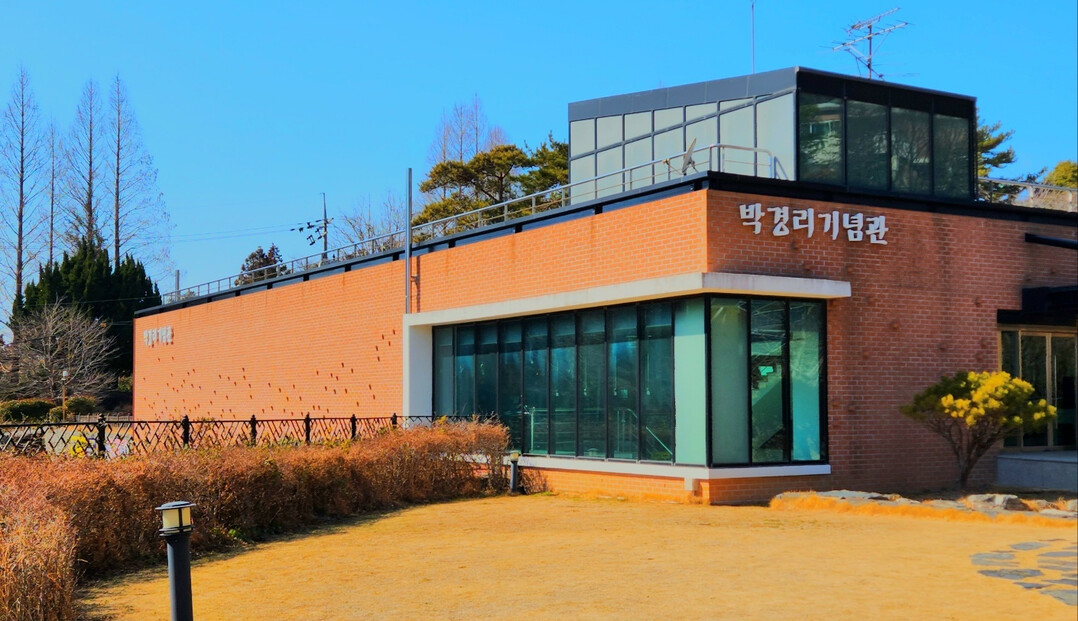
Tongyeong, long celebrated as a cradle of the arts, infuses its quiet fishing villages and winding alleys with an enduring cultural fragrance. This is especially true of Hangnam-dong, once the most bustling district following liberation. As you walk along Gangguan Port and slip into the backstreets, you encounter rows of small shops with low-hanging signs, where sunlight streams diagonally between aged buildings. It feels as though the footprints of the artists who once roamed these streets are still lingering.
This year marks the centennial of the birth of novelist Park Kyung-ni. Following a path that connects poetry, fiction, and music, our footsteps trace the lives of Park, poet Kim Sang-ok, and composer Isang Yun.
Finding Poetry in the Alleyways
Tucked among the densely packed buildings of the Hangnam 1st Street alley stands a two-story wooden house. This is the childhood home of sijo (traditional Korean lyrical verse) poet Kim Sang-ok. Built in 1936 as a Japanese-style residence, the structure is designated as a national registered cultural heritage and reopened early this year as the Kim Sang-ok Memorial Hall.
Stepping inside instantly calms the mind with its quiet, cozy atmosphere. The first floor exhibits paintings, calligraphy, and ceramic works alongside his sijo poetry. Kim was a versatile artist skilled in poetry, brushwork, and painting. In 1939, his sijo "Bongseonhwa" (Balsam Flower) was published in the literary magazine Munjang, launching his literary career, which later produced celebrated works like "Baekjabu," "Dabotap," and "Sahyang."
Exploring the exhibition reveals the poet’s upright and clear character, reflected just as much in his art as in his life. During the Japanese colonial period, he was imprisoned multiple times for his anti-Japanese independence activities. After liberation, he taught students in secondary schools across Tongyeong, Gyeongnam, and Busan. Toward the end of his life, Kim relied on a wheelchair. When his devoted wife passed away in 2004, he sank into deep grief, virtually fasting, and followed her in death just days after her funeral.
The second floor displays the brushes and tools he used during his lifetime, alongside stories of artists who crossed paths with him, notably novelist Park Kyung-ni, composer Isang Yun, and painter Lee Jung-seop. In particular, Isang Yun—who shared prison sentences with him during the colonial era—set Kim’s sijo poems "Geune" (The Swing) and "Pyeonji" (The Letter) to music as art songs.
Stepping out of the memorial hall, the alley returns to the rhythms of everyday life. Remodeled historic homes turned cafés and old shops stand side by side. It would be hard to find a path more suited for reciting a sijo as you walk.
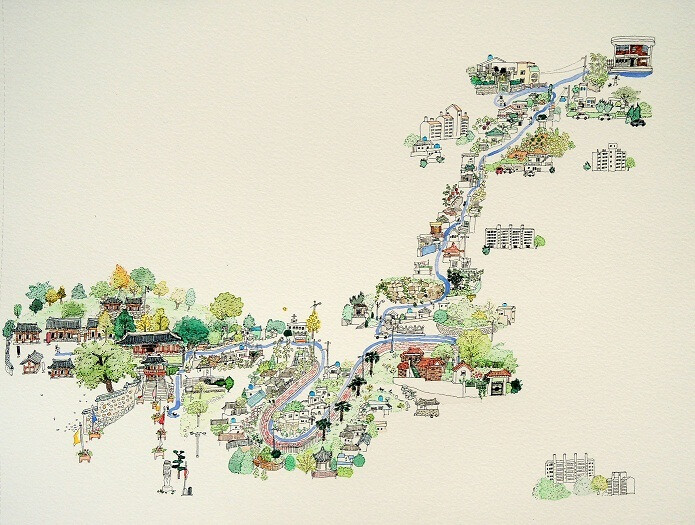
Seopirang: The Hill Where Novels Begin
Moving from Hangnam-dong toward Chungryolsa Shrine, you arrive at Seopirang, a village perched on a low-lying hill. "Pirang" is the Tongyeong dialect for cliff. Seopirang sits on the western hill facing Dongpirang. As the birthplace of novelist Park Kyung-ni, it serves as the primary setting for her novel The Daughters of Pharmacist Kim. Place names from the book, such as Seomun-gogae, Ganchang-gol, and Myeongjeong-saem, are still used in the alleys below Seopirang, allowing visitors to encounter the literary landscapes of the novel at every turn.
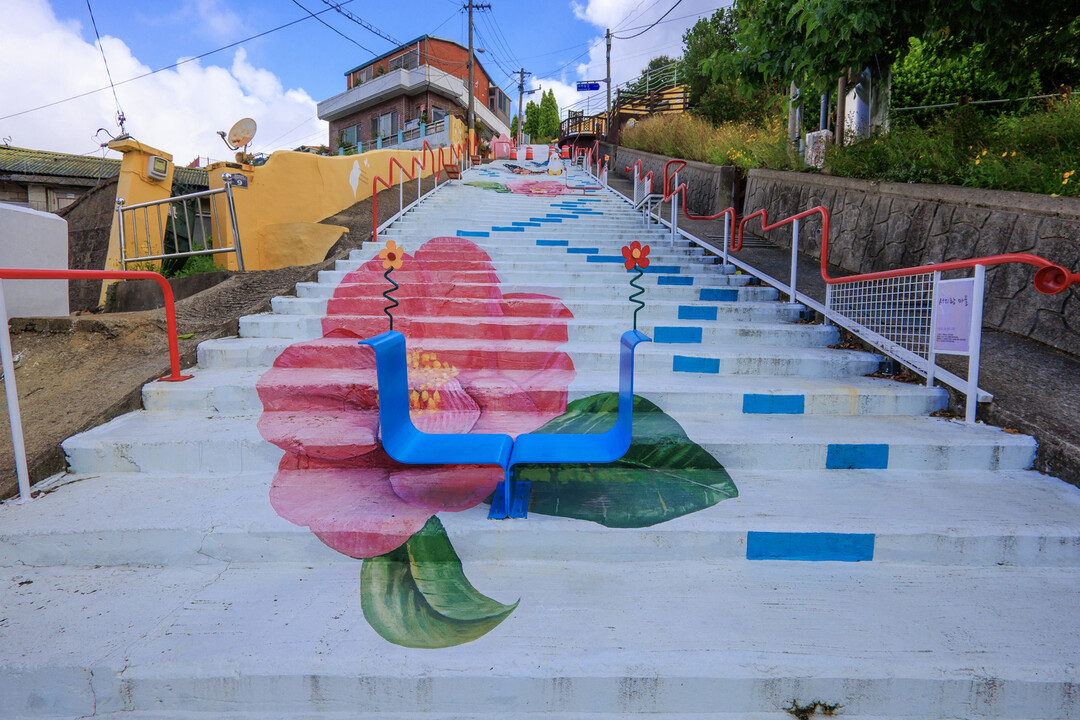
A must-visit in Seopirang is the 99-Step Staircase. The stone walls lining the stairs are inscribed with passages from Park Kyung-ni’s works. Reading the verses one by one as you climb brings you to the final step before you even realize it. Pause to catch your breath and look back, and the cityscape and sea of Tongyeong unfold in a single panoramic view.
At the very top of the Seopirang hill stands Seoporu Pavilion. Once a watchtower and command post during the Joseon naval headquarters era, standing here offers a sweeping view of Gangguan Port, Dongpirang across the water, and the historic naval site. Its wide-open vista makes it a wonderful spot for photography.
One of the most playful features of Seopirang is the Piano Stairs. Shaped like a treble clef, some of the steps are equipped with sound sensors that play notes when stepped on, letting visitors enjoy a brief musical performance as they walk up and down. There is also "The Road to School with Isang Yun," a path recreating the route Yun walked during his school days. Here, Park Kyung-ni’s literature seamlessly meets Isang Yun’s music.
The Tongyeong Boy Who Became a Global Composer
Descending the Seopirang hill toward Docheon-dong, the alley walls seem to whisper with music. The pathway once walked by a young Isang Yun has been transformed into a musical alley garden blending murals and melody. Sheet music of his school alma mater adorns the stone walls, and standing before an orchestra mural invites a momentary daydream of becoming a conductor. Exploring the murals and sculptures piece by piece adds a unique joy to the alley stroll.
At the end of the alley stands the Isang Yun Memorial Hall. Born in 1941 (note: born 1917) in Sancheong to his mother’s family home, Yun grew up in Tongyeong. Entering the exhibition, visitors are first greeted by his bust alongside a chronological timeline of his life and a vast catalog of works, condensing the long journey of a Tongyeong boy who rose to become a master of 20th-century contemporary music.
On one side of the exhibition hall, South Korean and German passports sit side by side. These two passports capture Yun’s turbulent life, which forced him to leave his homeland and settle in Germany. Yun left for Europe to study abroad in his late thirties. His name gained international recognition when his piece Music for Seven Instruments was premiered in Darmstadt, Germany. Just as he was solidifying his reputation as a composer through orchestral works like Réak, a massive crisis struck: his entanglement in the East Berlin Incident of 1967.
Forcibly abducted from Germany to Seoul, he was sentenced to 10 years in prison, triggered by a visit to North Korea to view Goguryeo tomb murals in search of musical inspiration. Although released after two years following international rescue efforts led by the German government, fellow composers, and European musicians, he never stepped foot in his homeland again during his lifetime. The passport he received after acquiring German citizenship stands as a testament to his life in exile and longing for home.
A few steps further lie the cello he cherished most, accompanied by the Grand Cross of Merit of the Federal Republic of Germany and the Goethe Medal. Isang Yun built a unique musical world by fusing traditional Korean sound textures and expressive techniques with Western contemporary composition methods. The honors bestowed upon him by the German government and cultural community reflect his monumental musical achievements and international stature. From his handwritten scores to personal memos, every exhibit holds the visitor's gaze.
Across from the exhibition hall is the Berlin House, a partial reconstruction of his German residence. The first floor functions as the Isang Yun Small Music Library, while the second floor recreates his study and reception room. Blank sheet music still rests on his desk, alongside the small scale he used to weigh letters every time he mailed them to save on international postage during his student days. Antique furniture, ceramics, and folk paintings scattered throughout offer a glimpse into his yearning for home.
Isang Yun passed away in Berlin in 1995. Twenty-three years later, he finally returned to his beloved hometown of Tongyeong. Today, he rests on a hill overlooking the sea beneath the Tongyeong International Music Hall. Anyone is welcome to visit this memorial space, where we invite you to pause for a moment and reflect on his life and music.
Travel Memo: Tasting Tongyeong Through its Artistic Fragrance
At the entrance of the alley housing the Kim Sang-ok Memorial Hall sits Tongyeong Dabang. Built by remodeling the historic Kim Yang-gon residence, it preserves original architectural charms such as its tiled roof, red brick exterior, and wooden window frames. Inside, designs inspired by traditional Tongyeong soban (small dining tables) and bamboo blinds embody the identity of Tongyeong traditional crafts. Enjoy a cup of tea and a leisurely rest in this space where café culture and archives meet.
In the Seopirang alleys lies Seopirang Tteokbokki, a long-standing local favorite. It serves a sweet, mild, traditional-style tteokbokki topped with minced Cheongyang chili peppers, leaving a lingering, sharp kick of heat. Their fried chicken, especially delicious when dipped in the tteokbokki broth, is widely celebrated among locals and travelers alike.
Not far from the Isang Yun Memorial Hall is Seoho Market, a traditional market with a deep history. From early dawn, market alleys bustle with vendors selling fresh seafood, dried goods, and vegetables. Many eateries open early in the morning. Representative market delicacies include comforting bowls of silakguk (dried radish leaf soup), and Chungmu gimbap served with fish cakes and spicy radish kimchi. Inside the market, specialty restaurants serving jolbok-jiri (clear pufferfish soup) offer a hearty and satisfying breakfast.
[Copyright (c) Global Economic Times. All Rights Reserved.]