![[등록] 2026-09-01 15:48:31](/support/_updata/banner2/tl181982910_6749.png)


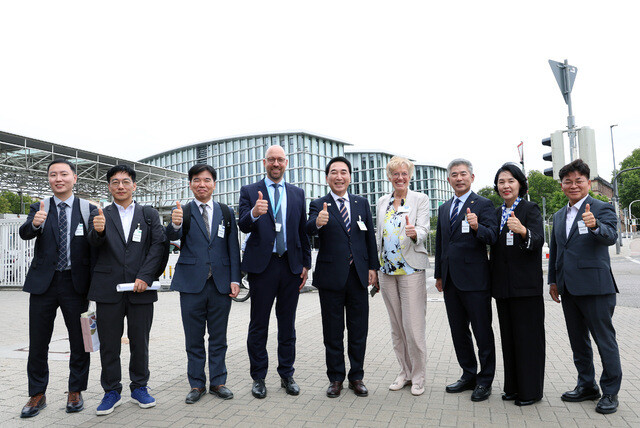
As part of a European tour aimed at attracting foreign investment and supporting the expansion of provincial companies into overseas markets, Chungnam Governor Park Soo-hyun visited the 160-year-old German comprehensive petrochemical complex to seek strategies for strengthening the future competitiveness and realizing carbon neutrality of the Seosan Daesan Petrochemical Complex.
On August 24 (local time), Governor Park visited the global chemical company BASF’s headquarters located in Ludwigshafen, Germany. Established in Germany in 1865, BASF is a global comprehensive chemical corporation that has deep ties with Chungnam province, notably operating a bio-surfactant plant in the Seosan Daesan Complex since March. BASF's business domains span high-value chemical materials for automobiles, electronics, and construction; advanced material businesses including engineering plastics, battery materials, and electronic materials; and the development of sustainable materials and eco-friendly production processes. BASF products serve as raw materials for over 40,000 items, ranging from daily consumer goods like vitamins and fragrances to medical supplies such as antipyretics and agricultural nutrients, building insulation, and electric vehicle battery covers.
Situated along the Rhine River in Ludwigshafen, BASF’s headquarters represents the world's largest single-company-operated petrochemical complex, spanning 10 square kilometers (equivalent to approximately 3.4 times the area of Yeouido). The massive site employs around 40,000 workers, boasting an internal road network stretching 6.5 km in length, 106 km of internal roads, 230 km of railway tracks, and 2,851 km of pipelines.
A key highlight of BASF's operational model is the "Verbund" system, which minimizes carbon emissions across the Ludwigshafen site. The Verbund system is an integrated network that organically links production facilities, raw materials, and energy flows to maximize resource efficiency. Byproducts generated in one production process are utilized as raw materials for another, and energy produced during manufacturing is channeled to other facilities. This integrated loop reduces raw material and energy consumption, enhances production efficiency and price competitiveness, and significantly lowers carbon emissions.
During his visit, Governor Park toured the corporate exhibition hall to learn about BASF's history, current operational status, products, and carbon-reduction efforts. Aboard a bus tour within the industrial site, he closely inspected integrated production facilities and resource-efficiency measures, including the internal power plant, methane treatment facilities, wastewater interception systems protecting the Rhine River, port infrastructure, green hydrogen production facilities, and raw material plants for fragrance products. Governor Park expressed keen interest in how BASF has grown in tandem with the neighboring city of Mannheim across the river and noted the pervasive influence of its products across virtually all modern industries.
"I highly evaluate BASF’s active engagement and cooperative ties with the Seosan Daesan Petrochemical Complex," Governor Park remarked. "I hope BASF continues to achieve technological advancements beneficial to humanity, and I look forward to sustained collaboration and solidarity with South Korea, including Chungnam province." He particularly emphasized, "BASF's virtuous cycle system, known as Verbund, is the ultimate value proud to its 160-year history. I hope this value can generate positive momentum through solidarity with Korean corporations."
Complementary Insights on Industrial Application and Future Implications
To successfully translate the lessons from BASF's Ludwigshafen Verbund model to the Seosan Daesan Petrochemical Complex, industry experts and policymakers emphasize that structural differences must be carefully navigated. While Ludwigshafen was built and expanded over a long period as a single-enterprise production network managed exclusively by BASF, the Daesan Petrochemical Complex is a multi-company cluster housing major domestic corporations such as HD Hyundai Oilbank, Hanwha TotalEnergies, LG Chem, and Lotte Chemical.
Consequently, applying an integrated Verbund framework in Daesan requires navigating complex multi-party variables, including corporate trade secrets, cost-sharing structures, safety liability divisions, and pipeline ownership rights. Experts note that future initiatives by the Chungnam provincial government should focus on analyzing the flow of raw materials, byproducts, and waste heat among distinct companies within Daesan. By identifying co-utilizable resources and establishing shared pipeline, power, and hydrogen infrastructures backed by governmental policy and corporate investment, the province aims to maximize carbon reduction and fortify the international competitiveness of Korea's core petrochemical hub.
[Copyright (c) Global Economic Times. All Rights Reserved.]