![[등록] 2026-09-01 15:48:31](/support/_updata/banner2/tl181982910_6749.png)


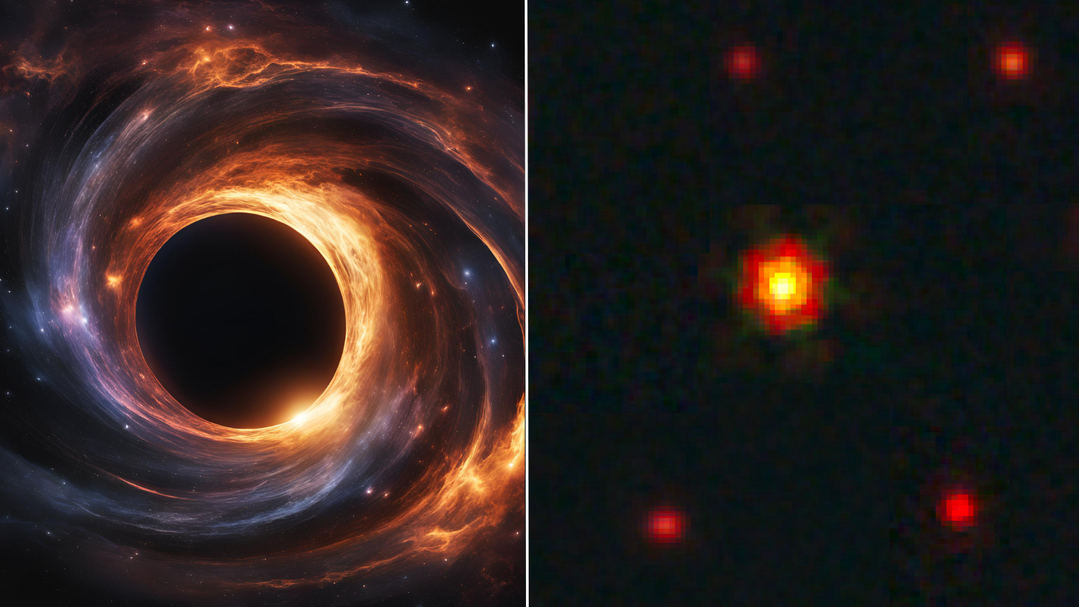
The identity of mysterious cosmic objects known as "little red dots" (LRDs)—primarily discovered in the early universe hundreds of millions of years after the Big Bang 13.8 billion years ago—has sparked intense curiosity and debate among astronomers. Recent research findings lean heavily toward the hypothesis that LRDs are rapidly growing black holes shrouded in thick layers of gas. These objects serve as a crucial clue to understanding how black holes and galaxies co-evolved and expanded during the infancy of the universe.
LRDs were first captured in 2022 with the launch and operation of NASA’s James Webb Space Telescope (JWST). This advanced observatory began observing extremely distant, early-universe celestial bodies that were previously invisible to the Hubble Space Telescope.
Because certain LRDs emit light characteristic of material surrounding a black hole, opinions have long been divided over whether they are exceptionally small, dense galaxies or massive black holes. Their tiny physical size and intensely bright central cores—making them appear almost like single points in observation images—further compounded the ambiguity. South Korean researchers note that the astronomical community was initially quite startled by these discoveries, emphasizing that LRDs have transformed into essential subjects for understanding the simultaneous growth of black holes and galaxies in the early cosmos.
Evidence of Surrounding Host Galaxies
The most recent breakthrough regarding the nature of LRDs comes from an international collaborative study led by Wuhan University and Hunan Normal University in China, published in Nature Astronomy. The research team proposed that LRDs are not isolated point sources, but rather small, compact galaxies actively forming stars.
By stacking and averaging 217 individual LRD images, the team meticulously observed the outer regions of these objects. While individual images were too faint to distinguish, the stacked data revealed ring-shaped emission patterns around the central cores.
The researchers interpreted this surrounding glow as signals originating from a star-forming host galaxy rather than a single central source, suggesting a configuration where a central black hole is encircled by a compact galactic structure. The average radius of these surrounding host galaxies was estimated to be roughly 210 parsecs (approximately 685 light-years). Experts point out that compared to the Milky Way, which spans tens of thousands of parsecs, the host galaxies of LRDs are remarkably miniature in scale.
Unlocking Early Cosmic Growth Through Next-Generation Telescopes
A major theoretical puzzle in modern astrophysics has been how supermassive black holes—billions of times more massive than the Sun—managed to amass such staggering mass when the early universe provided so little time for growth.
Addressing this, a research team led by Rohan Naidu at the Massachusetts Institute of Technology (MIT) Kavli Institute for Astrophysics and Space Research published findings in Nature regarding an LRD designated as "MoM-BH*-1". Their analysis indicates that the object is a black hole enveloped in a dense cocoon of gas. This gaseous shell traps high-energy radiation, allowing the black hole to bypass standard theoretical limitations—such as the Eddington limit—and expand at an accelerated pace.
The MIT team explained that LRDs appear red primarily because thick gas layers heavily filter and obscure ultraviolet light emanating from near the black hole. If confirmed as growing, gas-shrouded black holes, LRDs represent a previously hidden evolutionary phase of cosmic black hole growth. Furthermore, LRDs likely manifest in multiple forms, encompassing gas-obscured black holes, compact star-forming galaxies, or complex hybrid systems where black hole accretion and star formation occur simultaneously.
Korean research groups have also contributed actively to this field, previously discovering and analyzing "BlueDOGs"—objects similar to LRDs but characterized by strong blue light emission while still harboring supermassive black holes.
Astronomers emphasize that the overarching significance of LRD research lies in answering a fundamental question: Did black holes grow first in the early universe, or did galaxies? LRDs occupy the crucial boundary between these two evolutionary pathways. Deciphering their true nature is not merely an exercise in categorizing a single class of celestial bodies, but rather a vital key to understanding the chronological sequence and velocity of structure formation shortly after the Big Bang.
Moving forward, resolving the exact nature of LRDs will demand even sharper observational capabilities, including high-resolution spectroscopy to analyze chemical compositions and kinematics, alongside imagery clear enough to cleanly separate central engine light from faint surrounding starlight. Next-generation observatories—such as the Giant Magellan Telescope (GMT), in which South Korea is a key participant—are expected to play a decisive role in solving the lingering mystery of the universe's little red dots.
[Copyright (c) Global Economic Times. All Rights Reserved.]