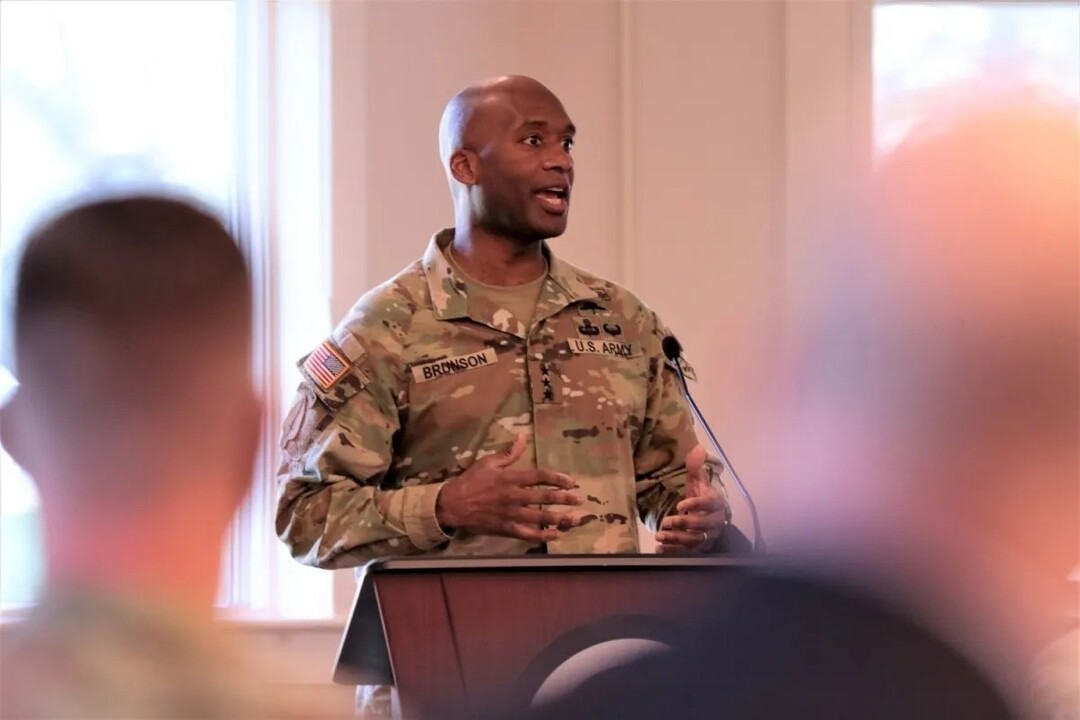
While General Xavier Brunson, Commander of United States Forces Korea (USFK), has made official his intention to delay the timeline for the wartime operational control (OPCON) transition pursued by the Lee Jae-myung administration, criticisms are mounting that he is intentionally disparaging the capabilities of the South Korean military. General Brunson cited changes in transition conditions due to North Korea’s advanced nuclear and missile programs and troop deployment experiences. In contrast, the South Korean military explains that it already possesses sufficient self-reliant defense capabilities.
Within the ruling party, there is a prevailing view that General Brunson’s remarks reflect the interests of U.S. President Donald Trump and the U.S. military establishment, such as demands to expand purchases of American weaponry. Some analysts interpret his negative stance as an attempt to prevent the reduction of the USFK commander's role following the OPCON transfer.
OPCON Transfer is a Matter of Will and Choice
General Brunson’s persistent cautious stance on the OPCON transfer has been based on the premise that South Korea's military preparations are inadequate. The conservative bloc has backed this up as General Brunson’s conviction that OPCON cannot be handed over by only meeting previously agreed conditions while ignoring changing security environments. However, the prevailing view among the majority of experts is that if South Korea continues to chase shifting conditions, the OPCON transfer will remain indefinitely out of reach.
The "premature argument," first raised in 1987 when former President Roh Tae-woo announced plans to reclaim wartime operational control, has repeatedly been utilized with the exact same logic over the past 40 years, despite significant enhancements in South Korea's military capabilities. It is more rational to view the OPCON transfer not as a matter of conditions or capabilities, but as a matter of will and choice between South Korea and the United States.
In reality, general assessments indicate that South Korea's military would face no issues with defensive capabilities in contingencies even if OPCON is transferred. The conservative bloc argues that South Korea lacks sufficient North Korean surveillance and reconnaissance assets, precision-strike capabilities, and command-and-control systems. However, to meet the conditions set during the 2014 conditional OPCON transfer agreement—namely, improvements in intelligence, surveillance, and reconnaissance (ISR), precision strikes, and command and control—the South Korean military has injected massive budgets to strengthen its combat power.
Regarding reconnaissance assets, South Korea currently operates five independent military reconnaissance satellites capable of observing the entire Korean Peninsula, and has introduced four Global Hawk high-altitude unmanned reconnaissance aircraft from the U.S. Recently, the country rolled out its first strategic-class unmanned aerial vehicle. The so-called "Hyunmoo series," including the Hyunmoo-5 known as a "monster weapon," is evaluated as the most powerful conventional firepower a non-nuclear state can possess, leaving no doubt about precision-strike capabilities.
The claims raised by General Brunson and the conservative bloc—regarding North Korea’s advanced nuclear capabilities and the uncertainty of the U.S. extended deterrence following the OPCON transfer—also lack persuasiveness. They argue that extended deterrence—the U.S. promise to provide a nuclear umbrella in the event of a North Korean nuclear attack—would be shaken after the OPCON handover. However, counterarguments note that this overlooks the true essence of extended deterrence.
The U.S. provision of extended deterrence to South Korea is a tailored strategy between the two nations and is completely unrelated to the OPCON transfer. Experts analyze that the U.S. commitment to extended deterrence also contains the implicit intent of curbing South Korea's pressure to acquire its own nuclear weapons. Furthermore, the argument lacks realism given that if the U.S. were to abandon extended deterrence post-OPCON transfer, it would trigger a "nuclear domino" effect across Northeast Asia, including Japan and Taiwan.
Meanwhile, some argue that the U.S. military is uncomfortable with the prospect of a South Korean general commanding U.S. forces in Korea after the OPCON transfer. However, this claim is only half-true. Under a 2018 agreement between Seoul and Washington, the future Combined Forces Command (CFC) set to replace the current CFC will be led by a South Korean general as commander, with a U.S. general serving as deputy commander.
Nevertheless, even under this structure, the U.S. forces under the operational control of the South Korean commander are reportedly limited to specifically designated units. OPCON over all other U.S. forces will continue to be exercised by the U.S. military. While conservatives argue that the U.S. military has never historically been under the command of another nation's military, there are several historical instances where U.S. expeditionary forces operated under foreign command during past wars.
The U.S. "Moving Goalposts" Must Not Be Tolerated
Within the ruling party, some suggest that General Brunson’s exceptional negativity toward the OPCON transfer—unlike some high-ranking officials in the Trump administration—is largely driven by the institutional interests of the U.S. Army. Many analyses suggest that, much like most past USFK commanders, Brunson holds this position out of concern that an OPCON transfer would reduce the role of the USFK commander, potentially lowering the rank from four-star general to lieutenant general.
As a U.S. Army four-star general, the USFK commander wears three hats: Commander of the ROK-U.S. Combined Forces Command, Commander of the United Nations Command, and USFK Commander. The intention, critics argue, is to prevent any disruption to this status quo. General Brunson's remark on the 14th that "from the UN Command's perspective, the Republic of Korea begins at the southern guard line" has also been interpreted in connection with this, as an arrogant statement ignoring South Korea's territorial sovereignty.
It remains unclear whether General Brunson’s remarks stem from personal conviction or serve to articulate the stance of the Trump administration. Given that U.S. Secretary of War Pete Hegseth expressed support for the OPCON transfer last May by stating, "It is very encouraging that our allies want to take control faster and in greater numbers," General Brunson's stance could be seen as a personal deviation. However, strong analyses also suggest he is playing a supporting role in Trump's strategy of using OPCON as leverage to advance American national interests.
In either case, tolerating the U.S. "moving goalposts" could practically derail South Korea's long-standing national task of achieving the OPCON transfer, meaning it cannot simply be overlooked. Alongside a firm expression of position toward General Brunson, persistent efforts are required to persuade the Trump administration that returning wartime operational control as quickly as possible ultimately serves U.S. interests as well.
[Copyright (c) Global Economic Times. All Rights Reserved.]