![[등록] 2026-09-01 15:48:31](/support/_updata/banner2/tl181982910_6749.png)


SANTIAGO / SEOUL — South Korean President Lee Jae-myung and First Lady Kim Hye-kyung officially concluded their state visit to Chile on Thursday, July 30 (local time), departing Santiago's Arturo Merino Benítez International Airport aboard Air Force One for Argentina, the final leg of their multi-nation South American diplomatic tour.
The summit in Santiago marked a vital moment in South Korea’s economic diplomacy, culminating in high-level discussions with Chilean President José Antonio Kast. The two heads of state addressed pivotal bilateral matters, prominently featuring the modernization of the historic South Korea-Chile Free Trade Agreement (FTA) and the dramatic expansion of strategic cooperation in critical industrial minerals—most notably copper and lithium.
During a joint press statement following the summit, President Lee announced that South Korea and Chile agreed to operationalize the 'Korea-Chile FTA Joint Committee.' This mechanism will serve as the official platform to negotiate upgrades to their two-decade-old trade framework, adjusting trade protocols to reflect modern digital commerce, environmental standards, and supply chain resilience.
“Chile, as the world’s primary copper producer and holder of the largest lithium reserves, and South Korea, a global leader in high-tech industries such as semiconductors and electric vehicle batteries, represent an ideal strategic match for building resilient critical mineral supply chains,” President Lee stated.
Underlining the economic complementarity between the two nations, both leaders signed a landmark Memorandum of Understanding (MOU) on Critical Mineral Resources Partnership. Under this framework, South Korea aims to combine its cutting-edge technological prowess in battery manufacturing and semiconductor production with Chile’s unparalleled natural resource endowments.
The relationship between Seoul and Santiago carries historic weight. Negotiations for the Korea-Chile FTA originally launched in 1999, culminating in its official enforcement in 2004 as South Korea’s very first bilateral free trade agreement. Over the past twenty years, bilateral trade between the two countries has surged more than fourfold.
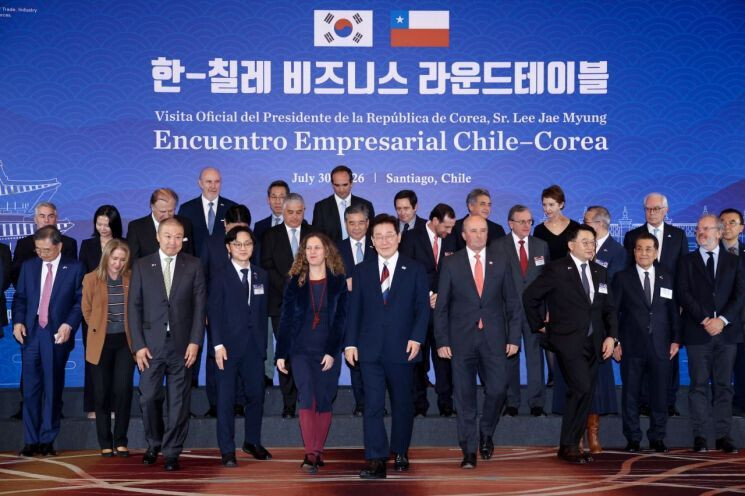
At the 'Korea-Chile Business Roundtable' held in Santiago alongside the summit, President Lee emphasized that the solid foundation built over twenty years must now serve as a springboard for next-generation economic ties. The high-level business forum brought together key industrial leaders from both nations, featuring 11 prominent South Korean business leaders—including Lee Woo-hyun (Chairman of OCI Holdings), Chang In-hwa (Chairman of POSCO Holdings), Koo Ja-eun (Chairman of LS Holdings), and Choi Yun-bum (Chairman of Korea Zinc)—alongside 11 top Chilean corporate executives.
Beyond commerce and mining, President Lee and President Kast engaged in comprehensive dialogues regarding multilateral trade integration, exchanging deep insights on regional frameworks such as the Comprehensive and Progressive Agreement for Trans-Pacific Partnership (CPTPP) and the Pacific Alliance (PA).
Furthermore, both governments agreed to expand bilateral collaboration into comprehensive non-resource sectors, including infrastructure, public safety, defense technology, law enforcement and crime eradication, artificial intelligence (AI), cultural exchanges, and human mobility programs.
As President Lee departs for Buenos Aires, the Santiago summit stands as a decisive milestone, solidifying South Korea’s strategic footprint in Latin America while safeguarding vital energy and technological supply chains.
[Copyright (c) Global Economic Times. All Rights Reserved.]