• 2026.07.25 (Sat)
  • All articles
  • LOGIN
  • JOIN
Global Economic Times
fashionrunwayshow2026
  • Synthesis
  • World
  • Business
  • Industry
  • ICT
  • Distribution Economy
  • Well+Being
  • Travel
  • Eco-News
  • Education
  • Korean Wave News
  • Opinion
  • Arts&Culture
  • Sports
  • People & Life
    • International Student Report
    • With Ambassador
  • Column
    • Cho Kijo Column
    • Cherry Garden Story
    • Ko Yong-chul Column
    • Kim Seul-Ong Column
    • Lee Yeon-sil Column
  • Photo News
  • New Book Guide
MENU
 
Home > New Book Guide

"Memory Editing" Like in the Movies Is Already a Reality

Hwang Sujin Reporter / Updated : 2026-07-25 07:29:59
  • -
  • +
  • Print


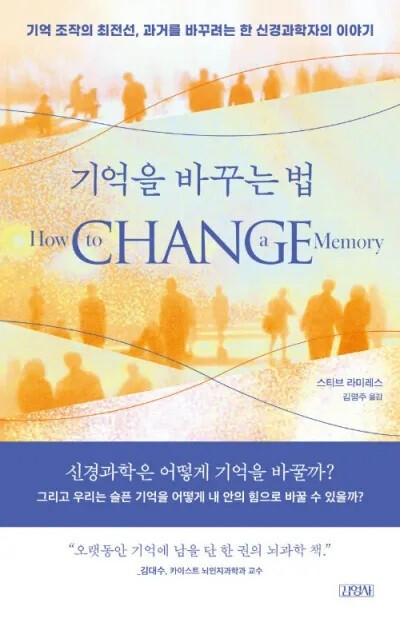
In the sci-fi movie Eternal Sunshine of the Spotless Mind, a company named Lacuna wipes away painful memories. While once considered pure fiction, recent advances in neuroscience have brought memory manipulation closer to reality. Tracing back to the concept of the "engram"—the physical trace of memory proposed over a century ago—scientists have successfully implanted false memories and reactivated specific neural circuits in laboratory animals.

In his book How to Change a Memory, neuroscientist Steve Ramirez explores these groundbreaking developments. During his doctoral studies at MIT, Ramirez pioneered the use of optogenetics to reactivate fear memories in mice. His subsequent research demonstrated that artificial light signals could trigger false memories or reactivate positive experiences to alleviate depression-like behaviors in animal models.

The book outlines the current state of memory-editing technology while examining its philosophical and ethical implications. Ramirez emphasizes that human memory is not a static recording. Each time a memory is recalled, it undergoes reconsolidation, subtly altering its content. Because memories are interconnected with emotions and experiences, surgically erasing a single isolated memory remains complex. However, Ramirez argues that this inherent malleability provides therapeutic potential for treating conditions such as post-traumatic stress disorder (PTSD) and clinical depression.

Beyond scientific findings, the author shares personal reflections, including the loss of his research colleague Xu Liu and its impact on his life's work. The narrative balances scientific history with ethical questions about technology, warning against the misuse of memory control and stressing that human attitudes toward memory remain far more critical than the technology itself.

[Copyright (c) Global Economic Times. All Rights Reserved.]

  • #Hormuz Impasse
  • #globaleconomictimes
  • #micorea
  • #mykorea
  • #nammidonganews
  • #singaporenewsk
  • #Samsung
  • #Daewoo
  • #Hyos
Hwang Sujin Reporter

Popular articles

  • Resurgence in the Gaming Market: How Korean Developers Master the 'Chart Reversal' Through Strategic Content

  • Actress Oh Yoon-ah Announces Remarriage After 11 Years: "I Will Continue to Live Happily"

  • Kia’s Strategic Pivot: Accelerating Electrification Through SDV, PBV, and EREV Innovation

I like it
Share
  • Facebook
  • X
  • Kakaotalk
  • LINE
  • BAND
  • NAVER
  • https://globaleconomictimes.kr/article/1065565744109790 Copy URL copied.
Comments >

Comments 0

Weekly Hot Issue

  • KAIST and NVIDIA Partner to Establish $300 Million AI Joint Research Center in Korea 
  • Hanwha Ocean Bolsters Alliances with U.S. Partners to Drive Forward "MASGA" Shipbuilding Initiative
  • Government Extends 5.2 Trillion Won in Loans for Homeplus Suppliers to Minimize Damage to Workers and SMEs
  • Samsung Electronics Reassigns CSS Power Semiconductor Staff to Memory and Foundry Divisions
  • BOK Governor Hyunsong Shin Discloses 8.2 Billion Won in Assets, Moves to Liquidate Foreign Assets Amid Ethics Scrutiny
  • S. Korea Accelerates Leveraged ETF Rules: ₩30M Cash Deposit Required Starting July 31

Most Viewed

1
[Special Feature] Laying the Foundation for Korea's Informatization: Looking Back at the 1st Administrative Computer Network Project - Part 1
2
Baek Geum-ja Wooriot to Host 'Musical Costume Fashion Gala Show' at DDP
3
South Korea to Tighten Rules on Single-Stock Leveraged Products; Minimum Deposit Raised to 30 Million Won
4
Google Cloud Deploys ‘Gemini Enterprise’ to Samsung Electronics DX Division
5
[Special Feature] The Foundation of Korea’s Informatization: Looking Back at the 1st Administrative Computer Network Project - Part 2
광고문의
임시1
임시3
임시2

Hot Issue

President Lee Embarks on 5-Nation Tour of the Americas and Germany... Full Focus on Advanced Industries and Supply Chain Diversification

EU Hits Google with €890 Million Fine Under Digital Markets Act, Triggering Sharp Backlash from Washington

KAIST and NVIDIA Partner to Establish $300 Million AI Joint Research Center in Korea 

“From AI to Robotics and Safety”: 80 Innovative Products Enter South Korea's Public Market

Fashion Runway Show 2026

Global Economic Times
korocamia@naver.com
CEO : LEE YEON-SIL
Publisher : KO YONG-CHUL
Registration number : Seoul, A55681
Registration Date : 2024-10-24
Youth Protection Manager: KO YONG-CHUL
Singapore Headquarters
5A Woodlands Road #11-34 The Tennery. S'677728
Korean Branch
Phone : +82(0)10 4724 5264
#304, 6 Nonhyeon-ro 111-gil, Gangnam-gu, Seoul
Copyright © Global Economic Times All Rights Reserved
  • 향기네무료급식
  • BCB부천방송
  • 반달곰 프로젝트
Search
Category
  • All articles
  • Synthesis
  • World
  • Business
  • Industry
  • ICT
  • Distribution Economy
  • Well+Being
  • Travel
  • Eco-News
  • Education
  • Korean Wave News
  • Opinion
  • Arts&Culture
  • Sports
  • People & Life 
    • 전체
    • International Student Report
    • With Ambassador
  • Column 
    • 전체
    • Cho Kijo Column
    • Cherry Garden Story
    • Ko Yong-chul Column
    • Kim Seul-Ong Column
    • Lee Yeon-sil Column
  • Photo News
  • New Book Guide
  • Multicultural News
  • Jobs & Workers